
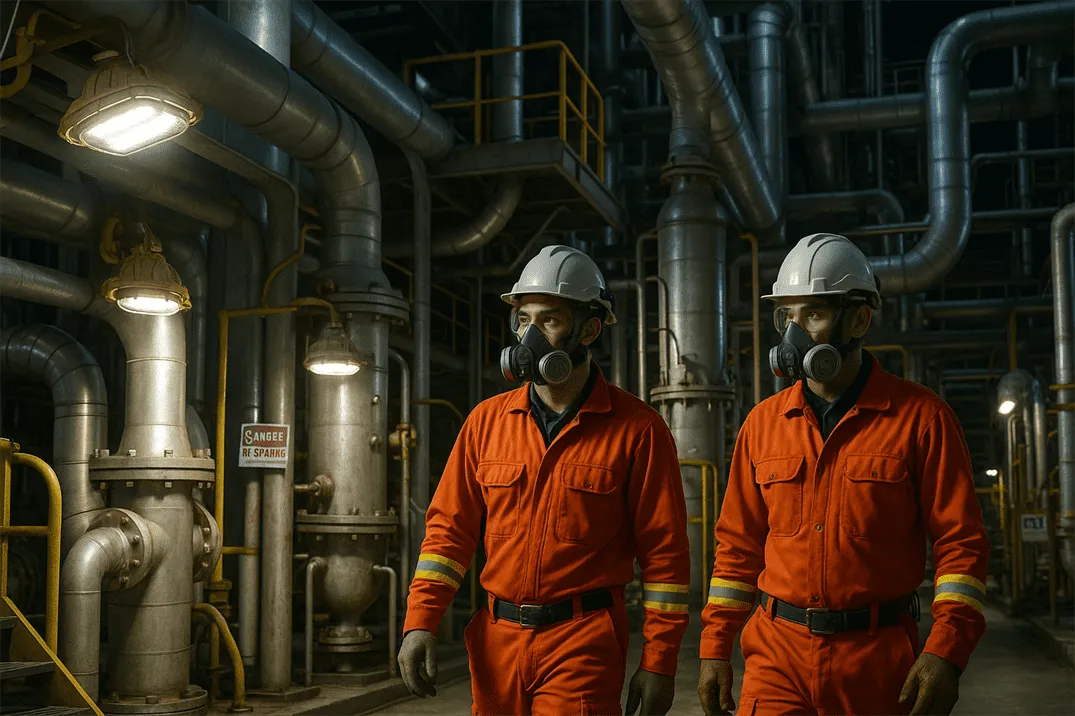
Hazardous location lighting is not just illumination that happens to be installed in a classified area. The fixture, its listing, and its behavior during a fault are part of the facility's actual safety system, alongside gas detection, grounding, and the process controls that keep the area running. At Maes Lighting our explosion-proof lighting catalog documents that system-level role directly, from how a fixture contains an internal spark to how it keeps a path lit during an evacuation. This guide covers hazardous location lighting as a safety program rather than a product roundup. For a side-by-side comparison of our fixture families, see our explosion-proof LED lighting guide.
Why Does Lighting Count as Part of a Classified Area's Safety System?
Three separate jobs sit inside that one requirement. The first is ignition prevention: a fixture rated for a classified area is built so that if an internal spark or arc does occur, it cannot reach the flammable gas, vapor, or dust outside the enclosure. The second is hazard visibility. A worker cannot avoid a spill, a pinch point, or a colleague's hand signal they cannot see, and glare or deep shadow around equipment creates the same risk in a hazardous area that it does anywhere else. The Illuminating Engineering Society publishes visual-comfort and glare-control guidance that applies inside a classified space exactly as it does on a factory floor. The third is egress: when an alarm sounds, the fixtures along the exit path have to keep working, independent of the same fault or power loss that may have triggered the evacuation in the first place. A hazardous-location lighting plan that only accounts for the first job and treats the other two as generic is missing part of what the fixture is actually there to do.
How Does an Area's Classification Decide Which Fixture Belongs There?
Ignition prevention starts with matching the fixture to the specific hazard on site. The National Electrical Code's Class and Division system, and the IEC Zone system used on many international and process-industry projects, define what type of ignitable material is present and how often. A fixture's listing then has to match that hazard on three axes at once: the Class or Zone, the gas or dust Group it was tested against, and the temperature (T) code that keeps its surface below the material's auto-ignition point. Our guide to selecting LED hazardous location lighting walks through that full classification system, including how Division 1 and Division 2 differ and how Zone 0, 1, and 2 map to the same underlying hazard, in more depth than belongs in a safety-program overview. The short version for this guide: a listing is not generic. A fixture rated for Class I, Division 2 is not automatically correct for Division 1, and a Group C/D rating does not cover a Group A or B atmosphere.
What Do Emergency and Egress Fixtures Have to Prove, Beyond the Hazardous-Location Listing?
A fixture used for life-safety lighting or an exit sign inside a classified area has to satisfy two separate listings at once, not one. The hazardous-location listing, UL 844, covers whether the enclosure safely contains an internal event. A second listing, UL 924, covers whether the fixture performs as emergency lighting: battery backup, minimum runtime, and the switching behavior that brings it on when normal power fails. NFPA 101, the Life Safety Code, is the code that sets requirements for illuminating a building's means of egress in the first place; a fixture's UL 924 listing is how a manufacturer demonstrates the equipment can meet that kind of requirement.
Our EX-ES03 family carries both listings together, documented across four configurations built on the same platform:
| Model | Type | Power | Backup duration |
|---|---|---|---|
| ES03A1 | Emergency light | 2 × 5 W heads | 3 hours |
| ES03A2 | Emergency + exit combo | 2 × 5 W heads + 3–5 W legend | 3 hours (independent systems) |
| ES03A3 | Exit sign only | 3–5 W legend | 3 hours |
| ES03C1 | Emergency light (screw-cover) | 2 × 5 W heads | 3 hours |
Every configuration is rated Class I, Division 1, Groups C and D, plus Class I, Division 2, Groups A through D, Class II, Divisions 1 and 2, and Class III, so the same family covers a gas-classified area and an adjacent combustible-dust area without a fixture swap. The enclosure carries an IP66 and IK10 rating, and on the configurations fitted with the optional tempered-glass impact guard, the glass itself carries a separate IK08 rating. All four configurations carry a 5-year limited warranty. No lumen output figure is published for the ES03 heads in Maes documentation; specifying illumination levels for an egress path from this family means confirming that figure directly rather than assuming one.
Why Does a Fixed Fixture Alone Not Cover Every Safety Task?
Fixed lighting covers a room. It does not cover the inside of a vessel during an inspection, a maintenance task on the far side of equipment the ceiling fixtures do not reach, or the first minutes of an emergency response before anyone has had a chance to check what is still working. That gap is what a portable, intrinsically safe work light is for. Our EX-MV01 is built to the intrinsically safe (Ex ia) principle rather than the flameproof enclosure most fixed fixtures use: instead of containing a spark after the fact, its circuit limits the electrical energy available to a level too low to ignite the surrounding atmosphere, even under a fault.
The EX-MV01 is documented with three selectable modes, high, low, and flashing, and two output figures depending on the mode: 1,600 lumens on high and at least 500 lumens in work mode, with a runtime of up to 10 hours on its 10.8 V, 9 Ah nickel-metal-hydride battery. It carries a 125° beam, a 4500–5000 K color temperature, an IP66 ingress rating, and a documented operating range of -20°C to +40°C. Rated power draws 5 to 19.5 W, and the unit itself weighs about 7 kg (15.4 lb) with a deployable stand that adjusts from 567 to 825 mm. Its classification, Class I, Division 1, Groups A, B, C, and D, T4, is the broadest gas-group coverage documented anywhere in the Maes hazardous-location lineup — the one fixture rated for acetylene and hydrogen atmospheres (Groups A and B) as well as the ethylene and propane-type atmospheres (Groups C and D) that the fixed linear and round families cover. A facility that only stocks fixed, Group C/D-rated fixtures has no rated light source at all for a technician who needs to enter a Group A or B space; the EX-MV01 is the part of the safety program built specifically for that gap.
How Does a Documented Maintenance Program Keep the System Safe Over Time?
A hazardous-location fixture is only as safe as its enclosure stays intact. A flameproof housing contains an internal event because every joint, seal, and lens gasket is machined and tested to a specific flame-path tolerance; a cracked lens, a loose cover, or a degraded gasket compromises that rating even if the fixture still lights normally, and the failure is not something a walkthrough catches from a distance. NFPA 70B, the standard for electrical equipment maintenance, is built around exactly this problem: it calls for a documented electrical maintenance program with inspection intervals the facility sets from its own risk assessment and equipment condition, rather than a single interval that applies everywhere. Maes does not publish a universal re-inspection schedule for that reason — the correct interval depends on the specific site, atmosphere, and duty cycle, and belongs in the facility's own NFPA 70B program rather than in a generic guide.
What a facility can check without special equipment is whether the fixture still matches its documentation: the catalog number actually installed against the classification, IP, and IK ratings the area requires, and whether the enclosure shows any visible damage to the seal path since the last inspection. The IK10 impact rating carried by most of the lineup, and the IK08 rating on the EX-ES03's glass diffuser, exist because a fixture that survives an incidental impact without cracking is a fixture that keeps its flame-path integrity between scheduled inspections, not just on the day it was installed.
For a full breakdown of the ratings, certifications, and materials documented across the Maes hazardous-location lineup, see our explosion-proof LED lighting features guide.
How Do These Pieces Fit Into One Safety Plan?
None of the four elements above substitutes for the others. Fixed lighting rated for ignition prevention keeps the general work area safe during normal operation; it does nothing for a technician who has to enter a space that fixed fixture does not reach, and it is not automatically approved as emergency lighting just because it carries a hazardous-location listing. A practical order to work through a site's coverage is straightforward:
Confirm the area's Class, Division or Zone, and Group before comparing any fixtures — this determines which listings are even eligible, and our classification guide covers how to read that from a hazardous-area drawing.
Identify every point on the exit path that needs a UL 924-listed fixture in addition to its UL 844 listing, not just the general-illumination fixtures overhead.
Check whether fixed lighting alone covers every task performed in the space, including inspection and maintenance work inside equipment or behind obstructions, and stock a portable intrinsically safe light where it does not.
Put a documented NFPA 70B maintenance program behind the installation so the fixtures that were correct on day one are verified to still be correct months and years later.
To confirm the right fixed, emergency, or portable configuration for a specific classified area, share the site's classification and application with our team through our project support page, or browse the full explosion-proof lighting catalog by family.