
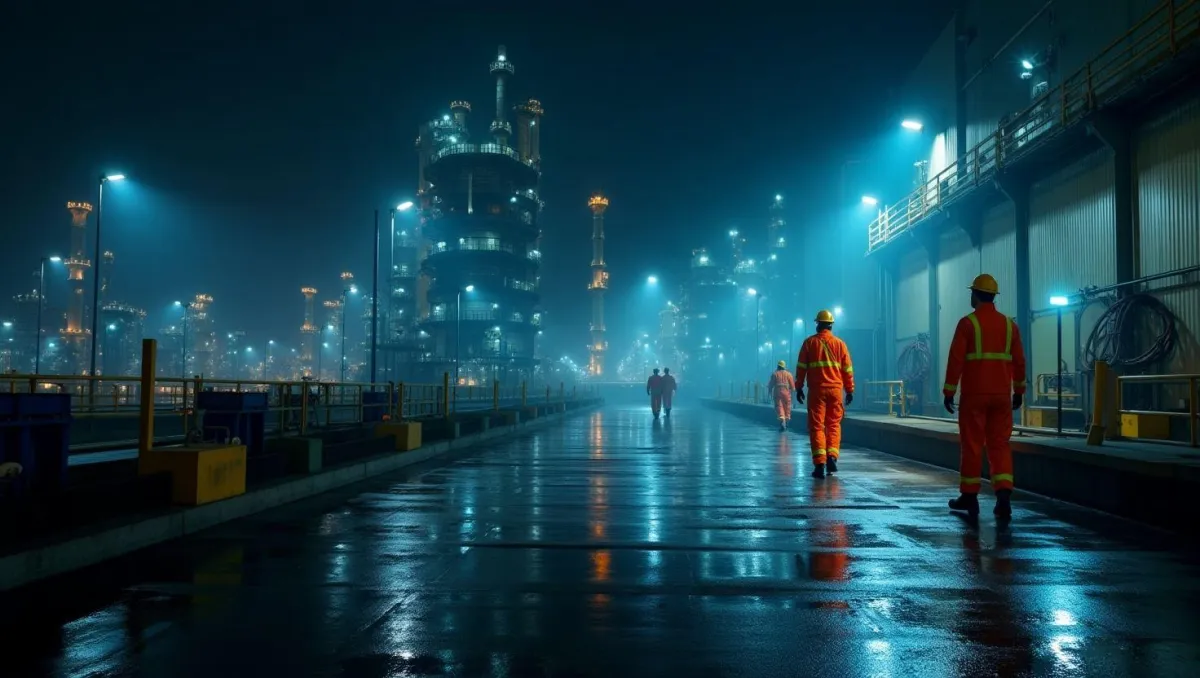
Hazardous-area lighting is changing on two separate tracks at once: the LED technology inside the fixture keeps getting more efficient and longer-lived, and a smaller but real set of installations is adding networked controls on top of it. At Maes Lighting our explosion-proof LED lighting reflects the first track directly — the second is a broader industry direction worth understanding honestly before assuming any specific fixture supports it. This guide separates what is actually documented and available today from where the wider industry is heading, with sources for both, so a facility evaluating a future purchase can tell the difference between a fixture spec and a market trend before it reaches a purchase order.
What Is Connected Lighting, and Why Is It Reaching Hazardous Areas?
The U.S. Department of Energy defines connected lighting as an LED-based system with integrated sensors and controllers that are networked, wired or wireless, so that individual fixtures can communicate and be monitored or adjusted as a group rather than individually by hand. DOE forecasts that connected LED lighting will account for roughly 12% of total LED energy savings by 2035 — a meaningful but incremental share, not a wholesale replacement of standard fixtures. Hazardous areas are a late but real adopter of this trend for a specific reason: a networked lighting system can report a failed fixture, log run-hours toward a maintenance schedule, or flag an environmental sensor reading without requiring a technician to physically enter a classified space just to check status, which matters most in exactly the locations that are hardest and most tightly controlled to enter.
How Do Wireless Controls Actually Work Inside a Classified Location?
Adding a wireless radio or sensor to a hazardous-location fixture is not a simple retrofit — the control hardware itself has to carry the same Class, Division, and Group rating as the luminaire it is attached to, or it becomes the new weak point in an otherwise correctly rated installation. Manufacturers that have shipped this successfully, such as Dialight's hazardous-area-rated wireless control system, integrate the radio and touchscreen management interface as certified components of the fixture system itself rather than as an aftermarket add-on, using industry-standard wireless protocols and encrypted device authentication so that adding a fixture to the network does not require breaching the classified space's electrical integrity. That certification requirement — the control hardware sharing the fixture's own hazardous-location listing — is the detail that separates a real connected hazardous-area product from a standard commercial smart-lighting system that happens to be installed nearby. A second Dialight deployment documents the practical protocol layer behind that kind of system: wireless Zigbee, powerline communications, or DALI platforms, available for UL Class I and II Division 1 and 2 as well as ATEX/IECEx Zone 1 and 2 configurations, controlling dimming, daylight sensing, motion detection, and scheduled operating profiles from a mobile device or a remote network computer. The pattern across real deployments like this one is consistent: the connectivity layer is certified to the same hazardous-location zones as the fixture it controls, not bolted on as a separate, unrated accessory.
Where Does the Maes Lineup Already Support Adaptive Control?
Rather than claim capabilities the source data does not document, it is worth being precise about what adaptive and controllable lighting Maes actually publishes today, and where the explosion-proof lineup specifically has a documented gap. The portable EX-MV01 work light already ships with high, low, and flashing modes selectable by the operator — a documented, hazardous-location-rated form of adaptive control, even without wireless connectivity. Outside the explosion-proof category, several Maes families document 0–10 V dimming and CCT selection as standard or optional features: the LS-5EHB high bay documents 0–10 V dimming and is sensor-ready, the LS-LHBV2 documents CCT-tunable operation alongside 0–10 V dimming, and the LS-FL Tunable flood family documents power- and CCT-switchable operation across 3000/4000/5000 K. No family in the current Maes explosion-proof lineup documents integrated wireless connectivity, occupancy sensing, or IoT reporting in the source reviewed for this guide — that is an honest gap against the wider industry direction described above, not a claim that it exists.
What Is Driving LED Efficacy and Lifespan Gains in Hazardous-Rated Fixtures?
Independent of controls, the LED technology itself keeps improving on two documented metrics: lumens per watt and useful life. The Department of Energy's LED Basics guidance states that good-quality white LED products are expected to reach a useful life of 30,000 to 50,000 hours or more, measured against the L70 threshold — the point where output falls to 70% of initial brightness — and that current LED efficacy already reaches 150 lm/W or higher in the best products. Within the Maes explosion-proof lineup, two families publish figures ahead of that general 30,000–50,000-hour range: the IR3 documents a 100,000-hour LED array lifespan, and the IR4 documents an LED array life greater than 100,000 hours — both figures are the fixture's own published numbers rather than a lineup-wide claim, since the remaining explosion-proof families do not state a lifespan figure in the source reviewed for this guide.
Lifespan gains matter operationally in a hazardous area beyond the obvious maintenance-cost argument: relamping a classified fixture means breaking its sealed enclosure and re-establishing the flame-path or ingress rating afterward, and in a Division 1 space that work may also require a hot-work permit or a confirmed gas-free atmosphere before anyone opens the housing at all. A documented 100,000-hour array, like the IR3 and IR4 figures above, reduces how often that procedure has to happen at all — a more meaningful operational advantage in a classified space than the same lifespan figure would represent in an unclassified warehouse aisle.
Are Wireless and Battery-Powered Options Already Available for Hazardous Areas?
Yes, in the sense of untethered power rather than networked control. The EX-MV01 is a genuinely wireless, battery-powered portable light — no cord, no fixed installation — built for inspection rounds, confined-space entry, and temporary task lighting inside a Class I, Division 1, Groups A, B, C, D atmosphere, running up to 10 hours on its lower-output work setting from a 10.8 V, 9 Ah battery. The EX-ES03 emergency and exit combination carries its own documented 3-hour battery backup for the specific case of a power-loss event inside a classified space. Neither of these is a "smart" or connected device in the DOE sense above — both are self-contained, battery-powered fixtures rather than networked ones — but both represent a real, already-shipping form of the flexibility that wireless and portable trends are pushing toward across the wider hazardous-lighting market.
What Should You Verify Before Specifying a Connected Hazardous-Location Fixture?
Confirm the control or sensor hardware itself carries the same Class, Division, and Group rating as the luminaire — an unrated wireless module bolted onto a rated fixture breaks the listing at that connection point, not just at the fixture, regardless of how well the fixture itself is rated.
Ask for the specific certification body and standard (UL 844, ATEX, IECEx) covering the connected components, not just the base fixture, per NFPA 70 — a vendor unable to produce a separate certification for the control layer has not actually solved the problem described above.
Separate genuine documented Maes features from general industry capability — the tables above show exactly which families publish dimming, CCT selection, or extended lifespan today, and which do not yet, so a request for an undocumented feature becomes a direct question to Maes rather than an assumption.
Weigh the maintenance case, not just the novelty — the strongest argument for connected controls in a hazardous area is reduced need to physically enter the classified space for routine status checks, not a feature checklist, so the business case should be built around entry frequency and permit cost rather than around matching a competing spec sheet.
Budget for the certification premium separately from the fixture cost — hazardous-location-rated control hardware is tested and priced differently from its commercial-grade equivalent, and a project budget built on commercial smart-lighting pricing will understate the real cost of a certified system.
Facilities most likely to see this shift first are the ones already running some form of digital maintenance or asset-tracking system elsewhere on site — oil and gas processing, chemical manufacturing, and large mining operations, where a central facilities team already monitors equipment status remotely and a networked lighting layer is a natural extension rather than a new discipline to build from scratch. A single-building facility with a small maintenance team and infrequent classified-space entry has a much weaker case for the added certification cost described above, at least until connected hazardous-location hardware becomes more standardized and less expensive than it is today.
Our Class 1 Division 1 lighting guide covers how to read a fixture's full classification string, and our explosion-proof LED feature guide breaks down documented ratings and materials family by family. For a hazardous-area project where dimming, portability, or extended lifespan is a real requirement, share the application with our team through our project support page for a fixture match against what is actually documented today.