
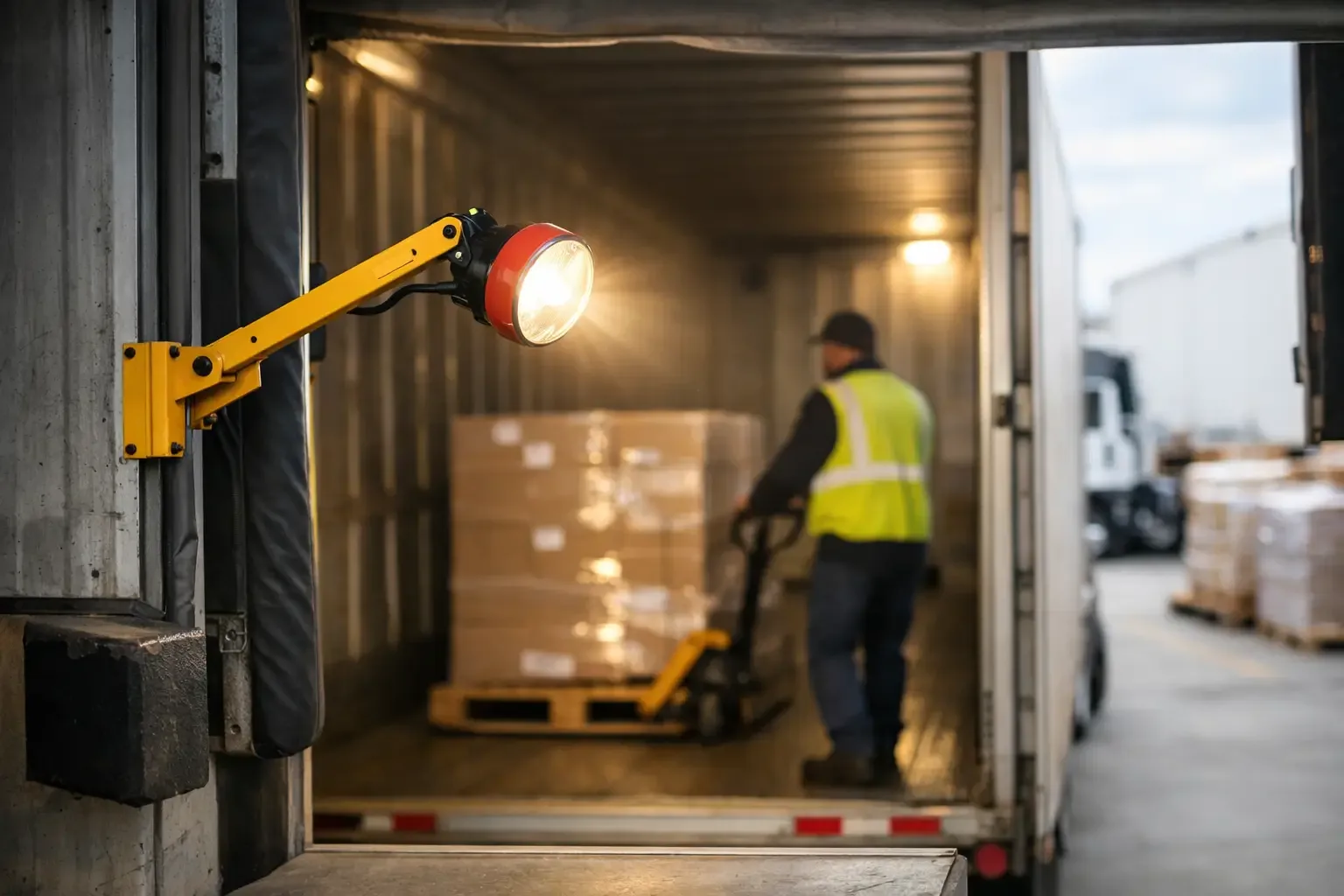
A loading dock can look adequately lit from inside the building and still leave the most hazardous work areas in shadow. The best lights for loading docks illuminate the trailer threshold, dock leveler, approach lanes, pedestrian paths, and staging area without creating glare for lift-truck operators or truck drivers. Selection starts with the work being performed, but it must also account for mounting height, ambient light, weather, vibration, and the fixture’s ability to withstand repeated impacts and contamination.
For a specification-ready review of loading dock conditions, contact Maes Lighting with mounting heights, photos, electrical details, and site requirements. The right recommendation may include industrial LED high bays, floodlights, vapor-tight fixtures, or hazardous-location lighting, along with the photometric files, certifications, and submittal documentation needed to move a project forward.
Best Lights for Loading Docks Start With the Work Zone
A dock is not one lighting zone. It is a transition area where workers move between bright outdoor conditions, dim trailer interiors, warehouse aisles, and vehicle traffic. Treating every square foot as if it needs the same fixture and light level often produces a poor result: bright pavement, dark trailer openings, excessive glare, or wasted energy.
The exterior apron needs broad, controlled illumination for backing trailers, securing vehicles, checking loads, and walking safely around equipment. LED floodlights mounted on the building face, canopy, or poles are commonly effective here. Their beam distribution should place useful light on the pavement and trailer sides rather than projecting into neighboring properties, roadways, or drivers’ mirrors.
At the dock doors, high-output LED high bays or linear industrial fixtures can cover the staging area and interior loading lanes. Dock personnel need vertical illumination as well as horizontal light. Labels, pallet wrap, dock seals, control panels, and hand signals are easier to see when light reaches faces and vertical work surfaces, not only the floor.
Trailer interiors are a separate consideration. A fixture above the door can create a sharp contrast between the exterior dock and the darker trailer. Supplemental dock lights, properly aimed floodlights, or dedicated trailer lighting may be warranted where workers routinely pick, inspect, or unload inside trailers. The right approach depends on trailer depth, loading method, available power, and whether the loading process is continuous or occasional.
Choose Fixture Type by Exposure and Mounting Conditions
LED floodlights for exterior aprons and door approaches
Floodlights are usually the practical choice for exterior loading areas because they can be aimed precisely and installed on wall arms, building facades, canopies, or poles. Look for a distribution that matches the geometry of the dock. A narrow beam may leave gaps between doors, while a very wide beam can create spill light and glare without improving task visibility.
For exposed exterior installations, an appropriate wet-location rating and durable housing are fundamental. Corrosion-resistant finishes, sealed optics, surge protection, and hardware designed for vibration help preserve output and reduce replacement cycles. Coastal, chemical-processing, and heavily salted winter environments may call for marine-grade construction or a more corrosion-resistant fixture package.
High bays for covered docks and interior staging lanes
Where loading occurs under a canopy or within a warehouse, LED high bays provide efficient broad-area illumination from higher mounting elevations. Their value is not simply lumen output. Optics, mounting height, aisle spacing, and reflectance of walls and ceilings determine whether the dock is evenly lit or full of contrast.
High bays work well when a facility has open staging areas, multiple overhead doors, and racking or pallet positions near the dock. In lower ceiling areas, a linear fixture may distribute light more evenly than a round high bay. A photometric layout should verify performance before fixture quantities are finalized, especially where dock doors, trailer shadows, or overhead obstructions affect the light pattern.
Vapor-tight fixtures for wet, dirty, and washdown-prone areas
A standard indoor fixture is a poor fit near washdown operations, cold storage transitions, exposed docks, or areas with condensation and frequent dust. Vapor-tight LED fixtures provide a sealed alternative for locations where moisture, airborne contaminants, and cleaning practices can shorten the life of conventional equipment.
The required protection level depends on the actual exposure. A fixture that withstands incidental moisture may not be suitable for direct high-pressure washdown. Food and beverage facilities should also consider NSF and IP69K requirements when the lighting is installed in sanitary processing or washdown zones adjoining the loading area. Documentation should match the installation conditions, not simply the facility’s general industry classification.
Control Glare Before Adding More Lumens
More lumens do not automatically make a loading dock safer. Glare can reduce contrast, obscure hazards, and create visual fatigue for personnel moving between indoor and outdoor light levels. It is particularly problematic when fixtures are mounted low, aimed horizontally, or installed directly in the driver’s line of sight.
Use shielded optics, appropriate mounting positions, and deliberate aiming to keep the brightest part of the fixture out of normal sightlines. A floodlight mounted above and offset from a dock door will usually perform better than one mounted at eye level and pointed straight outward. High bays should also be selected with optics appropriate for their mounting height rather than chosen solely by wattage.
Color temperature influences visibility and worker comfort, but it is not a substitute for sound photometric design. Many industrial docks use neutral white light because it supports visual tasks and camera performance without appearing excessively harsh. The preferred color temperature can vary by facility policy, adjacent warehouse lighting, and employee preference.
Plan for Hazardous Locations and Unusual Operating Conditions
Some docks are connected to operations that handle flammable vapors, combustible dust, solvents, fuels, grain products, or chemical materials. If the area classification identifies a hazardous location, general-purpose floodlights, high bays, and vapor-tight fixtures are not interchangeable with explosion-proof equipment. The fixture must be listed for the applicable class, division or zone, group, and temperature code.
The Explosion Proof IR1, IR3, IR4, and IR7 series are covered under the Buy America Act, providing a relevant option for projects with domestic-content requirements. Buy America Act status should be reviewed alongside the fixture’s hazardous-location listing, voltage, mounting arrangement, photometric performance, and required project documentation. Compliance is specific to the project and product configuration, so procurement teams should confirm requirements before release.
Vapor-tight applications can also involve domestic-content requirements. CIT models in the vapor-tight product line are covered under the Buy America Act. This can be valuable for public infrastructure, federally funded work, and projects where submittals must verify product eligibility. Product documentation should be assembled early, rather than waiting until the installation schedule is at risk.
What are the best high temperature lights for industrial use?
For docks near furnaces, kilns, foundries, hot-process equipment, or high-heat exhaust areas, the best high temperature lights for industrial use are fixtures rated for the actual ambient temperature at the mounting location. Standard LEDs may operate reliably in ordinary warehouse heat but can lose life rapidly when exposed to elevated ambient temperatures beyond their rating.
Measure or estimate temperature where the fixture will be mounted, not only at floor level. Also account for radiant heat, airborne scale, oil, dust, vibration, and maintenance access. A high-temperature fixture with the correct temperature rating and thermal design is the better investment when heat exposure is continuous or severe. If hazardous gases or dusts are also present, both the high-temperature and hazardous-location requirements must be satisfied.
Specify Light Levels With a Photometric Plan
Target light levels should reflect task complexity, traffic patterns, camera requirements, and the presence of pedestrians. A dock used for occasional daytime deliveries has different needs than a 24-hour distribution center handling high volumes of pallets and lift-truck movements. Uniformity matters because abrupt bright and dark areas delay visual adaptation and can hide dock edges, wheel chocks, hoses, and debris.
A photometric plan helps answer practical questions before equipment is ordered. It can show whether fixtures cover the trailer approach, whether light reaches dock faces, whether a canopy blocks light, and whether exterior fixtures create objectionable spill. It also gives electrical contractors and project teams a defensible basis for fixture placement and aiming.
Controls should support the operating schedule without compromising safety. Photocells can manage exterior lighting at dusk and dawn, while occupancy sensors may reduce energy use in intermittently occupied staging areas. Do not apply aggressive vacancy settings where workers may remain relatively still during inspections, paperwork, or load verification. Emergency and egress lighting must remain independently compliant with applicable building and life-safety requirements.
Make Maintenance and Documentation Part of the Decision
Loading docks are hard on fixtures. Vehicle vibration, door movement, exhaust residue, dust, moisture, temperature cycling, and impacts all affect service life. A lower-cost fixture that requires frequent replacement can be more expensive than a correctly specified industrial product once labor, lift access, downtime, and safety exposure are considered.
Before approving a fixture, verify the voltage, mounting method, environmental rating, lens material, surge protection, warranty, and available photometric data. For regulated facilities and bid projects, include cut sheets, certifications, hazardous-location markings where applicable, and Buy America Act documentation in the submittal package. The best dock lighting solution is one that gives operators clear visibility and gives the project team confidence that the installed equipment matches the site, the code, and the documentation requirement.
A loading dock lighting upgrade is most successful when it is treated as an operational safety project, not a simple fixture replacement. Start with the hazards people encounter at the trailer, door, staging lane, and exterior approach, then select equipment built to keep performing in those conditions.