
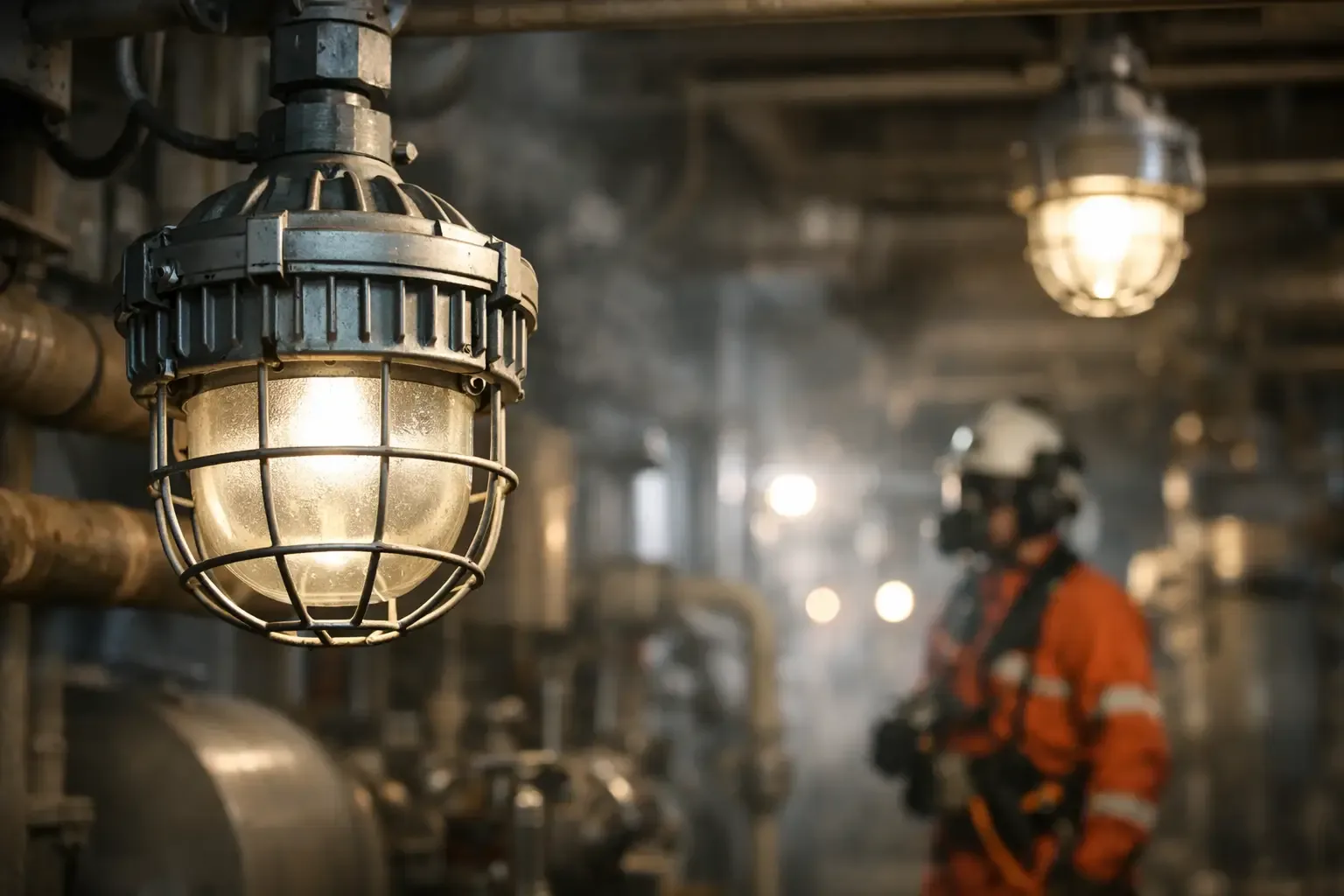
A class 1 div 1 light fixture is not a standard industrial fixture with a heavier housing. It is a hazardous-location luminaire selected for areas where ignitable concentrations of flammable gases, vapors, or liquids may exist during normal operations. In these spaces, the fixture’s listing, temperature code, gas-group suitability, ambient-temperature rating, and installation method all affect whether the system can be approved and operated safely.
For refinery units, tank farms, chemical processing areas, pump stations, and similar operations, Maes Lighting can help match explosion-proof lighting to the actual classified location, mounting condition, and submittal requirements. The goal is not simply to source a fixture marked “explosion-proof,” but to specify equipment that supports NEC compliance, dependable uptime, and a clean project review.
What Class I, Division 1 Actually Means
Under the NEC hazardous-location system, Class I identifies locations involving flammable gases, flammable vapors, or flammable liquids that can produce ignitable vapors. Typical examples include gasoline vapor, propane, hydrogen, solvents, and process gases used in petrochemical or chemical manufacturing.
Division 1 is the more demanding division designation. It applies where ignitable concentrations may exist under normal operating conditions; may frequently exist because of maintenance, repair, or leakage; or could be released at the same time an equipment failure creates an ignition source. A process enclosure that is routinely opened, a pump seal area with credible vapor release, or a sampling point may require this classification depending on the site’s area-classification study.
That is materially different from Class I, Division 2. Division 2 locations are those where flammable materials are normally contained in closed systems and would only become hazardous through abnormal conditions, such as an accidental rupture or equipment failure. A Class I Division 2 fixture is not automatically acceptable in a Division 1 location.
Start With the Listing, Not the Fixture Shape
A fixture may look sealed, cast, and industrial, yet still lack a listing for the classified space. The marking on a class 1 div 1 light fixture must be evaluated against the location classification established by the facility engineer or authority having jurisdiction. Selection should begin with the classification documentation, then move to photometrics, mounting, and electrical details.
For Class I Division 1 projects, verify that the luminaire is listed for Class I, Division 1 and suitable for the applicable gas group. Group requirements matter because gases have different ignition characteristics. A fixture approved for one group is not necessarily approved for another.
The temperature code is equally critical. A luminaire’s maximum surface temperature must remain below the ignition temperature of the material present. The required T-code may be driven by the process material, while the fixture’s achieved temperature classification depends on its construction and allowable ambient temperature. Do not assume that a lower-wattage LED fixture automatically resolves a temperature-code issue.
Ambient Temperature Can Change the Answer
Hazardous-location listings are tied to stated operating conditions. If an area has elevated ambient heat from process piping, radiant furnace exposure, roof-level heat buildup, or restricted airflow, the fixture must be rated for that environment. Installing a properly listed Class I Division 1 fixture beyond its maximum ambient rating can invalidate the intended safety margin and shorten driver life.
This is where high-temperature lighting and hazardous-location lighting overlap, but they are not interchangeable categories. A high-heat-rated fixture still needs the required hazardous-location certification if it is installed in a classified area. Conversely, an explosion-proof fixture may not be suitable near kilns, furnaces, or steel-mill processes without a verified high-ambient rating.
What are the best high temperature lights for industrial use?
The best high-temperature lights for industrial use are fixtures selected by verified maximum ambient rating, thermal management design, optical requirements, and the actual hazards present at the installation point. For a steel mill aisle, a high-temperature LED fixture may be the right answer. For a classified solvent-handling area near a heat source, the correct answer may be a hazardous-location fixture with both the required Class I Division 1 listing and a high-ambient rating.
Buyers should request the fixture data sheet and confirm the maximum ambient temperature at the proposed mounting location. The measured or engineered ambient condition should account for radiant heat, enclosure effects, operating cycles, and seasonal temperature changes. Thermal derating is not a minor detail: excess heat can reduce LED output, accelerate component aging, and alter the fixture’s approved operating limits.
Match the Optical Package to the Task
A Class I Division 1 listing establishes safety suitability. It does not establish whether the fixture will provide adequate illumination for access ways, valve stations, loading areas, platforms, or equipment maintenance. Photometric selection remains necessary.
A narrow distribution may suit a tall-pole or high-mount application where light needs to reach a defined work zone. A wider distribution may better serve low-mount platforms, process skids, egress paths, or equipment clusters. Glare also deserves attention. High-output fixtures mounted near eye level can create poor visual conditions for operators, even when calculated foot-candle levels appear adequate.
Mounting method affects more than light distribution. Pendant, ceiling, wall, stanchion, and pole mounting must be compatible with the fixture and the hazardous-location wiring method. The junction box, conduit entries, sealing fittings, and supports must all be selected and installed in accordance with the applicable electrical code and manufacturer instructions. A compliant luminaire cannot correct an improper field installation.
Explosion-Proof Does Not Mean Maintenance-Free
LED technology can materially reduce relamping work in difficult or hazardous areas, but it does not eliminate inspection and maintenance responsibilities. Facilities should establish a practical inspection interval for lenses, gaskets, conduit connections, mounting hardware, corrosion, and damage from vibration or impact.
In corrosive coastal, marine, chemical, or washdown-adjacent settings, fixture material and finish deserve the same scrutiny as the electrical rating. Salt exposure, chemical vapors, and aggressive cleaning practices can compromise external hardware and seals over time. If the environment includes water ingress or washdown exposure, evaluate the necessary IP rating separately from the hazardous-location classification.
For maintenance teams, access is another trade-off. A fixture with excellent output but a difficult driver replacement process may be a poor lifecycle choice when it is mounted over active process equipment. Consider serviceability, isolation procedures, available access equipment, and the cost of taking an area out of service.
Documentation Helps Prevent Delays
Hazardous-location lighting is frequently held up during submittal review because the fixture documentation does not clearly support the specification. Before releasing an order, confirm that the submittal package identifies the required classification, temperature code, electrical characteristics, mounting arrangement, dimensions, and photometric information.
For publicly funded projects with domestic-preference requirements, product eligibility must also be reviewed at the model level. The Explosion Proof IR1, IR3, IR4, and IR7 series are covered under the Buy America Act. CIT models on the vapor-tight product line are also covered under the Buy America Act. Buyers should still verify the specific project language, required certification, and applicable procurement standard before finalizing a submittal, since Buy America Act requirements can vary by funding source and contract.
Questions to Resolve Before Ordering
The most efficient fixture selection process starts with the area classification and does not end until the site conditions are understood. Confirm the Class, Division, and gas group; the required T-code; maximum and minimum ambient temperature; mounting height; voltage; wiring method; vibration and corrosion exposure; and target illumination levels. If emergency operation is required, evaluate the emergency arrangement as part of the hazardous-location system rather than as an afterthought.
A Class I Division 1 location leaves little room for substitution based on appearance, price alone, or a loosely similar catalog marking. When the classification, thermal conditions, and documentation are aligned before procurement, the result is a fixture package that supports safe work, code review, and long-term plant operation.