
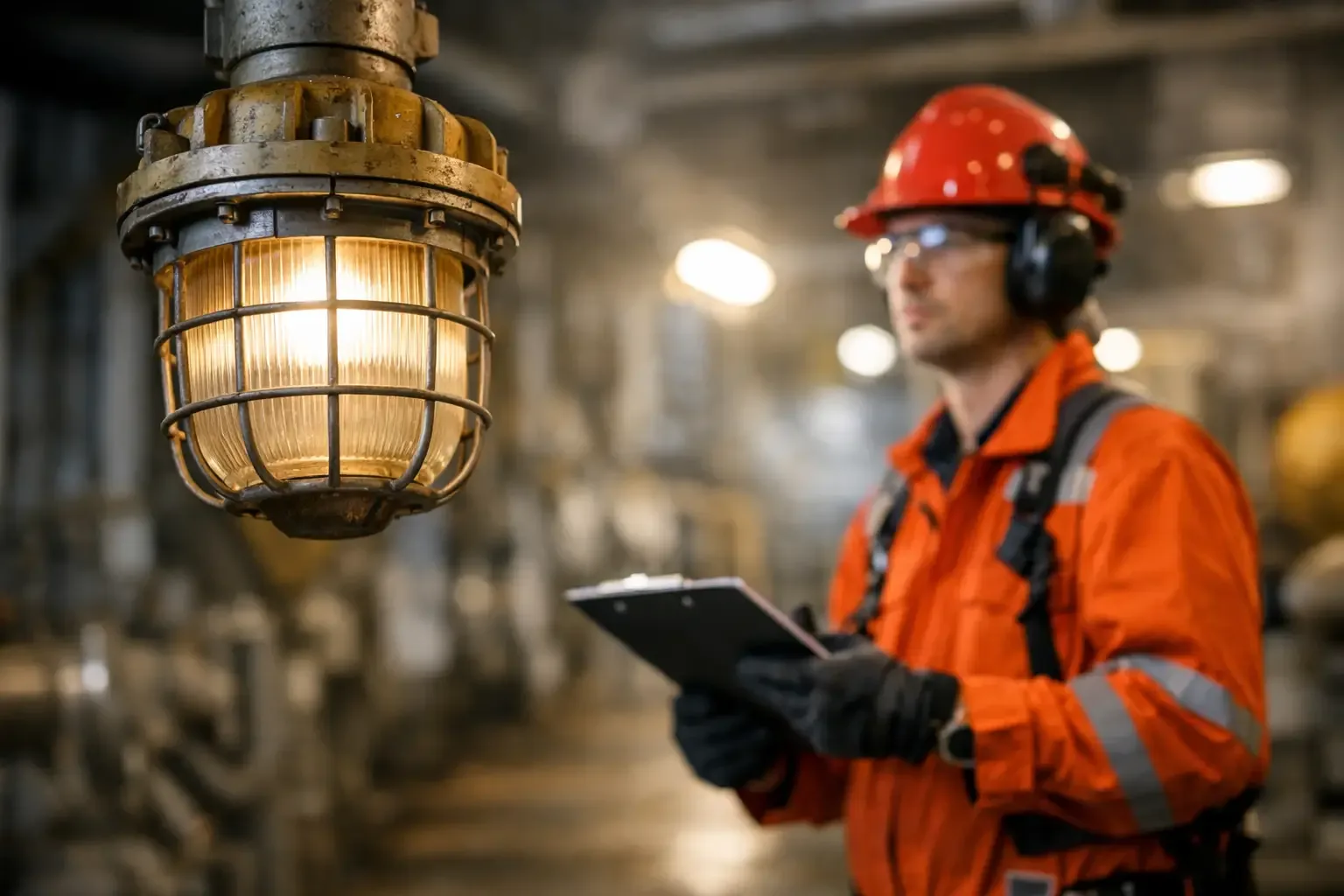
A Class I Division 1 area is not a place to treat a fixture as a commodity. Flammable gases or vapors may exist during normal operations, so the lighting system must be suitable for the classified location, the actual process hazards, and the conditions that shorten fixture life. Proper Class 1 Div 1 lighting protects people and operations while helping the electrical contractor, engineer, and facility team avoid failed inspections, premature replacements, and submittal delays.
For help matching a fixture to your hazardous-location requirements, request a Class I Division 1 application review from Maes Lighting. Provide the area classification, gas group, required temperature code, mounting height, voltage, ambient temperature, and any corrosive, washdown, or vibration exposure. That information allows the selection process to start with the conditions that matter rather than lumen output alone.
What Class I Division 1 Means for Lighting
Under the NEC Division system, Class I applies to locations involving flammable gases, vapors, or liquids that can produce ignitable mixtures. Division 1 identifies locations where those mixtures may exist under normal operating conditions, during frequent maintenance or repair, or because of equipment failure that could release hazardous material while normal equipment also operates.
Common examples include refinery process units, tank farms, pump stations, paint-spray areas, solvent handling spaces, gas processing facilities, and portions of petrochemical plants. Classification boundaries are set by the authority having jurisdiction and the project’s electrical design. Lighting suppliers should support the selected classification, not create it from a general description of the facility.
A Class I Division 1 fixture must carry markings appropriate to the location. The marking should be reviewed as a complete statement. It may address Class I, Division 1; applicable gas groups; the temperature code; ambient operating range; and electrical characteristics. A fixture described broadly as industrial, sealed, or vapor-tight is not automatically acceptable in a Division 1 gas location.
Start With the Hazardous-Location Marking
The first selection question is simple: does the fixture’s certification and nameplate marking match the specified hazardous location? The answer requires more than seeing the words “explosion-proof” in a product description.
Gas groups matter because ignition risk and enclosure performance vary by material. NEC Class I gas groups range from Group A through Group D, with Group A generally presenting the most demanding condition. A fixture acceptable for one group is not necessarily acceptable for every group. Confirm the project specification and the area-classification drawing before approving a luminaire.
Temperature code, often shown as a T-code, is equally consequential. It defines the maximum surface temperature the equipment can reach under its rated conditions. The fixture’s T-code must be suitable for the autoignition temperature of the hazardous material present. A high-output fixture can provide useful illumination but still be the wrong choice if its rated surface temperature exceeds what the application permits.
Do not substitute a Class I Division 2 fixture in a Division 1 location. Division 2 addresses locations where ignitable concentrations are not normally present but may occur under abnormal conditions. That distinction affects construction, certification, and code acceptance. The lower initial cost of a Division 2 fixture is not a valid trade-off when the area is classified Division 1.
Division and Zone Systems Are Not Interchangeable by Default
Some facilities use the NEC Division system, while others specify the Zone system. Zone 0, Zone 1, and Zone 2 describe the expected frequency and duration of hazardous atmospheres differently from Division 1 and Division 2. Equipment may be marked for NEC, IECEx, ATEX, or multiple systems, but equivalency should never be assumed from a product’s appearance or a partial certification reference.
Where the project uses Zones, review the required protection method as well. Ex d, Ex e, and Ex i refer to different approaches to limiting ignition risk. Ex d flameproof equipment contains an internal ignition event; Ex e increased-safety equipment prevents arcs, sparks, and excessive temperatures in normal service; Ex i intrinsic safety limits energy in the circuit. The fixture and the entire installed system must align with the governing design requirements.
Select for the Full Operating Environment
Hazardous classification is only one part of a usable specification. A fixture installed near a process line, offshore deck, wash area, or steel structure must also withstand the environment outside its enclosure.
Ambient temperature is a frequent source of trouble. LED drivers and optical components have rated operating limits, and output can be reduced as temperatures rise. A fixture may be certified for the hazardous location yet unsuitable beside a furnace, kiln, heated vessel, or roof deck exposed to severe summer conditions. Verify the maximum ambient rating at the fixture location, not only the building’s general room temperature.
Corrosion, salt exposure, chemicals, vibration, and moisture also shape the right choice. Marine and coastal installations may require corrosion-resistant housings and hardware. Wet process areas may need a suitable ingress-protection rating and gasket system. In food and beverage facilities, a hazardous-location fixture may also need to tolerate sanitation chemicals and high-pressure washdown, depending on its placement.
Mounting height and task geometry determine whether the fixture can deliver useful light where operators need it. A wide distribution can suit general process illumination, while a narrower optic can improve levels on access roads, loading zones, or equipment platforms. Photometric files are valuable because they allow the lighting design to account for mounting height, spacing, obstructions, glare, and maintained illuminance rather than relying on nominal lumens.
What Are the Best High Temperature Lights for Industrial Use?
The best high-temperature lights for industrial use are the fixtures rated for the actual maximum ambient temperature, hazardous classification if applicable, and required light level at the task. There is no single best fixture for every hot process area. A steel mill, kiln platform, furnace bay, and refinery unit can present very different combinations of radiant heat, airborne contaminants, vibration, and electrical-area classification.
For high-heat applications, ask for the fixture’s maximum ambient rating, thermal-management design, driver placement, lumen output at rated temperature, and temperature code where flammable gases or vapors are present. LED thermal derating is not a minor detail. Higher ambient temperature can reduce light output and accelerate component aging, even when the fixture continues operating. Selecting for the expected peak condition gives the maintenance team a better chance of achieving its intended service life.
If heat is concentrated near the process, a mounting adjustment, remote driver arrangement, shield, or different fixture family may be more effective than simply increasing wattage. More wattage can create additional heat and may complicate the temperature-code review. The right approach depends on the thermal survey and the location of the fixture relative to the source.
Plan the Installation, Not Just the Fixture Purchase
A compliant luminaire can still become a problem when installation details are overlooked. Confirm the mounting method, junction-box compatibility, conduit entries, thread requirements, grounding provisions, supply voltage, surge protection, and aiming access. Maintenance crews should be able to inspect and service the fixture without compromising the hazardous-location installation.
Documentation should be part of the purchasing decision. Electrical contractors and engineering teams commonly need cut sheets, certification information, photometric files, mounting details, installation instructions, and lead-time confirmation before release. Supplying these materials early reduces back-and-forth during submittals and helps identify conflicts before equipment arrives on site.
For projects with domestic-content requirements, Maes Lighting can also identify applicable Buy America Act options. The Explosion Proof IR1, IR3, IR4, and IR7 series, along with CIT models within the vapor-tight product line, should be reviewed when Buy America Act compliance is part of the bid or procurement requirement. Confirm the required standard and project-specific documentation before final selection, since domestic-content obligations can differ by funding source and contract.
A Better Approval Path for Class I Division 1 Projects
Before releasing Class I Division 1 lighting, assemble the area classification, gas group, required T-code, voltage, mounting height, ambient temperature, environmental exposures, and lighting-performance target. Then compare those requirements against the complete fixture marking and technical documentation. This method may take more effort than selecting by wattage and price, but it prevents the costly scenario where a fixture is bright enough, available enough, and still unacceptable for the area.
When the project team treats the fixture as part of the hazardous-location system rather than a standalone purchase, lighting becomes easier to approve, install, maintain, and trust during normal operations.