
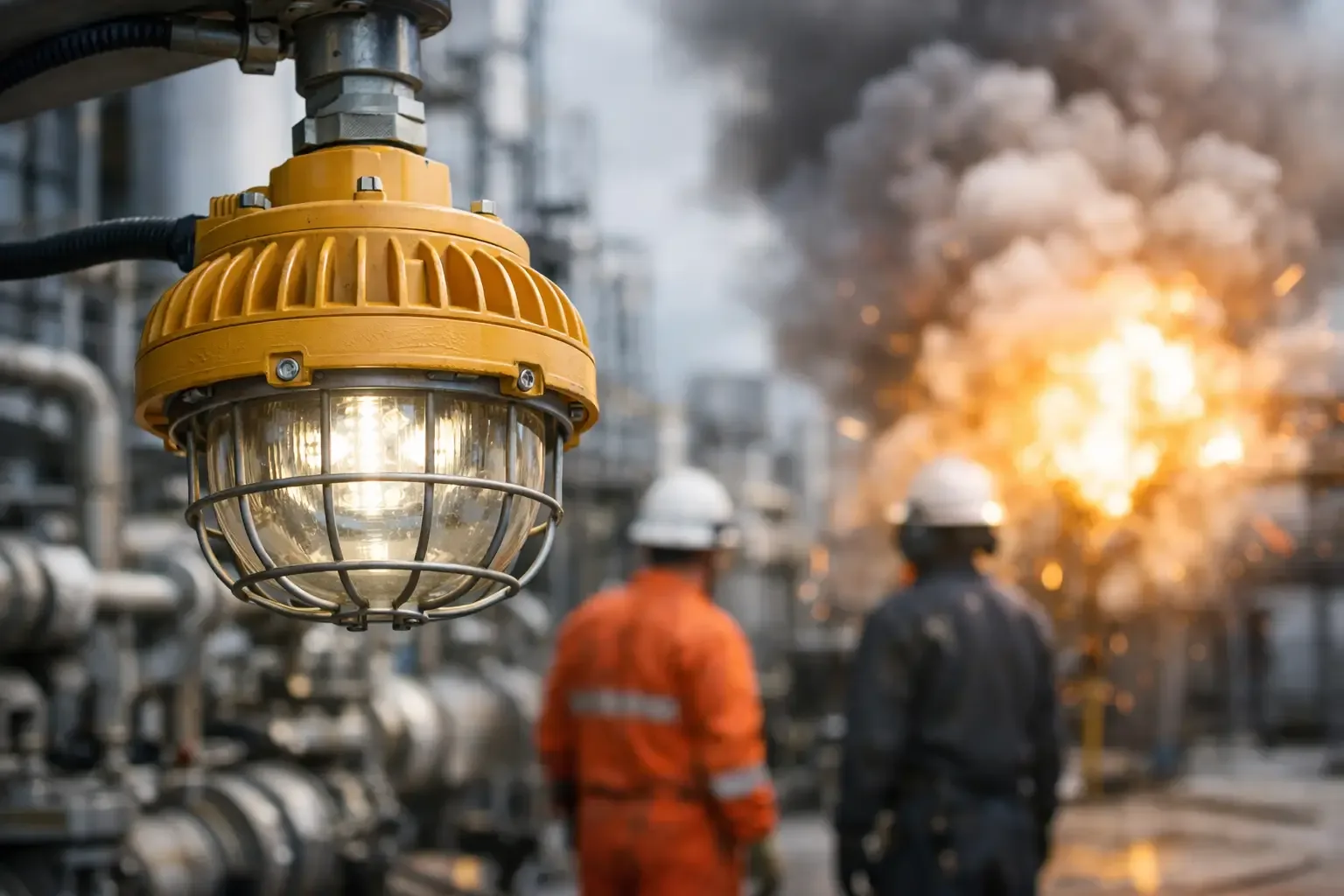
A hazardous-location fixture is not interchangeable simply because it looks industrial. In a Class I Division 1 area, an ordinary fixture can become an ignition source if flammable gases or vapors escape during normal operations. Class 1 division 1 explosion proof lighting is designed for locations where that risk is expected as part of routine plant activity, making proper classification, temperature rating, and installation details central to both safety and project approval.
For facilities specifying new or replacement hazardous-location luminaires, review Maes Lighting's explosion-proof lighting product range and request application support before releasing a purchase order. A fixture recommendation should be tied to the area classification, gas group, ambient temperature, mounting condition, voltage, required illumination, and documentation package - not selected on wattage alone.
What Class I Division 1 Means
Under the National Electrical Code classification system, Class I identifies locations involving flammable gases, vapors, or liquids that may produce ignitable mixtures. Division 1 means those hazardous concentrations may exist under normal operating conditions, may exist frequently because of repair or maintenance activity, or may be released by equipment failure that also creates an ignition source.
Typical examples include portions of refineries, chemical processing units, solvent storage and handling areas, petroleum pump stations, spray finishing operations, and certain oil and gas facilities. The classified boundary is determined by the process and site engineering assessment, not by the type of lighting a facility wants to install.
“Explosion-proof” has a specific practical meaning in this setting. A properly listed enclosure is built to contain an internal ignition and prevent flames or hot gases from igniting the surrounding atmosphere. That does not mean the fixture is immune to every explosion, nor does it replace sound process controls, ventilation, bonding, grounding, or electrical installation practices.
Class I Division 1 vs. Division 2
The difference between Division 1 and Division 2 is often the first selection checkpoint. A Division 1 location is hazardous during normal operation or likely to become hazardous through routine maintenance or expected equipment conditions. A Division 2 location is not normally hazardous, but gases or vapors could be present because of accidental rupture, abnormal operation, or ventilation failure.
A Division 1-rated luminaire may be appropriate for a Division 2 location when its listing and installation conditions allow it, but that can add unnecessary cost and weight. Conversely, a Division 2 fixture should never be assumed suitable for Division 1. The lower initial fixture price is insignificant compared with the risk of a rejected submittal, delayed startup, or unsafe installation.
Gas group and temperature code matter just as much as the division. The fixture marking must be compatible with the materials present, while its maximum surface temperature must remain below the ignition temperature of the hazardous atmosphere. A luminaire can be listed for Class I Division 1 and still be unsuitable if its temperature code, ambient rating, or gas-group marking does not match the application.
Zone markings are not automatically interchangeable
Many multinational projects use the Zone system, which classifies gas hazards as Zone 0, Zone 1, and Zone 2. Zone 0 generally describes a continuous or long-duration presence of an explosive gas atmosphere; Zone 1 describes likely presence in normal operation; Zone 2 addresses abnormal conditions. NEC Division classifications and IECEx or ATEX Zone classifications address related hazards, but they are not simple one-for-one labels.
For U.S. installations, the authority having jurisdiction and project specifications determine what markings are acceptable. A fixture with IECEx or ATEX documentation may be relevant to a global specification, but it does not automatically satisfy NEC listing requirements. Confirm the required certification path before procurement, especially for facilities with corporate standards developed outside North America.
Selecting the Fixture Beyond the Hazardous Location Marking
A Class I Division 1 listing is necessary, but it is only one part of a viable lighting specification. The physical environment determines whether the fixture will deliver its rated life and remain maintainable after installation.
Start with the actual ambient temperature at the mounting point. Heat accumulates above process equipment, near roofs, around furnaces, and inside poorly ventilated structures. LED drivers and optics are affected by heat, so the published maximum ambient temperature must be evaluated against measured or engineered site conditions. Do not rely on the general room temperature when the fixture will be mounted above a hot process line.
Chemical exposure also deserves attention. Salt air, hydrogen sulfide, caustic washdown chemicals, and process vapors can degrade housings, lenses, gaskets, fasteners, and cable entries. A marine-grade or corrosion-resistant configuration may be appropriate where a standard hazardous-location fixture would have a shortened service life.
Mounting and electrical details affect both performance and compliance. Confirm the pendant, stanchion, wall, ceiling, or yoke-mount arrangement; conduit hub size and location; branch voltage; emergency circuit requirements; and access for future service. For outdoor equipment, consider wind, vibration, water ingress, glare, and the ability to aim floodlighting without compromising coverage.
Ex d, Ex e, and Ex i describe different protection methods
On Zone-based documentation, protection concepts such as Ex d, Ex e, and Ex i may appear. Ex d refers to flameproof construction, where an enclosure contains an internal explosion. Ex e refers to increased safety, using design measures that reduce the likelihood of arcs, sparks, or excessive temperatures. Ex i refers to intrinsic safety, where available electrical and thermal energy is limited below ignition-capable levels.
These methods are not interchangeable descriptions of quality. They are engineering approaches used for different equipment, circuits, and classified-area conditions. For luminaires, the relevant marking must align with the approved installation method and the project’s governing code requirements.
High Heat Changes the Lighting Decision
What are the best high temperature lights for industrial use? The best choice is the fixture whose certified or published maximum ambient rating, temperature code, thermal design, and mounting arrangement match the real operating condition. In steel mills, kiln areas, furnace aisles, and high-heat fabrication processes, selecting by lumen output without accounting for heat exposure often leads to early driver failure, color shift, or reduced output.
LED thermal derating is the reduction in electrical or optical performance needed to control component temperatures as ambient conditions rise. This is not necessarily a defect. It is a design limitation that must be documented and understood before installation. Ask for photometric information and performance data applicable to the expected ambient range, rather than assuming output at a standard laboratory temperature will be maintained beside a hot process.
In some cases, moving the fixture farther from the heat source, using a different mounting elevation, adding a heat shield, or choosing a purpose-built high-temperature luminaire produces a better outcome than overspecifying a standard hazardous fixture. The right answer depends on whether the area is classified, how much radiant heat is present, and whether the fixture is exposed to vibration, scale, dust, or corrosive gases.
Documentation That Supports Approval and Procurement
Hazardous-location lighting should arrive with a submittal package that lets engineering, safety, and procurement teams verify the selection. At minimum, review the product datasheet, applicable listing certificates, hazardous-location markings, electrical ratings, ambient-temperature limitations, installation instructions, and photometric files. If the project includes emergency lighting, controls, battery backup, or specific mounting hardware, document those options as part of the exact configured fixture.
For public-sector work or projects with domestic-content requirements, verify the applicable rule set before making a compliance claim. Maes Lighting offers Buy America Act-covered Explosion Proof IR1, IR3, IR4, and IR7 series lights, as well as CIT models on the vapor-tight product line. Confirm the requested configuration, project requirement, and supporting documentation during the submittal process, since domestic-preference obligations can vary by funding source and project language.
The fixture label should be treated as a field-verification tool, not an afterthought. Installers and inspectors need a visible marking that matches the approved equipment and classified location. A substitute that appears similar but carries different markings, a lower ambient rating, or incomplete documentation can stop a project at closeout.
A Better Way to Review a Class I Division 1 Project
Before selecting a luminaire, bring the process safety classification, mounting location, highest expected ambient temperature, gases or vapors present, voltage, required light levels, and environmental exposures into one review. Add project-specific requirements such as corrosion resistance, emergency operation, control compatibility, Buy America Act coverage, and lead time. This makes it easier to distinguish a technically acceptable fixture from one that is genuinely suited to the site.
For critical areas, the best lighting decision is rarely the quickest catalog match. It is the fixture that can be documented, installed, inspected, and relied on through the conditions the facility actually expects to face.