
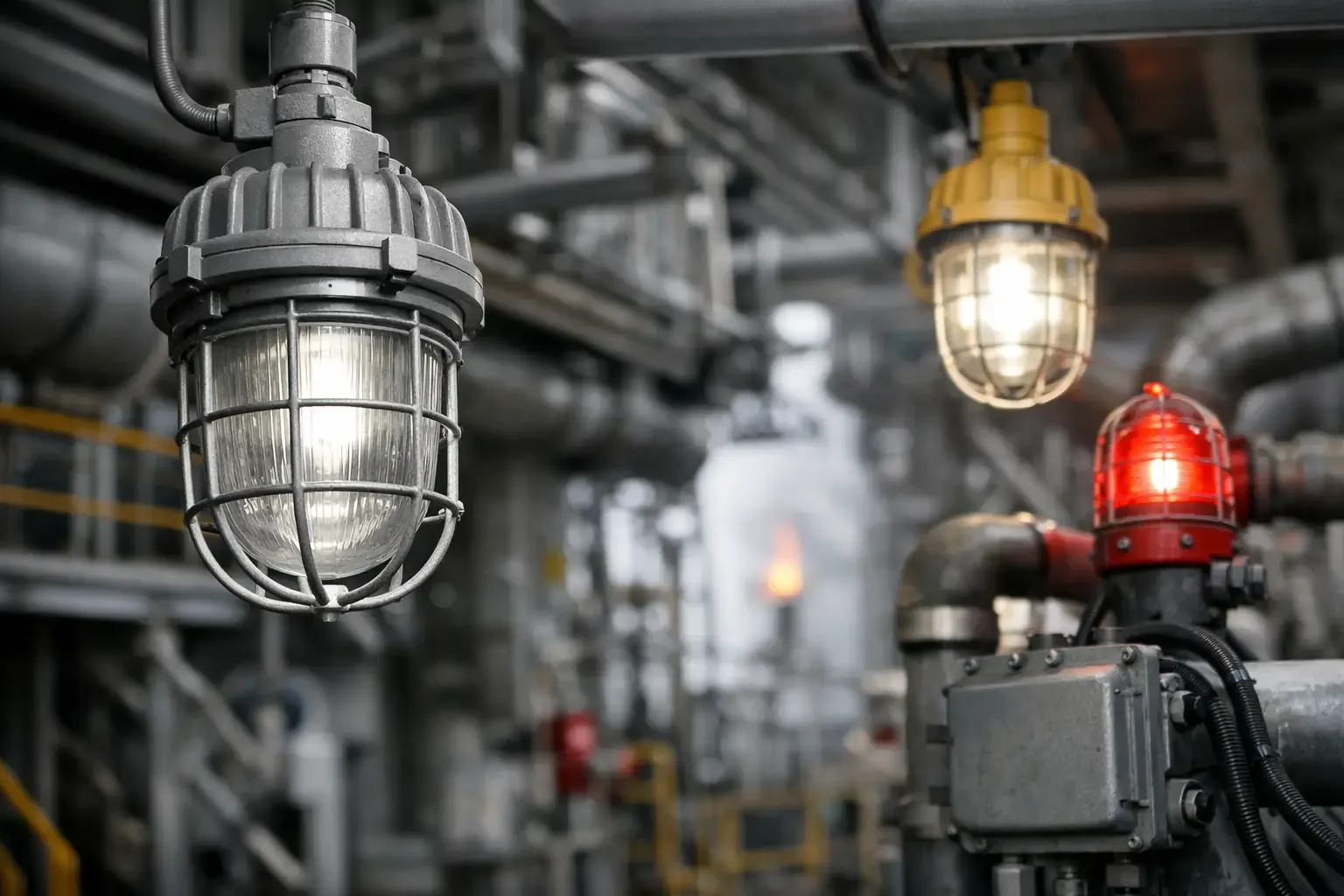
A lighting fixture installed near a pump seal, solvent transfer point, battery room, or gas-handling process is not simply an illumination decision. Class 1 Division 2 lighting must be selected around the actual hazard classification, the substance present, operating temperature, mounting conditions, and the requirements of the authority having jurisdiction. A fixture that looks industrial but lacks the correct listing or marking can delay approval, create a safety exposure, and add cost when replacement becomes necessary.
For fixture options and application support, review Maes Lighting's Class 1 Division 2 lighting solutions with the site classification and installation details in hand. Providing the area designation, gas group, required mounting height, voltage, ambient temperature, and desired light levels early allows the fixture recommendation and project documentation to be matched to the job rather than guessed from a catalog image.
What Class 1 Division 2 Means
Under the National Electrical Code, Class I locations are areas where flammable gases, vapors, or liquids may be present in sufficient quantities to create an ignitable mixture. Division 2 identifies locations where those materials are normally contained within closed systems or handled in a way that makes their presence under normal operating conditions unlikely. The hazard may appear because of an accidental rupture, equipment failure, abnormal operation, or ventilation failure.
That distinction matters. A Division 2 area is still a hazardous location, but it does not carry the same normal-operating exposure assumption as a Division 1 area. The lighting equipment must be suitable for the classified location, yet the correct fixture construction and certification depend on the site designation and applicable code path.
Class I Division 2 areas are common around petroleum and chemical processes, fuel storage and dispensing equipment, paint and coating operations, wastewater treatment systems, laboratories, and certain manufacturing lines. Boundaries can be surprisingly specific. A room may not be classified as a whole, while a zone around a vent, pump, cabinet, or process vessel is. The electrical area classification drawing should govern the decision, not a general description of the facility.
Class 1 Division 2 Lighting Is Not a Generic Label
A frequent specification error is treating "explosion-proof" as a universal substitute for hazardous-location suitability. Explosion-proof equipment is designed to contain an internal ignition and prevent flame propagation to the surrounding atmosphere. It may be appropriate for a given area, but the fixture marking must still align with the actual classification, gas group, temperature code, and installation conditions.
Likewise, a fixture labeled vapor-tight is not automatically suitable for Class I Division 2 service. Vapor-tight construction addresses moisture, dust, and environmental sealing. It can be valuable in wet or corrosive industrial areas, but it does not establish hazardous-location certification by itself. A high-bay or floodlight may also have a durable housing and high ingress-protection rating without carrying the required Class I, Division 2 listing.
Read the fixture marking and product documentation as part of the specification. The listing should identify the applicable Class, Division, and Groups, along with any ambient temperature limits and temperature-code information. When a project uses NEC Class/Division terminology, do not assume an ATEX or IECEx marking is interchangeable. Those systems address similar hazards through different classification frameworks, and local code acceptance must be confirmed.
Gas Groups Affect Fixture Eligibility
For Class I locations, gas groups help identify the ignition characteristics of the material that may be present. Groups A through D cover different gases and vapors, with Group B and Group C often requiring more careful review than a general Group D application. Hydrogen and acetylene are examples of gases with demanding requirements.
The fixture must be marked for the required group or for a group range that includes it. This is not a place for a “close enough” substitution. If the area classification calls for Class I, Division 2, Group B, a fixture listed only for Group D does not meet the requirement. Confirm the exact designation with the facility's classification documentation and the AHJ when questions remain.
Temperature Code Is a Safety Requirement
Every hazardous-location lighting review should include the temperature code, or T-code. The code indicates the maximum surface temperature the equipment can reach under specified conditions. That maximum must remain below the ignition temperature of the hazardous material.
LED fixtures generally produce less heat than legacy HID luminaires, but lower wattage does not remove the T-code requirement. Driver compartments, optical chambers, and heat-sink surfaces all influence the certified temperature rating. Ambient temperature also changes the equation. A fixture rated for a standard ambient may not retain its listed performance in a hot process area, near a furnace, or inside an enclosure with limited airflow.
Start With the Site Conditions, Not the Fixture Type
The most efficient selection process begins with a complete application profile. The electrical classification is essential, but it is only one part of the operating environment. A correctly listed fixture that corrodes prematurely, overheats, or provides inadequate illumination still creates an operational problem.
Review whether the installation is indoors or outdoors; whether it is exposed to washdown, salt air, chemicals, vibration, dust, or direct sunlight; and whether maintenance access is difficult. Mounting height and spacing determine whether a high bay, linear fixture, wall pack, or floodlight is the practical optical form. Voltage, branch-circuit arrangement, emergency-lighting needs, controls, and available mounting points also affect the final selection.
For food, beverage, and sanitary processing areas, the hazardous-location requirement may overlap with washdown requirements. In those cases, a fixture may need a suitable Class I Division 2 marking as well as a housing and lens system designed for frequent cleaning. NSF and IP69K considerations can be relevant in defined zones, but neither replaces the hazardous-location certification.
Corrosive coastal and marine environments present another trade-off. Aluminum housings, stainless hardware, gasket materials, coatings, and lens construction should be evaluated for the exposure. A compliant fixture with materials unsuited to salt spray or chemical vapor can become a recurring maintenance item long before its LED life is reached.
Use Photometrics to Protect Visibility and Uptime
Hazardous-location approval answers whether a fixture can be installed safely in the classified area. Photometrics answer whether people can safely perform the work. Both are necessary.
A one-for-one replacement based only on wattage often creates uneven lighting because LED distributions differ from HID and fluorescent fixtures. Mounting height, aisle geometry, obstructions, rack locations, equipment shadows, and task planes should guide the layout. Maintenance teams may need vertical illumination at panels and valves, while a loading area may need controlled glare and broad coverage at grade level.
Ask for photometric files and a lighting layout when the area is large, critical, or difficult to modify later. The goal is not maximum foot-candles everywhere. It is usable, consistent light that supports inspection, safe movement, troubleshooting, and process control without excessive glare or unnecessary energy use.
Documentation Keeps the Project Moving
Industrial lighting projects frequently slow down at submittal because the fixture was chosen before the documentation was checked. Procurement teams, engineers, contractors, and inspectors may each need different information, but the package should be consistent from the beginning.
For Class 1 Division 2 lighting, a specification-ready submittal commonly needs the product datasheet, hazardous-location certifications or listing details, fixture marking information, electrical characteristics, dimensional drawings, mounting details, photometric files, and warranty information. If emergency drivers, battery backup, sensors, or special optics are included, their compatibility with the classified application should also be reviewed.
Do not overlook field installation requirements. Conduit entries, sealing fittings, junction boxes, grounding provisions, and mounting hardware must be installed in accordance with the fixture instructions and applicable code. The fixture rating does not correct an installation that uses unsuitable accessories or compromises the enclosure.
A Practical Review Before Ordering
Before releasing an order, compare the fixture against the area classification drawing and confirm the Class, Division, gas group, and T-code requirement. Then verify voltage, ambient temperature range, mounting method, lumen package, optical distribution, environmental exposure, and required controls. Finally, make sure the submitted documentation matches the exact catalog configuration being purchased, including options that can change rating or performance.
That review takes less time than correcting a rejected submittal or replacing installed fixtures. When conditions are unclear, the best next step is to document the application details, involve the electrical engineer or AHJ as appropriate, and select lighting around the real hazard and work environment.