
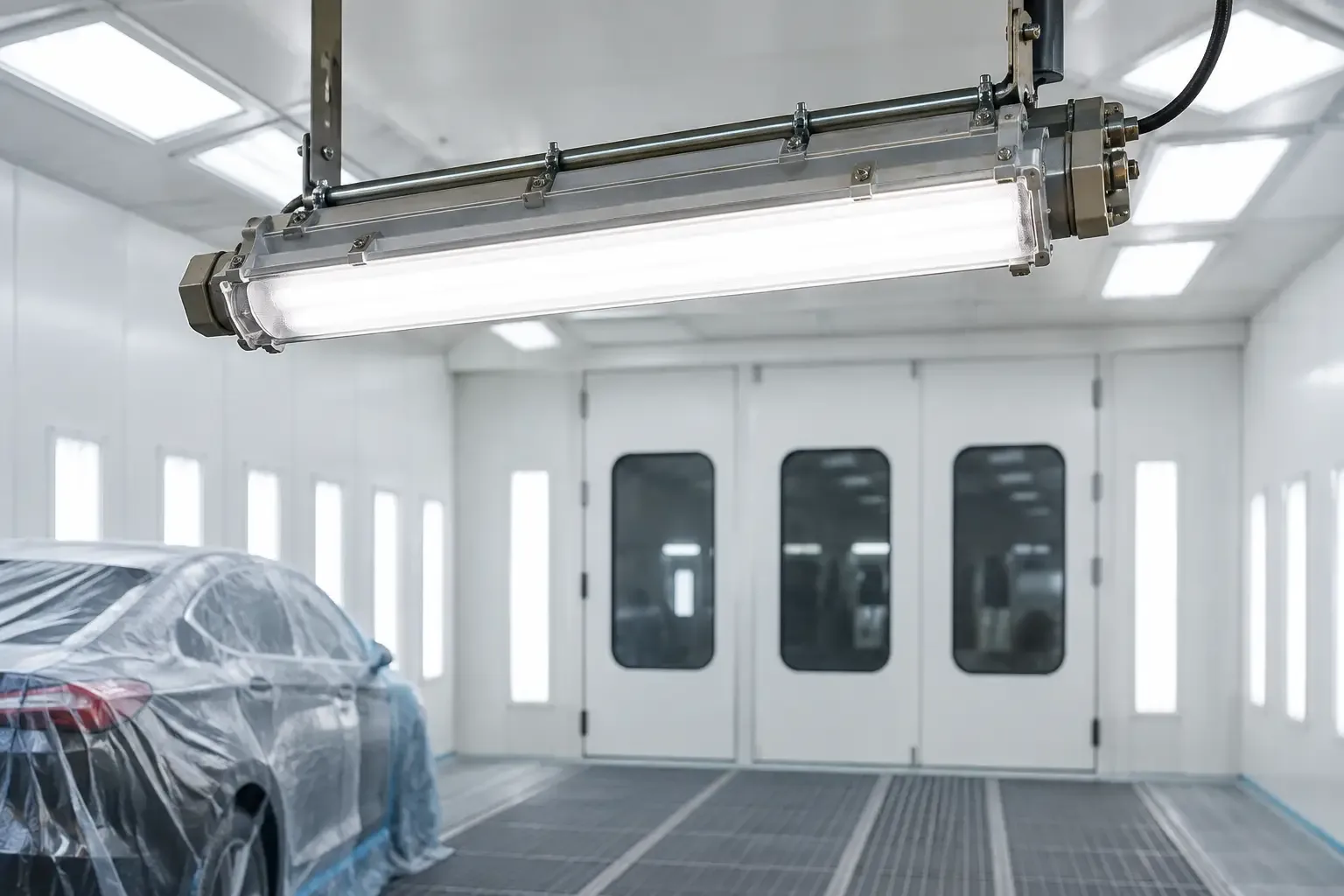
Paint finishing creates a lighting problem that ordinary industrial fixtures are not built to solve. Overspray, solvent vapors, airborne particulates, frequent cleaning, and the need to inspect surface quality all converge inside and around the booth. Explosion proof paint booth lights must provide clear, consistent illumination while matching the area classification and physical conditions established for the facility.
For help reviewing a booth layout, hazardous-location classification, and required submittal documents, contact Maes Lighting for guidance on its explosion-proof lighting products. A fixture should never be selected from appearance or lumen output alone. The right recommendation starts with the booth's classified boundaries, the coating materials in use, ventilation design, mounting location, and the authority having jurisdiction's requirements.
Why paint booth lighting requires a classified approach
Many coatings, reducers, cleaners, and solvents can release ignitable vapors during mixing, spraying, flashing, and cleanup. Where those vapors may be present in sufficient concentration, the National Electrical Code classification determines the type of equipment permitted in the space. In North American facilities, paint spray areas are commonly evaluated under Class I requirements because flammable gases or vapors are the concern. The exact division or zone is not assumed - it must follow the site design, applicable codes, and hazard assessment.
A Class I, Division 1 location is an area where ignitable concentrations can exist under normal operating conditions, during routine maintenance, or because of frequent equipment failure. A Class I, Division 2 location is an area where vapors are normally contained but could be released under abnormal conditions. A booth interior, exhaust plenum, mixing room, or adjacent preparation area may not carry the same classification. That distinction changes the fixture construction, marking, and installation method required.
The word "explosion-proof" is often used broadly, but it has a specific purpose in equipment selection. An explosion-proof enclosure is designed to contain an internal ignition event and prevent it from igniting the surrounding hazardous atmosphere. Not every hazardous-location fixture uses the same protection concept, and not every fixture marketed for tough conditions is suitable for a classified spray environment. Vapor-tight construction, for example, can be valuable for overspray and moisture exposure, yet it is not a substitute for an appropriate hazardous-location listing.
Start with the booth, not the fixture
The most dependable specifications begin with site information. Confirm what materials are sprayed, where vapors can accumulate, whether the booth operates continuously or intermittently, and how air moves through the enclosure. Request the electrical area classification drawing if it exists. It provides a defensible basis for selecting explosion proof paint booth lights and helps avoid a costly mismatch between the lighting schedule and the approved electrical design.
Mounting location matters just as much as classification. Recessed booth-wall fixtures may need a housing that maintains the booth panel's integrity and allows service from outside the spray area. Surface-mounted fixtures may work in prep spaces or exterior booth zones, but they must not interfere with airflow, access doors, sprinkler coverage, or moving equipment. Glass type, lens retention, gasketing, conduit entry, and mounting hardware should be evaluated as a complete assembly.
Photometrics also deserve more attention than a simple foot-candle target. Booth operators need light that reveals color variation, coverage gaps, orange peel, runs, and contamination without creating glare on glossy surfaces. Fixture placement on both sides of the work zone reduces shadowing around vehicle contours, fabricated parts, and rack-mounted components. A photometric layout can verify maintained illuminance at the actual work plane, rather than relying on nominal fixture output measured under ideal conditions.
Color quality and optical control
High color rendering can improve visual inspection, particularly where finish quality and color consistency affect acceptance. However, CRI is only one part of the decision. Color temperature, lens material, fixture spacing, and glare control influence whether technicians can see defects comfortably through a full shift. The best optical package depends on the booth geometry, wall reflectance, equipment height, and the distance between luminaires and painted surfaces.
LED fixtures usually reduce relamping work compared with legacy sources, but their service life still depends on operating temperature, driver quality, and thermal management. A fixture installed against a hot booth wall or near a cure process can run significantly hotter than its catalog test condition. Verify the ambient-temperature rating at the fixture location, not just the general plant temperature.
Listings, markings, and documentation that support approval
A compliant lighting package must be traceable. Review the fixture nameplate and documentation for the applicable Class, Division or Zone, gas group, temperature code, and ambient-temperature range. The required marking should align with the classified location and the materials handled in the area. A fixture rated for one gas group or temperature limitation may not satisfy another site's requirements.
Where the project uses the Zone system, protection methods such as Ex d flameproof, Ex e increased safety, and Ex i intrinsic safety may appear in the specification. These methods address hazards differently. Ex d equipment contains an internal explosion, Ex e limits ignition sources through enhanced construction, and Ex i limits energy within circuits so ignition cannot occur under defined fault conditions. The designation on a fixture must match the system and jurisdictional requirements used for the project.
Temperature code is especially relevant in finishing operations. It identifies the maximum surface temperature the equipment can reach under rated conditions. That value must remain below the ignition temperature of the hazardous material present. This is not a paperwork detail. Incorrect thermal selection can affect both site safety and approval by the authority having jurisdiction.
For contractor submittals, request datasheets, certification information, dimensional drawings, mounting details, and photometric files early. These documents allow the electrical engineer, safety team, and installer to verify that the equipment fits the design before fixtures arrive on site. They also reduce the chance that a field substitution delays inspection or startup.
Durability features that matter in a spray environment
Paint booth fixtures face more than ignition risk. Overspray can collect on lenses and housings, cleaning chemicals can attack gaskets, and vibration can loosen poorly designed mounting components. Specify materials and sealing appropriate to the actual exposure. Corrosion-resistant housings, durable lens assemblies, captive hardware, and serviceable gasketing can lower maintenance interruptions over the fixture's life.
Ingress protection should be read in context. A high IP rating indicates resistance to solids and water ingress under defined test conditions, but it does not independently establish hazardous-location suitability. Likewise, a washdown-capable fixture may be valuable in an adjacent cleaning area without being the correct selection inside a classified spray zone. Each rating answers a different operational question.
For projects with domestic-content requirements, verify Buy America Act eligibility at the model level and obtain current supporting documentation before release. Maes Lighting's Explosion Proof IR1, IR3, IR4, and IR7 series are covered under the Buy America Act. The CIT models on the vapor-tight product line are also covered. Confirm the required standard, project-specific threshold, and documentation format with the project team, since public-funding requirements can vary.
What are the best high temperature lights for industrial use?
The best high temperature lights for industrial use are fixtures rated for the maximum ambient temperature at their installed location, with thermal performance verified for the application. In a kiln area, steel mill, furnace line, or near a curing oven, standard hazardous-location lighting may not be adequate simply because it has a suitable Class and Division marking. Heat affects drivers, LEDs, seals, and wiring differently, and thermal derating can reduce output or shorten expected life.
For a paint operation, this becomes relevant when lighting is installed near bake ovens, curing zones, or hot exhaust equipment. Separate the hazardous-area review from the high-temperature review, then select a fixture that meets both where required. If one fixture cannot satisfy both conditions, the design may need a different mounting location, shielding, or a specialized high-temperature luminaire.
Avoid the common specification shortcuts
The most frequent error is treating all booth areas as identical. Overclassifying can increase project cost unnecessarily, while underclassifying exposes personnel and the facility to unacceptable risk. Another common shortcut is specifying a hazardous-location fixture without confirming its ambient rating, mounting method, or lens suitability for the finish environment.
Do not rely on fixture labels alone after installation. Proper conduit seals, wiring methods, bonding, mounting integrity, and maintenance procedures are part of the overall system. Lens cleaning should follow the fixture manufacturer's instructions so solvents or abrasive methods do not damage optical surfaces, gaskets, or markings.
A well-designed paint booth lighting package gives operators the visibility to do precise work and gives project teams confidence in the equipment behind the walls. When classification, photometrics, temperature, documentation, and field installation are reviewed together, the lighting becomes one less variable in a safe, productive finishing operation.