
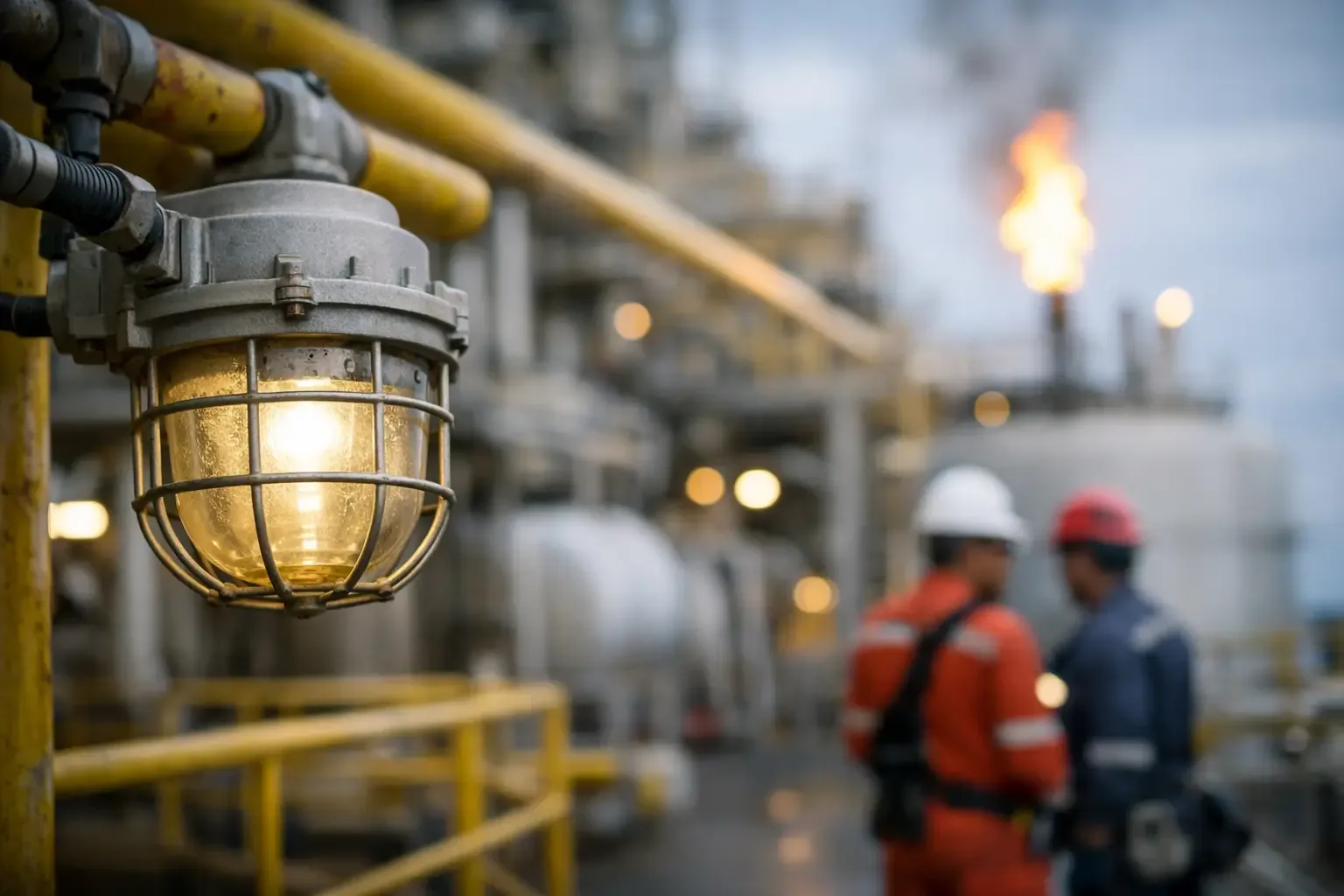
A classified boundary on a facility drawing is not a fixture specification. It identifies where an ignitable atmosphere may be present and establishes the minimum protection required for every electrical device installed there. This hazardous area classification guide explains how industrial teams can translate those boundaries into safer, code-aligned lighting decisions without confusing an IP rating, a heavy-duty housing, or a marketing claim with a hazardous-location listing.
For projects involving flammable gases, vapors, or combustible dust, review Maes Lighting’s explosion-proof lighting product range with the classification schedule, site drawings, and required submittals in hand. Matching the fixture to the actual area designation early helps avoid rejected submittals, field rework, and delays when a shutdown window is already scheduled.
Hazardous Area Classification Guide: Start With the Area
In the United States, hazardous locations are commonly classified under the National Electrical Code (NEC). The classification is based on the type of combustible material that may be present, how often it may be present, and the characteristics of that material. The site owner, process engineer, qualified classifier, or authority having jurisdiction (AHJ) determines the area classification. The lighting supplier’s role is to recommend equipment whose listing and markings fit that determination.
The traditional NEC Class and Division system divides hazards into three material classes. Class I covers flammable gases, vapors, and liquids, such as those found around solvent handling, petroleum processing, fuel transfer, and certain chemical processes. Class II covers combustible dust, including metal, coal, grain, flour, starch, and many organic dusts. Class III addresses easily ignitable fibers and flyings, often associated with textile, woodworking, and similar operations.
Each class is further divided by the likelihood of the hazardous material being present. Division 1 applies where ignitable concentrations can exist during normal operations, during frequent maintenance, or because of routine equipment leakage. Division 2 applies where those concentrations are not normally present in normal operations but could occur because of accidental rupture, abnormal operation, or failure of process equipment.
A Division 2 designation is not a reason to use ordinary commercial lighting. The anticipated hazard is less frequent, but it remains a code and safety requirement. The fixture must still carry markings appropriate for the area.
Groups define the material characteristics
Groups add another layer of detail. For Class I locations, Group A includes acetylene, Group B includes hydrogen and similar gases, Group C includes ethylene, and Group D includes propane and similar vapors. For Class II, Group E includes metal dusts, Group F includes carbonaceous dusts such as coal, and Group G includes grain, flour, starch, and other nonconductive dusts.
These distinctions affect enclosure design, heat management, and the ability of a fixture to prevent ignition. A fixture acceptable for one Class I group may not be acceptable for another. Do not rely on a broad statement such as “rated for hazardous locations.” Read the complete listing mark against the classification shown on the project documents.
Class/Division and Zone Systems Are Not Interchangeable
Many U.S. facilities use the Class/Division system, while others use the NEC Zone system, especially when equipment is designed around IEC-based standards or a project has international engineering requirements. For gases and vapors, Zone 0 represents a continuous or long-duration presence of an ignitable atmosphere, Zone 1 represents a likely presence during normal operation, and Zone 2 represents an unlikely or short-duration presence under abnormal conditions.
Combustible dust locations may be designated Zone 20, Zone 21, or Zone 22 using a similar frequency-based approach. A Zone-marked fixture is not automatically a substitute for a Class/Division fixture, and the reverse is also not automatically true. Whether a particular product is acceptable depends on its complete listing, the governing code, the project specification, and AHJ approval.
For specification teams, the practical rule is simple: document the exact classification stated for the installation and select a fixture listed for that classification. If the drawings show Class I, Division 2, Group C and D, the submitted fixture should visibly support that use. A product family name or a generic “explosion-proof” description is not sufficient documentation.
Read the Fixture Marking, Not Just the Product Category
Explosion-proof lighting is designed to contain an internal ignition should one occur and prevent that ignition from igniting the surrounding atmosphere. It does not mean the fixture cannot experience an internal event, nor does it mean every enclosed metal fixture is explosion-proof. The applicable listing, construction, and marking are what matter.
A proper review checks the class, division or zone, gas or dust group, and temperature code. The temperature code, often shown as a T-code, establishes the maximum surface temperature of the equipment under stated operating conditions. This is critical where the process material has a low autoignition temperature or where elevated ambient temperatures reduce the fixture’s thermal margin.
Ambient temperature is frequently overlooked. A fixture rated for a hazardous location at a standard ambient may not remain suitable near furnaces, process piping, roof-level heat buildup, or hot washdown operations. High-temperature environments require a fixture evaluated for the actual ambient, not just the electrical classification. The same discipline applies to cold storage, where driver performance, gasket behavior, and lens impact resistance can change at low temperatures.
Separate Hazardous Ratings From Environmental Ratings
Hazardous-location suitability and environmental durability overlap, but they are not the same requirement. An IP66 or IP69K rating addresses ingress protection from dust and water. A vapor-tight fixture helps protect electrical components from moisture, washdown exposure, and contaminants. NSF suitability may be necessary in food-processing areas. Marine-duty construction can be appropriate where salt spray, vibration, and corrosion are persistent concerns.
None of those ratings alone authorizes installation in a classified location. Conversely, a hazardous-location fixture may still need additional evaluation for caustic washdown, food-zone sanitation, extreme heat, corrosive chemicals, or mounting vibration. A food plant can have both challenges at once: a washdown production room may need NSF and IP69K characteristics, while a solvent storage or ethanol process area may also require a classified fixture.
The right selection reflects the whole operating environment. Ask what can ignite, how often it can be present, what temperatures the fixture will see, how the area is cleaned, and what chemicals contact the housing, lens, and seals. That is more useful than starting with wattage alone.
Build the Lighting Submittal Around Field Conditions
A compliant fixture can still be a poor project choice if its optics, mounting, voltage, or maintenance access do not fit the application. Refinery walkways may need controlled glare and long-throw distribution. A grain handling area may require dust-rated equipment with mounting that limits accumulation and simplifies inspection. Processing rooms may prioritize uniform illumination, washdown resistance, and quick replacement during limited maintenance windows.
Before finalizing a fixture schedule, confirm the mounting height, light levels, target areas, available voltage, emergency-lighting approach, control requirements, ambient range, and corrosive exposure. Photometric files, datasheets, certification documents, dimensional drawings, and wiring information should be reviewed before procurement, not after fixtures arrive on site.
Buy America Act requirements should also be identified at the beginning of public or federally funded work. Maes Lighting offers Buy America Act-covered options within the Explosion Proof IR1, IR3, IR4, and IR7 series, as well as CIT models in the vapor-tight product line. Project teams should verify the specific compliance documentation required by the contract, since funding source, agency language, and domestic-content rules can vary by project.
When an Application Review Prevents Costly Errors
The most expensive lighting error is often not the purchase price of the wrong fixture. It is the installation stoppage, rejected inspection, emergency replacement, lost production time, or safety exposure that follows. This risk increases when a classified area is being upgraded in phases or when the existing fixtures have incomplete markings and the facility is relying on legacy assumptions.
Bring the area schedule, process information, photos, mounting details, and any owner standards into the review. If the classification is uncertain, resolve that question with the responsible engineering authority or AHJ before ordering. A lighting recommendation can align with a confirmed classification, but it should not be used to create one.
Good hazardous-location lighting decisions are methodical: confirm the hazard, match the listing, account for temperature and exposure, then make sure the product documentation supports the installation. That process keeps the fixture from becoming the weakest point in a demanding industrial environment.