
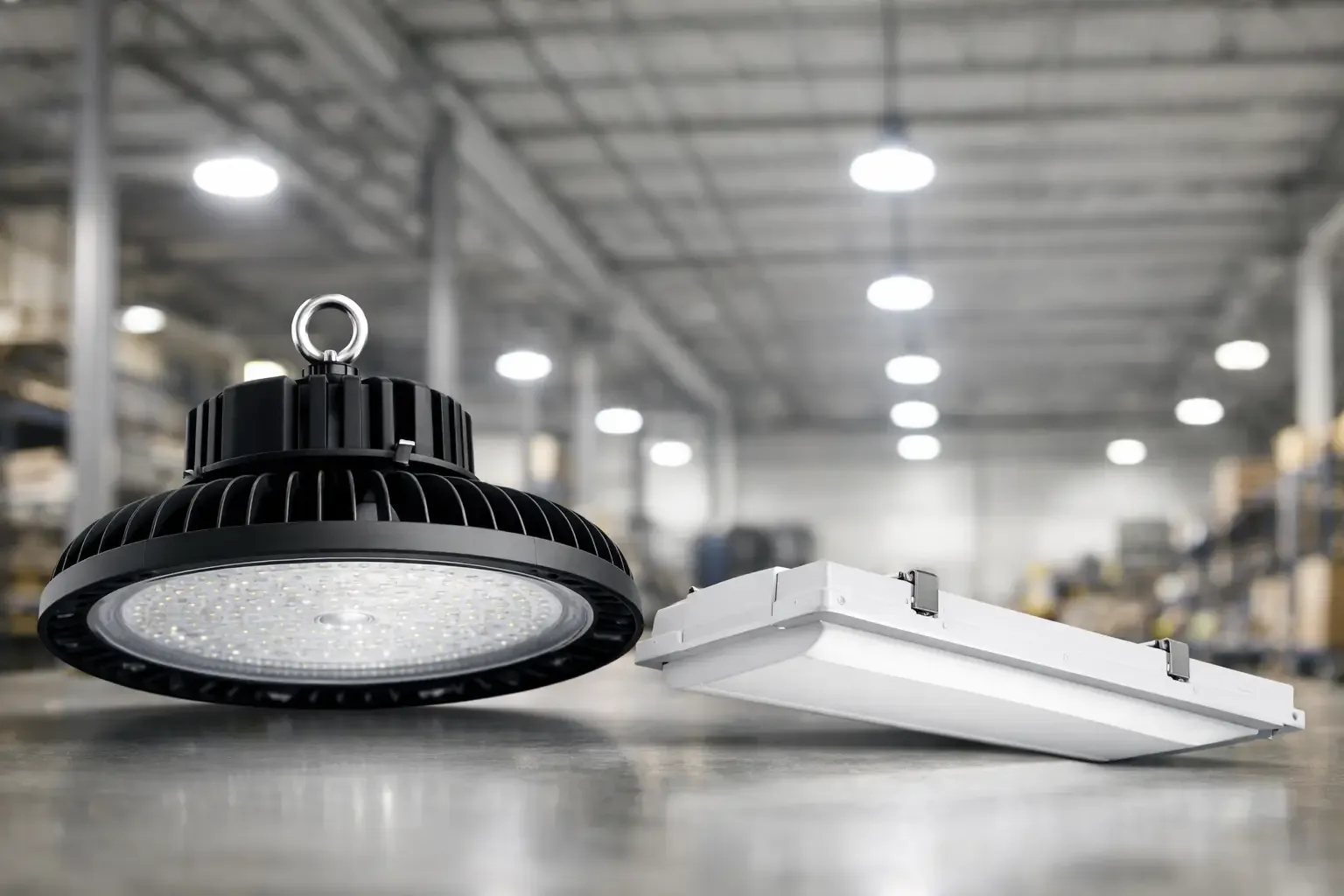
A fixture that performs well over a 20-foot storage aisle can create glare, uneven work-plane illumination, and wasted energy when installed at 12 feet. That is the practical difference behind a high bay lowbay lighting decision. Mounting height matters, but so do ceiling geometry, rack layout, task visibility, ambient temperature, contamination, and the maintenance conditions crews will face after installation.
For a fixture review based on your mounting heights, required foot-candles, and operating environment, consult Maes Lighting’s industrial LED high bay and low bay product resources and request application-specific technical guidance. The right recommendation should include photometric files, datasheets, mounting details, voltage options, and any required environmental or safety certifications before the fixture reaches the submittal stage.
High Bay Lowbay Lighting: The Practical Difference
High bay fixtures are generally used where mounting heights exceed approximately 20 feet. Warehouses, distribution centers, fabrication bays, aircraft hangars, and high-ceiling production areas are common applications. Their optics are designed to direct higher lumen packages downward over a longer throw, while controlling light loss between fixtures.
Low bay fixtures are typically applied at mounting heights from roughly 10 to 20 feet. They are common in maintenance shops, lower-ceiling manufacturing spaces, loading areas, utility rooms, and open work areas. At these heights, a high-output high bay may produce excessive brightness directly below the fixture and poor visual comfort across the space. A low bay with the correct distribution can provide more usable illumination with less glare.
Those ranges are starting points, not design rules. A 20-foot facility with tall pallet racking may need high-bay-style optics to move light down narrow aisles. A 24-foot maintenance area with close-set workstations and reflective machinery may perform better with a wider, lower-glare distribution. The layout and task plane determine the answer.
Start With the Task Plane, Not Fixture Wattage
Watts are an input number. Foot-candles at the task surface are the performance number that affects safety and productivity. A plant manager considering a high bay lowbay conversion should first identify where employees need visibility: the floor, a packing bench, a machine control panel, a vertical rack face, or an inspection station.
General storage may require moderate illumination, while detailed fabrication, inspection, and assembly work require more. Uniformity also matters. A bright spot directly below each fixture does not solve a visibility problem if the areas between fixtures are too dark.
A photometric layout accounts for mounting height, fixture output, beam distribution, spacing, reflectances, and obstructions. It also shows whether light reaches the vertical surfaces that matter in rack aisles, process areas, and loading zones. For a new build or a major retrofit, this is more dependable than matching the wattage of an older fixture.
Optics and spacing work together
Narrow distributions suit high mounting heights and aisle applications where light must travel farther in a controlled pattern. Wide distributions are often appropriate for open-floor work areas and lower mounting heights. A wider beam is not automatically better. If fixtures are mounted too high or spaced too far apart, it can reduce maintained light levels between rows.
Conversely, a concentrated optic used too low can cause objectionable glare. Consider shielding, lens design, fixture position relative to sightlines, and whether personnel routinely look upward from equipment controls or elevated platforms.
Environmental Ratings Can Override the Standard Choice
A conventional indoor high bay may be appropriate for a clean, dry warehouse. It is not automatically suitable for every industrial building. Moisture, airborne dust, chemicals, washdown, vibration, salt exposure, and heat can change the required fixture construction completely.
In food and beverage operations, fixtures near production and sanitation zones may need washdown resistance, suitable materials, and ratings such as IP66 or IP69K depending on the cleaning process. NSF-rated lighting may also be required where food-zone sanitation requirements affect equipment selection. The correct fixture is not merely bright enough. It must remain sealed, cleanable, and functional after repeated exposure to water and cleaning agents.
For corrosive, wet, or high-humidity locations, vapor-tight fixtures can be a stronger fit than an open high bay design. Where project requirements call for Buy America Act coverage, Maes Lighting’s CIT models on the vapor-tight product line are specifically relevant. Confirm the applicable project language and supporting documentation early, since domestic-content requirements vary by funding source and procurement terms.
Hazardous locations require an even more deliberate approach. If flammable gases, vapors, combustible dust, or ignitable fibers may be present, fixture selection begins with the area classification, not the desired lumen output. Class and Division or Zone designations, gas groups, temperature codes, and installation conditions must align with the fixture listing. A standard industrial high bay cannot be substituted into a classified area because it has a durable housing.
For projects requiring Buy America Act-qualified hazardous-location products, the Explosion Proof IR1, IR3, IR4, and IR7 series should be evaluated alongside the site classification and required certification. Documentation should be matched to the fixture actually specified, including listing information, photometrics, and project-specific compliance records.
Heat Changes LED Performance and Service Life
High ambient temperature is one of the most common reasons a seemingly correct LED fixture underperforms. LED output and driver reliability are affected by heat, and a fixture rated for a typical warehouse may not be suitable near a kiln, furnace, rolling mill, oven, or process line.
What are the best high temperature lights for industrial use?
The best high temperature lights for industrial use are fixtures rated for the actual maximum ambient temperature at the mounting location, with thermal management designed for that condition and certifications that fit the area classification. The answer is not a single wattage or housing style. It depends on the measured ambient temperature, radiant heat exposure, mounting distance from the process, airflow, and required illumination level.
Buyers should distinguish maximum ambient rating from the temperature of the equipment below it. A fixture mounted above a furnace may experience heat plume effects that exceed the general room temperature. It may also be exposed to radiant heat that a basic ambient measurement does not capture. Site measurements during representative production conditions provide a more reliable basis for selection.
Thermal derating is also relevant. As fixture operating temperature rises, light output can decrease and component stress can increase. A high-temperature fixture may cost more upfront than a standard industrial high bay, but the comparison should include replacement labor, unplanned outages, lift access, and the consequences of a lighting failure near critical production equipment.
Plan for Maintenance Access and Controls
Long LED life does not eliminate maintenance planning. Drivers, lenses, mounting hardware, and external controls still need inspection and, eventually, service. In a 35-foot warehouse, every replacement can require lift equipment, scheduling around operations, and work-at-height procedures. Selecting a durable fixture and verifying its service conditions reduces that burden.
Controls can improve energy performance, especially in intermittently occupied aisles, storage zones, and loading areas. Occupancy sensors and daylight response should be reviewed carefully in industrial applications. Fast-moving equipment, high racks, dust accumulation, and shifting inventory can affect sensor performance. The control strategy should support safe visibility, not create unexpected light-level changes in active work zones.
Emergency lighting requirements also need separate consideration. A high bay lowbay layout intended for normal operation may not satisfy egress lighting requirements during a power loss. Verify emergency coverage, battery performance under site temperatures, and code requirements as part of the complete electrical design.
Build the Submittal Package Before Ordering
Industrial lighting approvals are easier when the fixture selection is supported by complete, consistent documentation. Before release, confirm voltage, mounting method, lumen package, optic, color temperature, ingress protection, certifications, ambient-temperature rating, hazardous-location marking where applicable, and photometric performance.
For replacement work, document the existing mounting height and spacing, but do not assume the replacement must follow the old layout. LED optics and output can make a better arrangement possible. For expansion or new construction, coordinate fixture locations with sprinklers, cranes, ductwork, racking, and other ceiling-level equipment before the electrical rough-in is complete.
The most reliable high bay lowbay choice is the one designed around the actual work being done beneath it and the conditions surrounding it. When height, optics, environment, and documentation are evaluated together, the result is lighting that supports safe work, consistent output, and fewer costly corrections after installation.