
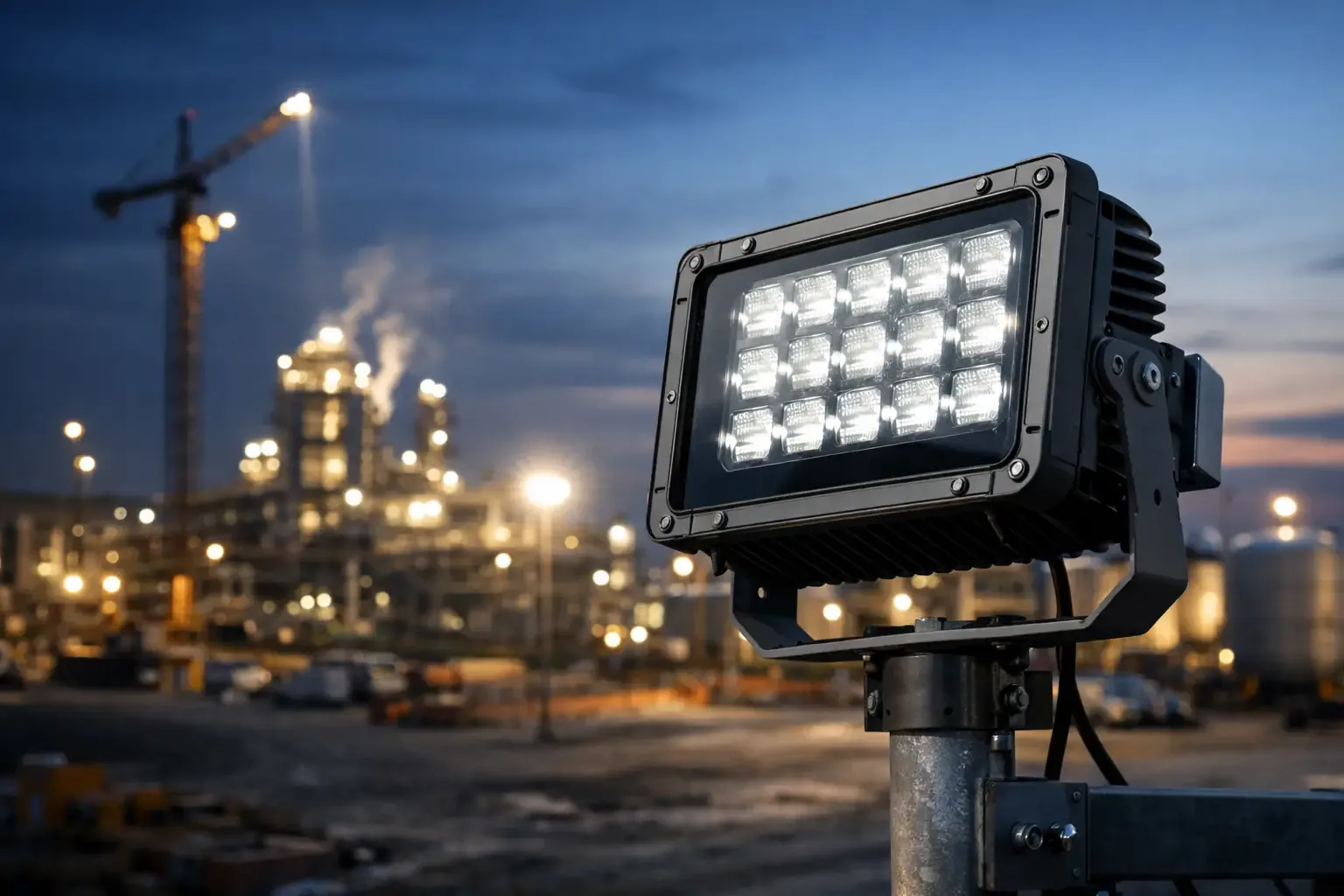
A floodlight that looks suitable on a warehouse wall can fail quickly at a tank farm, loading rack, steel mill, washdown room, or marine berth. This industrial floodlight review focuses on the specifications that determine whether a fixture will provide usable illumination, survive the environment, and support a compliant installation. Wattage and lumen output matter, but they are only part of the evaluation.
For fixture options, photometric files, and application support, review Maes Lighting's industrial LED floodlights product page and provide the site classification, mounting height, ambient temperature, and exposure conditions. That information allows a technical review to begin with the actual operating environment instead of a generic lumen comparison.
Industrial Floodlight Review: Start With the Environment
The first question is not "How bright should the floodlight be?" It is "What can damage or disqualify this fixture?" In many industrial projects, environmental conditions set the fixture category before lighting calculations begin.
A standard outdoor floodlight may be appropriate for a relatively clean loading yard with routine weather exposure. It is not automatically suitable where flammable vapor, combustible dust, corrosive chemicals, high-pressure washdown, extreme heat, or sustained vibration are present. Selecting the wrong enclosure can create an approval problem, shorten service life, and expose personnel to unnecessary risk.
For oil and gas processing, solvent handling, paint operations, and similar hazardous locations, the fixture must match the area classification. Under the NEC Division system, Class I locations involve flammable gases or vapors. Division 1 indicates that ignitable concentrations may exist during normal operations, while Division 2 describes locations where they are handled or contained but would normally be present only under abnormal conditions. Grain handling, milling, and other dust-producing operations may require Class II-rated equipment.
Do not treat Class I Division 1 and Division 2 as interchangeable. A Division 2 fixture is not a substitute for a Division 1 requirement. Projects using the Zone system likewise require careful review of Zone 0, Zone 1, or Zone 2 requirements and the relevant protection method, such as Ex d, Ex e, or Ex i. A floodlight's certification marking, temperature code, and installation instructions must align with the site classification and authority having jurisdiction.
What a Good Industrial Floodlight Must Deliver
Lumen output is easy to compare. Useful light at the task plane is harder, and more valuable. A floodlight mounted 25 feet above a truck lane needs a different optic than one mounted 60 feet above a storage yard or aimed across a process area. Wide distributions can cover nearby work zones efficiently, while narrower beams can project light farther with less spill. The best choice depends on mounting height, setback, aiming angle, obstructions, and the required horizontal and vertical foot-candle levels.
Poor beam control creates familiar problems: bright fixture images, dark work areas, glare for forklift operators, and wasted light beyond the property or work zone. Review IES photometric files rather than relying on a published lumen figure alone. A lighting layout should confirm average illumination, minimum levels, uniformity, and glare risk at the positions where people actually work.
Ingress protection is equally important. IP65 may be sufficient for windblown dust and rain, but it does not mean the fixture is designed for direct high-pressure washdown. Food and beverage plants, sanitation rooms, and chemical processing areas frequently require IP66 or IP69K equipment, depending on the cleaning procedure. In these environments, gasket materials, lens retention, cable entries, mounting hardware, and smooth cleanable surfaces deserve the same attention as the IP rating.
A fixture described as vapor-tight may be a better fit than an open-frame floodlight where moisture, condensation, and airborne contaminants are constant. For sanitary installations, NSF requirements can also be decisive. NSF/ANSI 2 generally addresses food equipment and cleanability in food-processing environments, while NSF/ANSI 51 addresses materials used in food equipment. Buyers should confirm which standard applies to the fixture, location, and facility specification rather than assuming that an NSF reference covers every sanitation requirement.
Heat Changes Every Part of the Evaluation
What are the best high temperature lights for industrial use?
The best high temperature lights for industrial use are fixtures specifically rated for the highest sustained ambient temperature at the mounting point, not merely fixtures with a high wattage rating or metal housing. Kilns, furnaces, foundries, steel mills, and hot process lines can produce localized temperatures far above the room's stated ambient condition. Heat from radiant sources, trapped ceiling air, and nearby exhaust paths must be considered during selection.
LED output and driver life decline as operating temperature rises. This is thermal derating: as the fixture environment becomes hotter, light output, component life, or both may be reduced according to the manufacturer's published limits. An industrial buyer should request the maximum ambient rating, expected lumen performance at that temperature if available, driver operating limits, and any mounting-clearance requirements.
A high-temperature floodlight may use remote drivers, specialized thermal paths, heat-resistant wiring, and component selections intended for severe ambient conditions. Those features can increase initial cost, but they can be preferable to repeated failures near a furnace door or rolling mill line. The trade-off is that a specialized fixture may have fewer optic options or require more deliberate mounting. That is acceptable when the alternative is frequent maintenance in a difficult or hazardous access area.
Temperature code also matters in hazardous locations. The fixture's surface temperature must remain below the ignition temperature of the gas or vapor present. High ambient conditions can affect this evaluation, so hazardous-location certification cannot be separated from thermal conditions.
Construction Details That Affect Service Life
Industrial floodlights are exposed to more than rain. Vibration from conveyors and heavy equipment can loosen brackets and cable fittings. Corrosive air can attack coatings, fasteners, and dissimilar metals. Marine environments introduce salt exposure that calls for appropriate corrosion resistance, sealing, and hardware selection.
Look closely at the housing material, lens type, gasketing, cable gland arrangement, bracket construction, and mounting method. A useful floodlight is serviceable without compromising its environmental seal. Where impact is likely, consider the lens and guard arrangement along with the fixture's IK rating if specified. Where corrosive washdown occurs, stainless hardware and compatible materials can matter more than a small difference in efficacy.
Electrical quality should also be reviewed. Confirm voltage range, surge protection, power factor, operating temperature, and driver replacement approach. Sites with switching loads, long runs, or exposure to lightning may need a higher surge-protection strategy than a typical commercial exterior installation. If emergency lighting is required, confirm whether the floodlight is part of a separate emergency system or whether an integral battery solution is appropriate for the environment.
Documentation Is Part of the Fixture Selection
For a professional industrial submittal, the fixture should come with documentation that supports the specification. That commonly includes datasheets, certification documents, dimensional drawings, photometric files, installation instructions, and warranty information. Hazardous-location projects may also require clearly legible certification markings and records that identify the exact listed configuration.
Buy America Act requirements should be addressed early, especially on public infrastructure and federally funded work. The Explosion Proof IR1, IR3, IR4, and IR7 series are covered under the Buy America Act, as are CIT models within the vapor-tight fixture range. Procurement teams should still verify the project-specific requirement and obtain the applicable documentation before release, since domestic-content rules and contract language can vary.
A Practical Review Process Before Ordering
Start with the area classification and environmental exposure, then verify mounting height, aiming positions, voltage, control requirements, and desired illumination levels. Next, compare photometrics and fixture ratings rather than comparing wattage alone. Finally, confirm the documentation package before the purchase order is issued.
This process is particularly valuable for retrofit work. Replacing metal halide fixtures with LED floodlights can reduce energy use and maintenance, but a one-for-one wattage substitution does not guarantee comparable coverage. LED optics can improve usable light dramatically, yet the layout may need revised aiming, mounting locations, or fewer fixtures to avoid glare and unevenness.
The right industrial floodlight is the one that can be documented, installed, and maintained with confidence in its actual location. When the site conditions are clear, the fixture decision becomes less about choosing the highest advertised lumen package and more about protecting uptime, personnel, and project approval.