
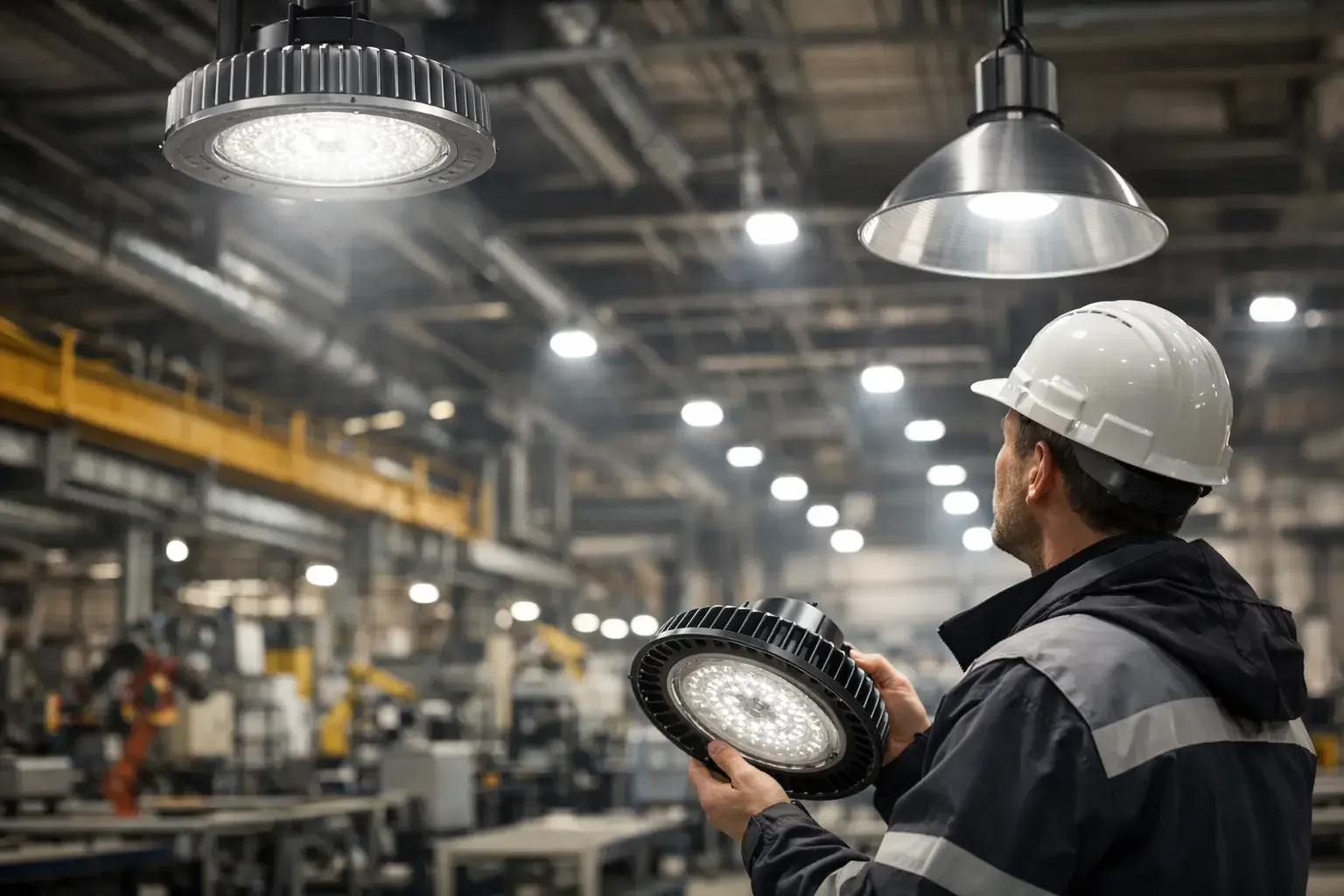
A lighting retrofit can reduce energy use, but that is rarely the deciding factor inside a refinery, steel mill, food plant, grain elevator, or marine facility. The real objective is to install equipment that remains safe, compliant, and maintainable under actual operating conditions. This industrial lighting retrofit guide focuses on the decisions that prevent expensive fixture failures, rejected submittals, and avoidable maintenance work.
For a project-specific review of fixture classifications, photometrics, certificates, and lead times, contact Maes Lighting for industrial LED retrofit support. The right retrofit starts with the operating environment, not a one-for-one wattage replacement or a generic high-bay schedule.
Start the Industrial Lighting Retrofit Guide With Site Conditions
Before comparing lumens, identify what the fixture must survive. Existing lighting locations often have conditions that were accepted years ago but are not adequately documented for a current capital project. A useful audit records mounting height, target light levels, voltage, controls, emergency-lighting needs, access constraints, ambient temperature, and the source of contamination or exposure.
The environment determines the fixture family. A dry warehouse aisle may accept a standard industrial high bay, while a washdown room needs a sealed, cleanable luminaire. A pump station may require a hazardous-location fixture, and a casting line may require a high-temperature design that can operate in elevated ambient air. Treating all of these as ordinary LED conversions creates risk because fixture output, driver life, seals, and approvals are all affected by the application.
Also inspect the electrical and mechanical condition of the installation. Confirm branch-circuit voltage, conduit arrangement, junction-box capacity, mounting hardware, vibration exposure, and whether the new fixture changes load or wind-area considerations. Retrofit crews should not discover after delivery that a fixture is incompatible with existing hubs, pendant stems, or hazardous-location wiring methods.
Classify Hazardous Locations Before Selecting Fixtures
Hazardous-location lighting is selected from the area classification, not from a general description such as “chemical area” or “dusty room.” Under the NEC Division system, Class I addresses flammable gases or vapors, while Class II addresses combustible dust. Division 1 indicates that an ignitable hazard can exist during normal operations; Division 2 indicates the material is normally confined but may be present under abnormal conditions.
That distinction affects fixture construction, approval markings, installation practices, and budget. A Class I Division 1 location often requires more specialized equipment than a Class I Division 2 space. Do not assume that upgrading to LED permits a lower classification. The authority having jurisdiction and the facility’s hazardous-area documentation govern the classification.
Some facilities use the Zone system rather than Divisions, particularly on projects influenced by IECEx or ATEX documentation. Zones 0, 1, and 2 apply to gas atmospheres, while Zones 20, 21, and 22 address dust. A Zone-rated fixture is not automatically interchangeable with a Division-rated fixture. Confirm the required certification route and marking before a fixture is specified.
Understand Exd, Exe, and Exi Markings
Exd, Exe, and Exi describe different protection concepts, not interchangeable quality levels. Exd equipment contains an internal ignition through a flameproof enclosure. Exe is increased-safety construction designed to avoid arcs, sparks, and excessive temperatures during normal service. Exi, or intrinsic safety, limits electrical energy so ignition cannot occur under defined fault conditions.
For lighting retrofits, the required protection method depends on the equipment certification and site classification. The practical takeaway is simple: specify the complete fixture by its approved marking and temperature code rather than relying on a partial label description or a housing that merely looks industrial.
Oil and gas sites, refinery process units, loading areas, rigs, and pump stations commonly require Class I hazardous-location equipment because of flammable vapor exposure. Grain elevators, feed operations, and dust collection areas demand equally careful evaluation for combustible dust. Dust accumulation can also impair heat dissipation, so the retrofit should account for cleaning practices and permitted surface temperatures.
Design for Light Levels, Glare, and Maintenance Access
An LED fixture with more listed lumens does not necessarily produce a better work area. Mounting height, distribution pattern, reflectances, obstructions, and task orientation determine usable illumination. A narrow optic can improve light at floor level from a high ceiling, while a wide distribution may suit lower mounting or open work zones. In racking aisles, directional optics may improve vertical visibility and reduce dark faces on stored materials.
Request photometric files and verify the layout against the work plane. This is especially valuable where workers read gauges, inspect welds, handle materials, or move equipment through changing shadows. Overlighting can create glare on wet floors, stainless equipment, instrument screens, and moving machinery. Underlighting can reduce inspection quality and increase safety exposure.
Maintenance access deserves equal weight. A fixture placed over process equipment, conveyors, or production lines may require shutdowns, lifts, permits, or fall-protection planning to service. Longer-rated LED systems can reduce maintenance visits, but only if ambient temperature, voltage quality, vibration, and contamination remain within the fixture’s limits.
What Are the Best High Temperature Lights for Industrial Use?
The best high temperature lights for industrial use are not simply fixtures with metal housings. They are luminaires rated for the measured maximum ambient temperature at the mounting point, with thermal management designed to protect the LED array, driver, seals, and wiring.
For kilns, furnaces, steel mills, foundries, and hot-process lines, measure ambient conditions where the fixture will be installed. The temperature near the roof deck, crane rail, or furnace wall can be significantly higher than the general building temperature. Include radiant heat, hot-air discharge, dust buildup, vibration, and thermal cycling in the evaluation.
LED thermal derating matters because LED output and component life decline as temperatures rise. A fixture may operate at a stated high ambient rating but deliver less output than it does at standard room temperature. That is not necessarily a problem if the lighting calculation uses the manufacturer’s high-temperature performance data. The problem occurs when a standard fixture is installed near a heat source and its driver fails early or light output drops below task requirements.
High-temperature fixtures may cost more upfront, but they can be less expensive over the project life when they prevent repeated replacements and unplanned maintenance in difficult areas. Verify the maximum ambient rating, thermal test data, warranty terms, and mounting restrictions. A high-temperature rating does not remove the need to protect fixtures from direct flame, excessive radiant heat, or process conditions beyond the published limits.
Specify Washdown and Food-Processing Fixtures Correctly
Food and beverage retrofits must account for sanitation, not just humidity. Areas exposed to routine washdown need housings, lenses, gaskets, and cable-entry methods that resist water intrusion and cleaning chemicals. IP66 indicates strong protection against dust and powerful water jets; IP69K is intended for high-pressure, high-temperature washdown conditions. The correct rating depends on the sanitation procedure, nozzle pressure, water temperature, distance, and exposure frequency.
NSF requirements also require careful reading. NSF/ANSI 2 is associated with food equipment, while NSF/ANSI 51 addresses materials used in food equipment and related areas. Buyers should confirm the applicable standard with the facility’s sanitation, quality, and engineering teams rather than assuming every NSF reference means the same thing. In food zones, smooth exterior surfaces, shatter-resistant construction where required, corrosion resistance, and cleanable geometry can matter as much as lumen output.
Vapor-tight fixtures are often a practical retrofit option for coolers, processing rooms, packaging areas, and utility spaces with moisture exposure. However, “vapor-tight” alone does not establish suitability for direct washdown or chemical exposure. Check the ingress rating, lens material, gasket compatibility, mounting details, and the actual cleaning regimen.
Plan Documentation and Procurement Before Release
A retrofit moves faster when documentation is identified before fixtures are ordered. Typical submittal packages may include datasheets, photometric files, installation instructions, hazardous-location certificates, ingress-protection information, dimensional drawings, and warranty details. Confirming these items early helps electrical contractors avoid approval delays and gives engineers a clear basis for fixture selection.
For projects subject to Buy America Act requirements, identify compliant products during the specification phase. The Explosion Proof IR1, IR3, IR4, and IR7 series are covered under Buy America Act requirements, as are CIT models in the vapor-tight fixture range. Request the applicable project documentation before release, since public-project requirements can vary by funding source, contract language, and date.
Finally, use a pilot installation when the application is unusual or the existing lighting is poorly documented. A small installed section can confirm glare, mounting fit, illumination, controls behavior, and washdown or heat exposure before a plant-wide release. That modest step often provides the practical evidence needed to make the full retrofit safer, easier to approve, and easier to maintain.