
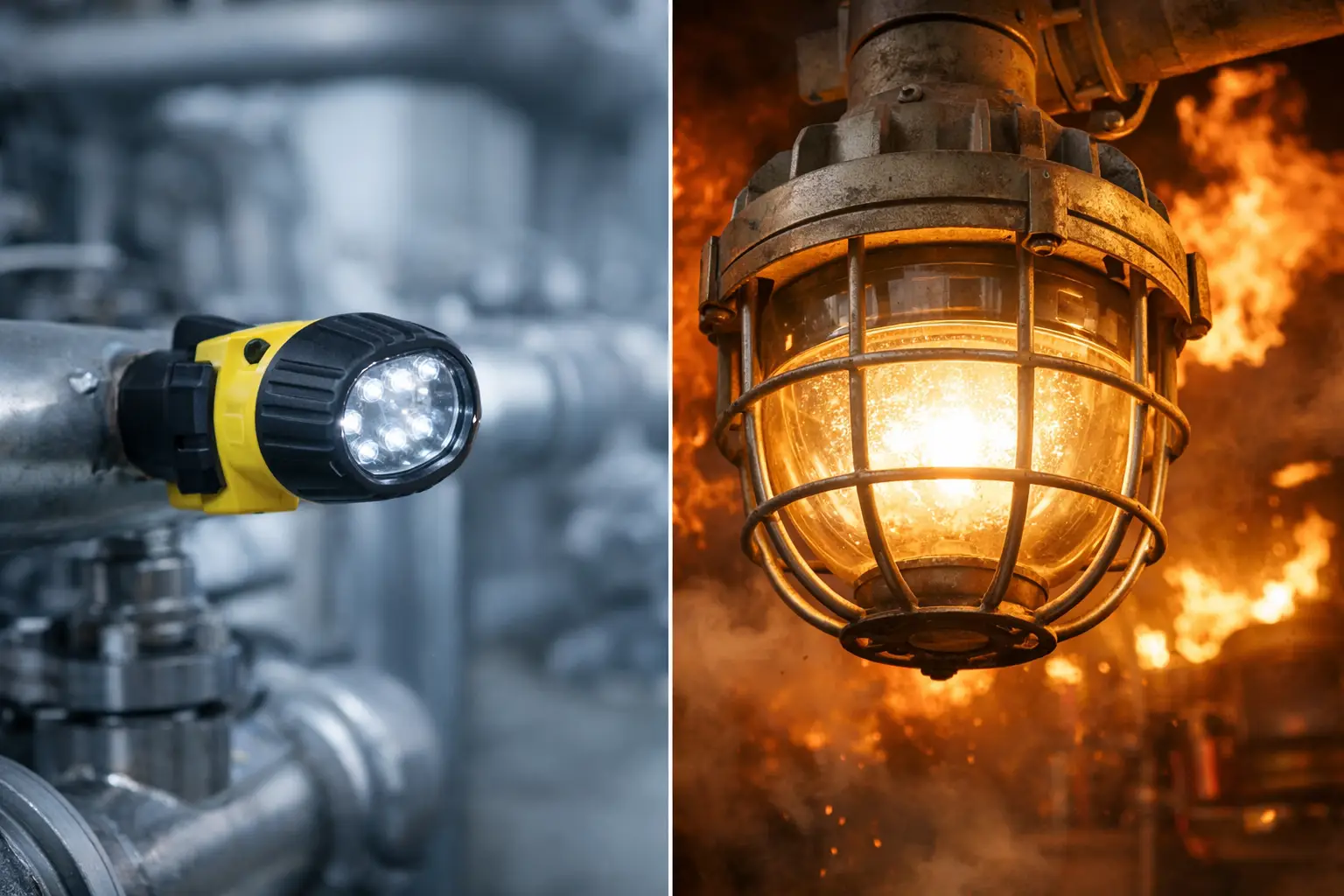
A fixture installed above a solvent blending line, grain conveyor, or gas processing skid cannot be selected on lumen output alone. The decision between intrinsically safe vs explosion proof lighting begins with a more fundamental question: how will the lighting system prevent an ignition source in the specific hazardous location?
For projects requiring enclosed hazardous-location luminaires, review Maes Lighting's explosion-proof lighting options with the site classification, mounting conditions, voltage, and required documentation in hand. A fixture that is properly certified for the environment can reduce approval delays, simplify submittals, and support dependable operation long after installation.
The Core Difference: Preventing Ignition vs Containing It
Intrinsic safety and explosion-proof protection address hazardous atmospheres in different ways. Neither is automatically “better.” Each is appropriate only when its protection method, certification, and installation requirements match the area classification and the equipment's intended use.
Intrinsically safe equipment is designed so that the electrical and thermal energy available under normal operation and specified fault conditions remains below the level capable of igniting a hazardous atmosphere. In practical terms, an intrinsically safe circuit limits voltage, current, stored energy, and surface temperature. The goal is to make ignition unlikely because the circuit does not have enough available energy to create an ignitable spark or excessive heat.
Explosion-proof equipment uses a different approach. Its enclosure is built to withstand an internal ignition of a flammable gas or vapor and prevent the flame, hot gases, or burning particles from escaping to the surrounding atmosphere at a temperature that could ignite it. The equipment may contain energy capable of causing ignition internally, but the certified enclosure contains the event.
The term “explosion-proof” can be misleading to non-specialists. It does not mean a fixture is indestructible or suitable for every explosive environment. It means the product has been evaluated to a defined hazardous-location standard, for stated Classes, Divisions or Zones, Groups, temperature codes, and installation conditions.
Where Intrinsically Safe Lighting Fits
Intrinsically safe lighting is most often associated with low-power devices, instruments, controls, communications equipment, and portable inspection lights. It is useful where personnel need to bring equipment into a hazardous area and where a low-energy design offers a practical safety advantage.
A compact intrinsically safe work light, for example, can be appropriate for inspection, maintenance, or emergency tasks in a classified space. Because the fixture and its power arrangement are part of an intrinsically safe system, the evaluation may include the luminaire, battery pack, barriers, wiring parameters, connectors, and associated apparatus. Substituting a component without confirming compatibility can invalidate the intended protection method.
The trade-off is output and application range. Intrinsic safety is harder to achieve as electrical power rises. That makes it less common for permanent, high-output area lighting such as high bays, floodlights, and large process-area luminaires. A facility that needs broad, sustained illumination over equipment, walkways, or loading areas will often require another certified protection method.
Where Explosion-Proof Lighting Fits
Explosion-proof LED fixtures are commonly used for permanent lighting in Class I hazardous locations involving flammable gases or vapors. Typical applications include refinery process units, petrochemical facilities, tank farms, paint and solvent handling areas, gas compression stations, and certain chemical processing spaces.
These fixtures are designed around certified housings, threaded or otherwise approved joints, sealed entries, appropriate gasketing, and thermal management that maintains the marked temperature code. Modern LED designs can provide the illumination needed for general area lighting while reducing relamping frequency compared with legacy HID systems.
That does not mean every harsh industrial location requires an explosion-proof fixture. A wet processing room may need NSF-rated or IP69K washdown lighting. A dusty but nonclassified warehouse may need vapor-tight fixtures. A steel mill may need high-temperature lighting. Selecting explosion-proof equipment where it is not required can increase cost, weight, mounting complexity, and maintenance burden without improving compliance.
Intrinsically Safe vs Explosion Proof Lighting by Application
The most useful comparison is not product against product. It is protection method against the actual operating environment.
For portable maintenance and inspection, intrinsically safe lighting may be the preferred choice when workers enter classified areas and need a battery-powered task light. Its limited-energy design can be well suited to close-up work where a conventional portable fixture would introduce an unacceptable ignition risk.
For fixed general illumination in a classified process area, explosion-proof lighting is often the more practical choice. It can support higher lumen packages and permanent installation while meeting the hazardous-location marking specified for the space.
For Zone-classified facilities, the decision may involve protection concepts identified by IEC or ATEX-style markings, as adopted by the facility and accepted by the authority having jurisdiction. “Ex d” flameproof protection is broadly analogous in purpose to explosion-proof enclosure protection, while “Ex i” identifies intrinsic safety. The exact marking, equipment protection level, gas group, and temperature classification still matter. Similar terminology does not make certifications interchangeable.
For Class II combustible dust areas, do not assume a Class I explosion-proof fixture is appropriate. Dust hazards have separate concerns, including dust ingress, surface temperature, enclosure performance, and the specific Class and Division or Zone marking. Grain handling, food ingredients, plastics, metals, and coal operations require classification-specific review.
Read the Fixture Marking, Not the Product Name
“Hazardous-location rated” is not enough information for a submittal or field installation. The fixture marking and supporting certification documents should be reviewed against the area classification established for the facility.
Start with the Class. Under the NEC system, Class I addresses flammable gases and vapors, Class II addresses combustible dust, and Class III addresses ignitable fibers and flyings. Next, confirm the Division or Zone, which reflects the likelihood or duration of the hazardous material being present. Then verify the gas or dust Group and the fixture's temperature code, or T-code.
Temperature code is frequently overlooked. A luminaire can have the correct Class and Division but still be unacceptable if its maximum surface temperature exceeds the ignition temperature limits associated with the material present. LED fixture thermal design, ambient temperature rating, mounting orientation, and dirt accumulation can all affect this evaluation.
Also verify supply voltage, conduit entry type, mounting method, wet-location suitability, ambient range, emergency-lighting requirements, photometrics, and maintenance access. In corrosive or washdown areas, the hazardous-location rating alone may not address chemical exposure or sanitation requirements. Material selection, lens type, gasketing, and ingress protection remain part of the specification.
Installation Can Change the Outcome
A properly listed fixture can still become a compliance problem if installed incorrectly. Hazardous-location wiring methods, sealing fittings, conductor selection, grounding, torque requirements, unused openings, and approved accessories must follow the applicable code and the manufacturer's instructions.
This is especially relevant for explosion-proof luminaires. The enclosure's protection depends on its construction and approved joints. Damaged threads, an incorrect conduit arrangement, missing plugs, or unauthorized field modifications can compromise the installation. Opening a fixture in a hazardous area without following site procedures can create a separate safety issue.
Intrinsic safety also requires disciplined installation. Cable capacitance and inductance, barrier selection, grounding method, separation from nonintrinsically safe circuits, and entity parameters may all be part of the approved system design. An intrinsically safe label on one component does not certify every possible combination of components.
A Better Specification Process
Before choosing a fixture, obtain the area classification from the facility's electrical drawings, hazardous-area study, or qualified engineering authority. The lighting supplier should not be asked to infer a classification from a general description such as “chemical area” or “dusty room.” Conditions can vary substantially within one facility.
Then define the lighting task. Identify mounting height, target foot-candles, beam distribution, glare concerns, operating hours, emergency coverage, available voltage, and environmental exposures. A process platform may need controlled vertical illumination for valves and gauges, while a truck rack may require wide-area coverage with minimal shadowing.
Finally, request specification-ready documentation early: datasheets, certification records, dimensional drawings, photometric files, installation instructions, and applicable warranty information. This gives engineering, procurement, contractors, and the authority having jurisdiction a clear basis for approval before product arrives on site.
Choose the Protection Method the Area Requires
The practical answer to intrinsically safe vs explosion proof lighting is not a preference for one label. Intrinsically safe lighting is valuable where low-energy circuits and portable equipment are needed. Explosion-proof lighting is often the workhorse for permanently installed illumination in Class I hazardous locations that require higher output and durable containment.
Treat the classification, marking, temperature code, and installation method as one coordinated decision. When those details are confirmed before purchase, the lighting package is more likely to pass review, perform in service, and keep maintenance teams focused on the plant rather than avoidable fixture issues.