
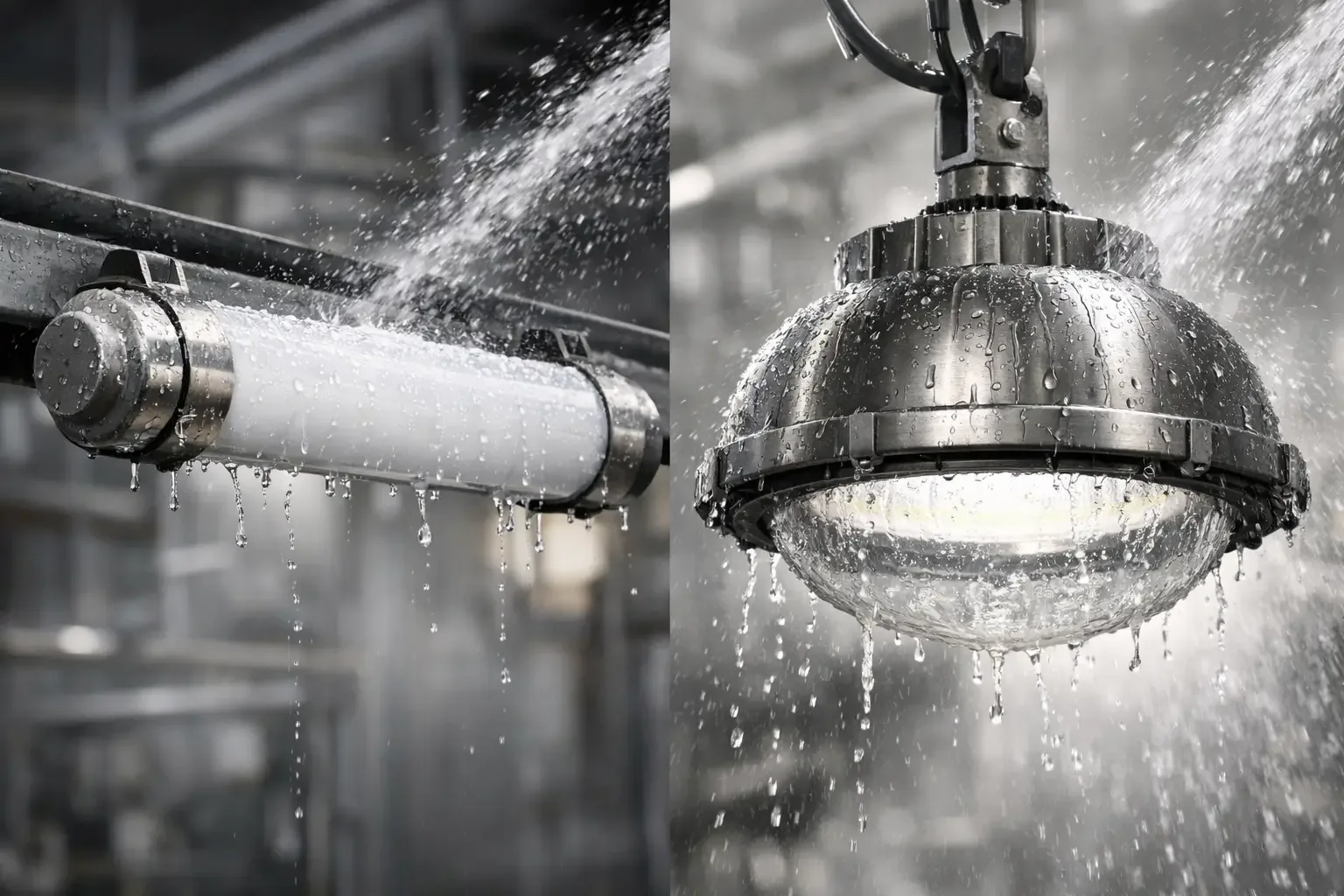
A fixture can survive rain, hose-down cleaning, or an enclosed high-pressure wash cycle, but those are not the same duty. Understanding IP66 versus IP69K ratings prevents a common specification error: selecting a fixture that is well sealed against dust and powerful water jets, then installing it where daily sanitation exposes it to hot, close-range, high-pressure washdown.
For help matching an ingress rating to sanitation procedures, mounting locations, and required documentation, consult Maes Lighting's food processing lighting specialists. An application review can determine whether an NSF/IP69K fixture is warranted or whether an IP66 vapor-tight luminaire is the more practical fit for the area.
What an IP Rating Actually Tells You
IP stands for Ingress Protection. The rating follows IEC 60529 and uses two digits. The first digit addresses protection against solid objects and dust. The second addresses resistance to water under a defined test condition. It does not rate corrosion resistance, hazardous-location suitability, food-zone compliance, impact resistance, temperature capability, or light output.
That distinction matters in industrial lighting. A fixture may carry a high IP rating yet still be unsuitable for a classified hazardous location, a corrosive chemical process, or a high-ambient-temperature steel mill. The IP code answers one narrow but critical question: how effectively does the enclosure prevent the specified solids and water exposure from entering it?
Both IP66 and IP69K begin with a 6. That first digit means the enclosure is dust-tight. Talc-sized dust is used during testing, and the enclosure must prevent dust ingress that could interfere with safe operation. For plants handling flour, sugar, grain, powders, fines, metal particles, or outdoor airborne dust, this is a meaningful baseline.
The difference is in the water test.
IP66 Versus IP69K Ratings: The Water-Test Difference
An IP66 fixture is protected against powerful water jets. During testing, water is projected from a 12.5 mm nozzle at a defined flow rate and pressure from multiple directions. The fixture must prevent harmful water ingress. This rating is appropriate where equipment receives weather exposure, washdown with a hose, or heavy splashing that is not a close-range high-pressure sanitation cycle.
IP69K is designed for substantially more severe washdown. The fixture is subjected to high-pressure, high-temperature water jets from several angles while mounted on a rotating test table. The test uses water at approximately 176°F and pressure up to 1,450 psi. It simulates the aggressive cleaning conditions found on food-processing equipment, vehicle wash systems, and other environments where sanitation crews use concentrated hot-water spray.
An IP69K rating is not simply “more waterproof” than IP66 in every possible circumstance. It demonstrates performance under a specific high-pressure, hot-water jet test. IP66 demonstrates resistance to powerful water jets under its own defined test. A fixture may be marked IP69K, IP66, or both, depending on the testing and manufacturer documentation. When the specification requires both ratings, verify both ratings appear on the product datasheet or certification record.
Why hot, pressurized washdown changes the decision
A standard hose-down can expose a fixture to a broad stream of water. High-pressure washdown concentrates energy into a narrow jet that can challenge lens gaskets, cable entries, housing seams, and mounting interfaces. Hot water adds another stressor by cycling materials through temperature changes and potentially accelerating seal wear over time.
In a protein-processing room, dairy facility, brewery, or ready-to-eat food line, the cleaning procedure may be more demanding than the operating environment. A luminaire mounted outside the direct wash zone may only need resistance to moisture and incidental spray. A fixture above an open conveyor or beside a foam-and-rinse station can face repeated direct spray at close range. That is where IP69K becomes a selection requirement rather than a marketing preference.
Where IP66 Is Usually the Right Choice
IP66 lighting is a strong fit for many industrial locations that are wet, dusty, exposed, or periodically cleaned without intense sanitary washdown. This can include exterior loading docks, rail areas, marine walkways, wastewater facilities, sawmills, warehouses with open dock doors, and general manufacturing spaces with hose-down maintenance.
It is also common in applications where the fixture must withstand driving rain, windblown dust, and occasional washdown while delivering reliable illumination over a large area. Vapor-tight fixtures, industrial floodlights, and certain high bays may use IP66 enclosures for these conditions.
Still, “IP66” should not become a shortcut for every wet-area specification. If cleaning crews use pressure washers, ask how close the nozzle comes to the fixture, whether water is heated, how often cleaning occurs, and whether chemicals are used. A fixture installed 20 feet above a floor may experience a different exposure than one installed three feet from a processing line, even within the same room.
When IP69K Should Be Specified
IP69K is typically justified where frequent, direct, high-pressure and high-temperature washdown is part of the sanitation program. Food and beverage processing is the most familiar example, particularly in raw protein, dairy, beverage filling, produce handling, commercial kitchens, and other facilities governed by strict hygiene controls.
NSF requirements can be equally relevant. An IP69K rating addresses enclosure ingress during washdown, while NSF certification addresses material and cleanability criteria for food-related environments. Depending on the zone and the facility's sanitation standard, a fixture may need both. Specifying one does not automatically satisfy the other.
IP69K can also be appropriate in specialized transportation, agricultural, pharmaceutical, and industrial wash systems. However, it should be selected because the actual washdown procedure calls for it, not because it is the highest number on a datasheet. Higher-rated equipment can carry additional cost, and it does not replace the need to evaluate mounting, cable glands, junction boxes, conduit seals, and the rest of the installation.
The Rating Does Not Cover the Entire Installation
A washdown-rated luminaire can fail prematurely if its connections are not protected to the same standard. Water frequently enters through field-installed conduit fittings, damaged cable jackets, improperly tightened glands, or junction boxes that are less protected than the fixture itself. The lighting system is only as protected as its weakest entry point.
For sanitary areas, project teams should also consider fixture geometry. Smooth housings, exposed fastener count, lens retention, gasket design, and mounting hardware affect how easily a unit can be cleaned and whether residue can collect. A high ingress rating helps, but a difficult-to-clean fixture can create operational concerns in an inspected environment.
Chemical exposure deserves separate attention. Chlorinated cleaners, caustics, acids, salt air, and disinfectants can degrade coatings, hardware, seals, and lenses. An IP69K enclosure may pass its water-ingress test and still require a particular housing material or finish for chemical durability. Stainless steel, marine-grade construction, and chemically compatible gaskets may be necessary depending on the cleaning agents in use.
Hazardous Locations Require a Separate Review
Neither IP66 nor IP69K means a fixture is explosion-proof or approved for a hazardous location. In refineries, petrochemical plants, grain handling facilities, paint operations, and other classified areas, the luminaire must carry the appropriate Class, Division or Zone marking for the gases, vapors, dusts, and ignition-temperature concerns present.
Ingress protection may remain part of the specification, especially where washdown, weather, or dust exposure exists, but it is not a substitute for hazardous-location certification. Electrical contractors and engineers should review the area classification, mounting height, ambient temperature, voltage, emergency-lighting requirements, and available documentation before releasing a fixture schedule.
Documentation and Buy America Act Requirements
For project submittals, request the datasheet, photometric files, certifications, dimensions, mounting details, and stated IP rating for the exact fixture configuration. A family-level statement is not enough when a project requires a specific wattage, lens, driver, cord set, or mounting option. Confirm that the supplied configuration carries the required rating.
For projects requiring Buy America Act coverage, Maes Lighting offers qualifying options in the Explosion Proof IR1, IR3, IR4, and IR7 series, along with designated CIT models in the vapor-tight line. Procurement teams should request current compliance documentation early in the submittal process, particularly when domestic-content requirements, public funding conditions, or project-specific origin certifications apply.
Specify for the Cleaning Process, Not the Label
The practical choice between IP66 and IP69K begins with observing the actual exposure. Document the pressure-washing method, water temperature, nozzle distance, chemical use, cleaning frequency, fixture location, and whether the fixture is directly sprayed or merely exposed to runoff. Then evaluate the full system, including mounting and wiring methods.
A properly selected IP66 fixture can provide long service life in demanding wet and dusty areas without adding unnecessary cost. Where sanitation crews use hot, concentrated, high-pressure spray, IP69K and, when applicable, NSF-rated lighting provide a more defensible path to uptime, hygiene, and specification compliance. The right rating is the one that matches the conditions your fixture must withstand every shift, not the one that simply sounds most severe.