
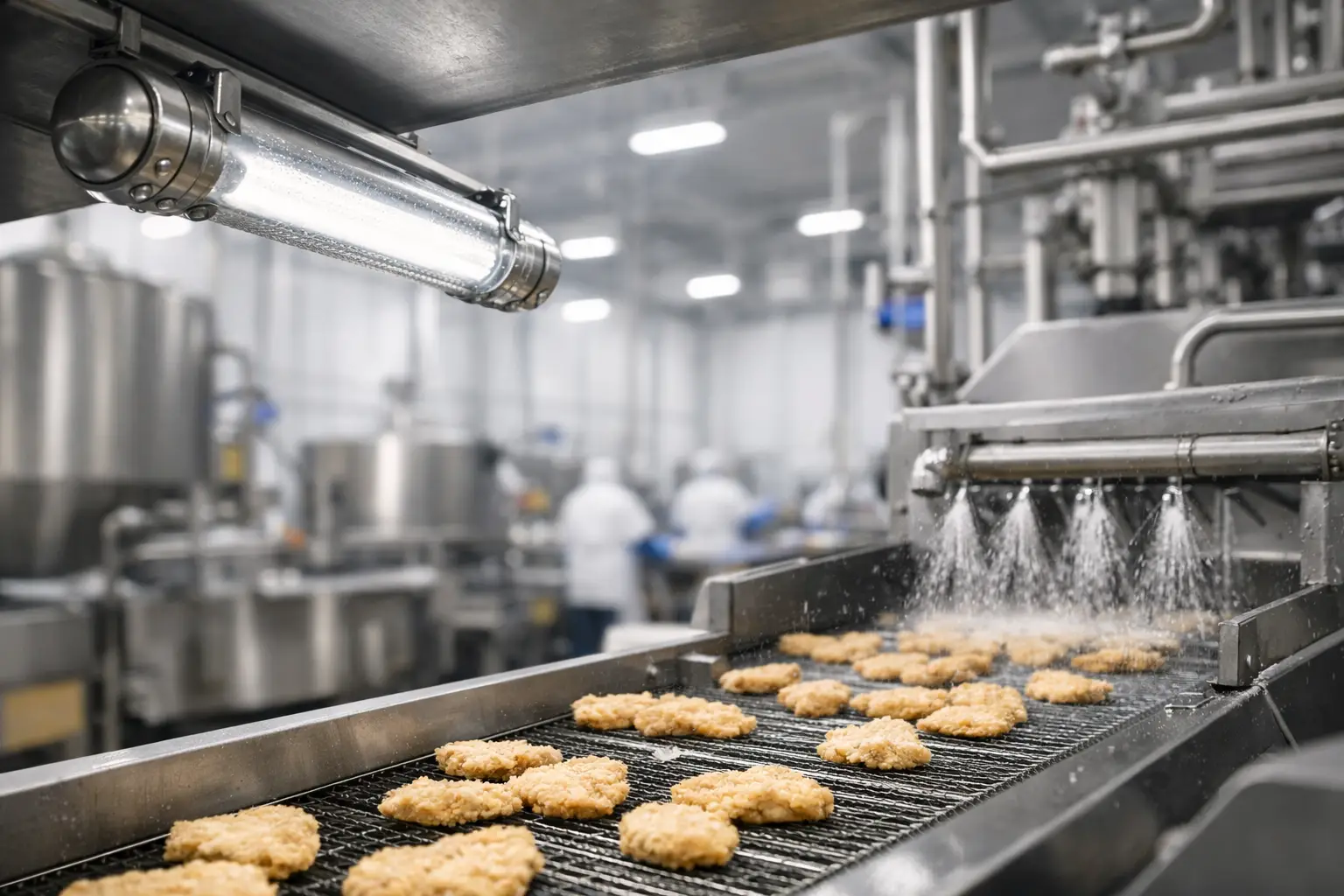
A daily sanitation cycle can be harder on a light fixture than years of normal industrial service. High-pressure spray, elevated water temperature, foam, chemical residue, and repeated thermal cycling expose every gasket, lens, cable entry, and housing seam. IP69K lighting for food processing is designed for that reality, helping plants protect visibility, reduce fixture-related maintenance, and support hygienic operations in areas that cannot tolerate water intrusion or difficult-to-clean equipment.
For fixture selection, application review, and specification documentation, Maes Lighting can help teams evaluate food processing lighting for washdown zones, cold rooms, packaging lines, and other sanitary production areas. The right fixture is not simply the highest IP rating on a cut sheet. It must also fit the washdown method, chemical exposure, mounting arrangement, ambient temperature, and any required NSF, electrical, or hazardous-location classification.
What IP69K Means in a Food Plant
IP ratings define a fixture enclosure's resistance to ingress from solids and water. The first digit addresses protection against solid objects and dust. The second digit addresses water exposure. An IP69K rating represents the highest standard water-ingress designation commonly specified for industrial equipment subject to intensive washdown.
The rating is associated with testing that uses close-range, high-pressure, high-temperature water jets directed at the enclosure from multiple angles. For food and beverage operations, that matters because routine cleaning is often far more severe than rainfall, incidental splashing, or standard hose-down exposure. A fixture that performs well in a warehouse may fail prematurely when exposed to a daily sanitation program.
IP69K does not mean every product is appropriate for every food processing area. It confirms performance against a specific ingress test, not broad suitability for all chemicals, temperatures, mounting conditions, or regulatory requirements. Housing material, lens construction, gasket chemistry, cable glands, and installation details still determine whether the complete lighting system will hold up in service.
Why Washdown Lighting Fails
Most washdown-related fixture failures begin at a point that appears minor during installation. A damaged gasket, loose conduit connection, incompatible cord grip, cracked polycarbonate lens, or poorly sealed mounting penetration can provide a path for moisture. Once moisture reaches drivers, terminals, or internal electronics, light output may become intermittent before the fixture fails completely.
Chemical exposure can accelerate the problem. Chlorinated cleaners, caustic compounds, acids, and sanitizers can affect painted finishes, elastomer seals, plastics, and metal hardware differently. Stainless steel construction may be preferred in aggressive or hygiene-sensitive areas, but even stainless selection requires care. Grade, finish, fasteners, weld quality, and exposure duration all affect long-term corrosion resistance.
Thermal conditions add another layer. Cold storage rooms, blast chillers, cook lines, and washdown cycles can expose luminaires to fast temperature changes. Materials expand and contract at different rates. Over time, that cycling can stress seals and lenses, especially where a fixture is mounted near steam, hot equipment, or refrigeration discharge.
Selecting IP69K Lighting for Food Processing
The selection process should start with the actual environment rather than a product category. A packaging room with occasional rinse-down has different requirements than a raw protein processing area receiving high-pressure sanitation every night. Likewise, a fixture above an open process line may require more attention to cleanability and material suitability than a fixture installed in an adjacent corridor.
Match the Fixture to the Sanitation Method
Ask how the fixture will be cleaned, how often, and from what distance. Confirm water pressure, water temperature, cleaning agents, dwell time, and whether personnel direct spray at ceiling-mounted equipment. These details help determine whether IP69K is necessary, or whether an IP66 or IP67 vapor-tight fixture may be sufficient in a lower-exposure location.
Over-specifying every area can increase capital cost without improving plant performance. Under-specifying fixtures in direct washdown zones creates the more expensive outcome: repeated replacements, unplanned maintenance, sanitation concerns, and possible production disruption. The useful approach is to divide the facility into exposure zones and select accordingly.
Review Hygienic Design, Not Just Ingress Rating
A food-safe lighting installation should minimize places where residue can collect. Smooth external surfaces, enclosed housings, sealed lenses, and cleanable mounting geometry support sanitation work. Fixtures with deep fins, exposed hardware, sharp ledges, or inaccessible cavities may be harder to maintain even when their ingress rating is high.
NSF-related requirements may also influence the specification. NSF listing or certification can be relevant where a facility, customer standard, or project specification requires equipment suited to food-zone or splash-zone conditions. The applicable requirement depends on the process area and the governing standard, so project teams should verify the exact listing needed rather than treating the term NSF as a universal approval.
Confirm Light Levels and Optical Control
Washdown durability does not replace a lighting design. Processing, inspection, sanitation, maintenance, and packaging tasks require different illuminance levels and glare control. High-output LED fixtures can reduce fixture count, but poor distribution can leave shadows around conveyors, vats, machinery, and work surfaces.
Photometric files allow engineers and contractors to verify light levels before installation. They are particularly useful in facilities with low ceilings, dense equipment layouts, reflective stainless surfaces, or areas where fixtures must be positioned around sprinkler heads, ductwork, and overhead utilities. A well-selected luminaire should provide usable light where work occurs while avoiding unnecessary glare for operators looking up from a line.
Construction Details That Deserve Attention
For a washdown fixture, the housing is only one part of the system. Examine the complete assembly and the way it will be installed. Stainless steel housings and hardware can be appropriate for severe wet environments, while corrosion-resistant aluminum or engineered polymer housings may be suitable in other zones. The correct choice depends on chemical exposure, mechanical impact risk, temperature, and the site's sanitation procedures.
Lens material is equally consequential. Polycarbonate offers strong impact resistance but may not be ideal for every chemical environment. Tempered glass may provide different advantages in certain applications, provided the fixture design and plant policy permit its use. Review manufacturer chemical-compatibility guidance whenever cleaning compounds are known.
Cable entry is another common weak point. Use rated conduit hubs, cord grips, glands, and fittings that preserve enclosure integrity. Field modifications should be limited and controlled. Drilling a housing, substituting a fitting, or using an unapproved plug can compromise the rating that justified the fixture selection in the first place.
IP69K Is Not a Hazardous-Location Classification
Food plants can contain conditions that require more than washdown protection. Flour, sugar, starch, grain dust, alcohol vapors, solvents, hydrogen, methane, or refrigerant systems may create hazardous-location considerations in specific areas. IP69K describes enclosure protection from water and dust ingress. It does not make a luminaire explosion-proof or suitable for a classified hazardous location.
If an area is classified, the fixture must carry the required Class, Division, Zone, Group, temperature code, and other applicable markings. In some applications, a facility needs both high washdown resistance and hazardous-location compliance. That combination narrows the product field and should be verified before procurement, particularly when a fixture is being used near dust-producing processes or flammable materials.
Documentation Supports Faster Project Approval
Industrial lighting projects often slow down because documentation arrives late or does not match the fixture being quoted. For food processing applications, electrical contractors, engineers, and plant teams may need datasheets, dimensional drawings, photometric files, ingress ratings, NSF documentation where applicable, and hazardous-location certificates for classified areas.
Request these materials during the selection stage, not after fixtures are released. This gives the design team time to confirm mounting, voltage, lumen output, color temperature, emergency requirements, and compliance markings. It also reduces the risk of approving a fixture that is technically acceptable on paper but impractical to install or maintain in the field.
Plan for Maintenance Before Installation
LED lighting reduces relamping, but it does not eliminate maintenance planning. Fixtures should be accessible for inspection without creating unsafe work conditions or interfering with sanitation operations. Consider mounting height, lift access, cable routing, spare-fixture strategy, and whether the fixture can be replaced without modifying surrounding conduit or supports.
A consistent fixture family can simplify spare parts, training, and maintenance procedures across a facility. However, standardization should not force one fixture into every room. The most effective approach is usually a coordinated set of fixtures: high-pressure washdown luminaires in severe zones, vapor-tight products in moderate moisture areas, and appropriate industrial fixtures in dry support spaces.
The best time to prevent lighting failures is before the fixture reaches the ceiling. Define the cleaning exposure, verify the required ratings and documentation, and make installation details part of the specification. That work helps turn a washdown lighting purchase into a longer-lasting facility decision.