
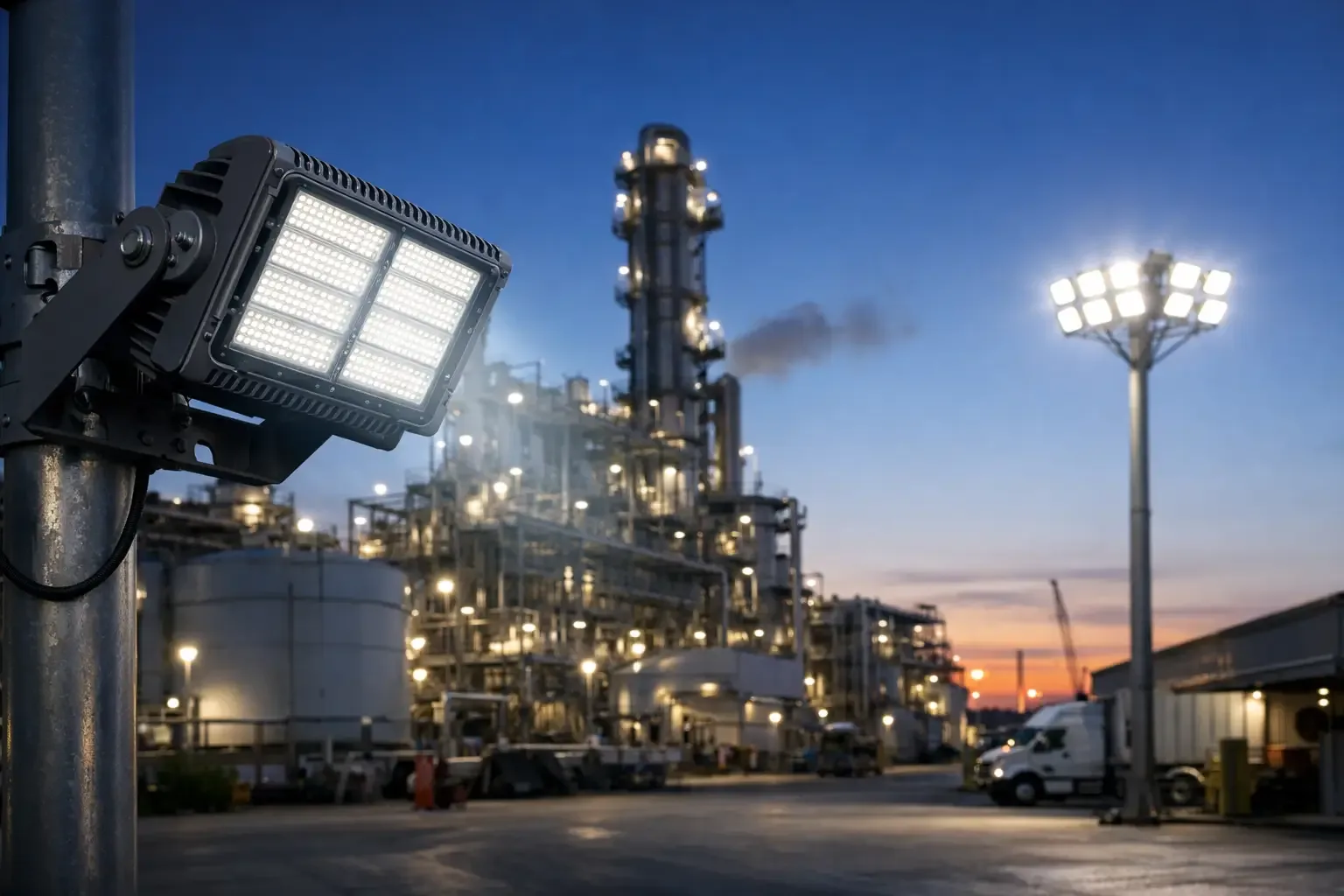
A floodlight mounted 40 feet above a loading rack, tank farm, shipyard berth, or rail yard has one job: put usable light on the work area when conditions are at their worst. LED flood lights can reduce energy use and relamping demands, but those benefits only matter when the fixture survives its environment, controls glare, and meets the site’s electrical and safety requirements. For industrial facilities, selecting a floodlight is not simply a wattage comparison. It is an application, classification, mounting, and documentation decision.
For a project-specific review of LED flood lights, contact Maes Lighting with the mounting height, target area, operating conditions, voltage, and any required certifications. A technical review before ordering can identify whether a standard industrial floodlight, vapor-tight luminaire, marine-rated fixture, or explosion-proof solution is appropriate for the location.
Start With the Operating Environment
The first selection question is not, “How many lumens do we need?” It is, “What will the fixture be exposed to?” A floodlight installed above a warehouse loading dock faces different risks than one aimed at a refinery process area or a food-processing yard.
Outdoor industrial fixtures may be exposed to rain, wind-driven dust, UV, vibration, salt spray, chemical vapors, temperature swings, and frequent switching. A fixture that performs well in a covered distribution area may fail prematurely when installed near a coastal terminal, a washdown zone, or a corrosive process. Housing material, gasket design, lens construction, finish, cable entry, and mounting hardware all affect service life.
Ingress protection is a practical starting point. An IP65-rated fixture provides protection against dust and water jets, while higher protection levels may be appropriate where water exposure is more severe. The rating should match actual site conditions rather than a generic preference for the highest number. A high IP rating does not replace the need for chemical compatibility, corrosion resistance, or a suitable temperature rating.
Ambient temperature deserves the same attention. High-heat manufacturing, steel processing, and certain outdoor locations can push fixture components beyond their rated operating range. Cold storage and northern outdoor applications introduce the opposite concern: drivers, gaskets, and optics must continue operating reliably at low temperatures. Verify the fixture’s published ambient range, not just its LED efficacy at laboratory conditions.
When LED Flood Lights Need Hazardous-Location Ratings
Hazardous locations require a different level of review. If flammable gas, vapor, combustible dust, or ignitable fibers may be present, the area classification determines whether a conventional floodlight is permissible. A fixture described as weatherproof, rugged, or industrial-grade is not automatically suitable for a classified location.
The project team should confirm the applicable Class, Division or Zone designation, gas group or dust group, temperature code, and governing installation standard. The fixture certification must align with the classification identified for the exact installation area. Mounting a non-rated floodlight just outside a process unit does not solve the issue if the actual classified boundary includes that location.
Explosion-proof lighting is often specified where an enclosure must contain an internal ignition event and prevent ignition of the surrounding atmosphere. The term should not be used loosely. For a facility owner, contractor, or engineer, the important documentation is the fixture’s actual listing, marked ratings, installation instructions, and temperature limitations.
Where Buy America Act requirements apply, make that requirement part of the specification review early. The Explosion Proof IR1, IR3, IR4, and IR7 series of lights, along with CIT models in the vapor-tight product line, are covered under the Buy America Act. Procurement teams should still request the current supporting documentation for the specific model and project, particularly when a public infrastructure, federally funded, or contract-specific sourcing requirement is involved.
Light Levels Alone Do Not Define Performance
A high-lumen floodlight can still produce a poor result. The useful question is how much light reaches the task plane, how evenly it is distributed, and whether the beam creates glare for drivers, operators, security personnel, or neighboring properties.
Mounting height, setback distance, aiming angle, and optical distribution work together. A narrow distribution may provide strong reach across a rail spur or vessel deck, but it can create hot spots if used over a broad loading area. A wider distribution may improve uniformity at lower mounting heights but may not carry far enough for perimeter or yard coverage. The appropriate answer depends on the geometry of the site.
Photometric files and a lighting layout are especially valuable for large yards, truck courts, tank farms, fabrication areas, and exterior work zones. They allow the design team to evaluate maintained foot-candle levels, uniformity, spill light, and glare before fixtures are installed. This is more reliable than replacing an existing HID floodlight with an LED model based only on nominal wattage or lumen output.
Color temperature should be selected for visibility and operating needs. Many industrial exterior projects use neutral-to-cool white light to support task visibility and security-camera performance. However, a cooler color temperature is not automatically better. Consider worker comfort, nearby residential exposure, camera requirements, and the visual character of the work area.
Do Not Ignore Glare and Aiming
Floodlights are directional by design, which makes aiming a field-critical step. A fixture can meet the photometric plan on paper but perform poorly if it is tilted incorrectly, mounted at a different elevation, or blocked by structural steel, piping, or equipment. Adjustable brackets should be secured after final aiming, and installers should follow the manufacturer’s mounting limitations.
Glare control may require a different optic, a visor, shielding, a revised pole location, or more fixtures operating at lower output rather than fewer high-output fixtures. This trade-off is common at vehicle entrances, crane operations, waterfront facilities, and elevated work areas where direct view of the luminaire cannot be avoided.
Electrical and Mechanical Details That Affect Uptime
Driver performance matters as much as LED output. Industrial sites may experience voltage fluctuations, frequent switching, electrical noise, or power disturbances. Confirm input-voltage compatibility, surge-protection provisions, dimming or control requirements, and expected driver serviceability before standardizing on a fixture.
Surge protection is particularly relevant for pole-mounted exterior lighting and sites with exposed electrical infrastructure. A lightning event or switching transient can damage electronics even when the fixture housing remains intact. Evaluate the site’s overall surge strategy, including panel-level protection and grounding, rather than treating the luminaire’s internal protection as the only safeguard.
Mounting is another frequent source of premature failure. A floodlight bracket suitable for a wall may not be adequate for a vibrating catwalk, marine structure, high-mast pole, or equipment rack. Consider wind loading, vibration, fastener material, adjustment range, access for maintenance, and the risk of corrosion at dissimilar-metal connections.
Controls can reduce operating hours and energy consumption, but they should support the operational schedule. Photocells, occupancy sensors, timers, and networked controls may be useful for low-traffic yards and perimeter areas. Continuous-process facilities, safety egress routes, and active loading zones may require a more conservative control approach. Controls should never compromise required illumination when people, vehicles, or emergency response activity are present.
Specify Documentation Before It Becomes a Delay
Industrial lighting projects often stall at submittal, not installation. A fixture may appear to fit the application until the engineer requests photometrics, certification records, dimensional drawings, wiring information, environmental ratings, or confirmation of country-of-origin requirements.
Build documentation into the selection process. For each proposed fixture, the project file should identify the model number, voltage, mounting method, lumen package, optic, finish, environmental rating, hazardous-location certification where applicable, and available photometric data. If the project has Buy America Act, marine, food-safety, washdown, or temperature requirements, document the relevant compliance information alongside the fixture selection.
This preparation protects the contractor from late substitutions and helps maintenance teams obtain the correct replacement parts or additional fixtures later. It also creates a clearer record of why the luminaire was selected for a particular area.
A Better Way to Plan a Floodlighting Upgrade
The most reliable LED floodlighting projects begin with site information, not a catalog search. Identify what workers need to see, where the fixtures will be mounted, what environmental conditions exist, and which codes or owner specifications apply. Then compare optical performance, certification, construction, and maintenance access as a complete package.
The lowest initial fixture price may be reasonable for a protected, noncritical area. In a corrosive yard, hazardous process zone, washdown environment, or high-access-cost location, the better value is usually the fixture that fits the application the first time. Choosing the right light before installation is one of the simplest ways to protect uptime, safety, and the project schedule.