
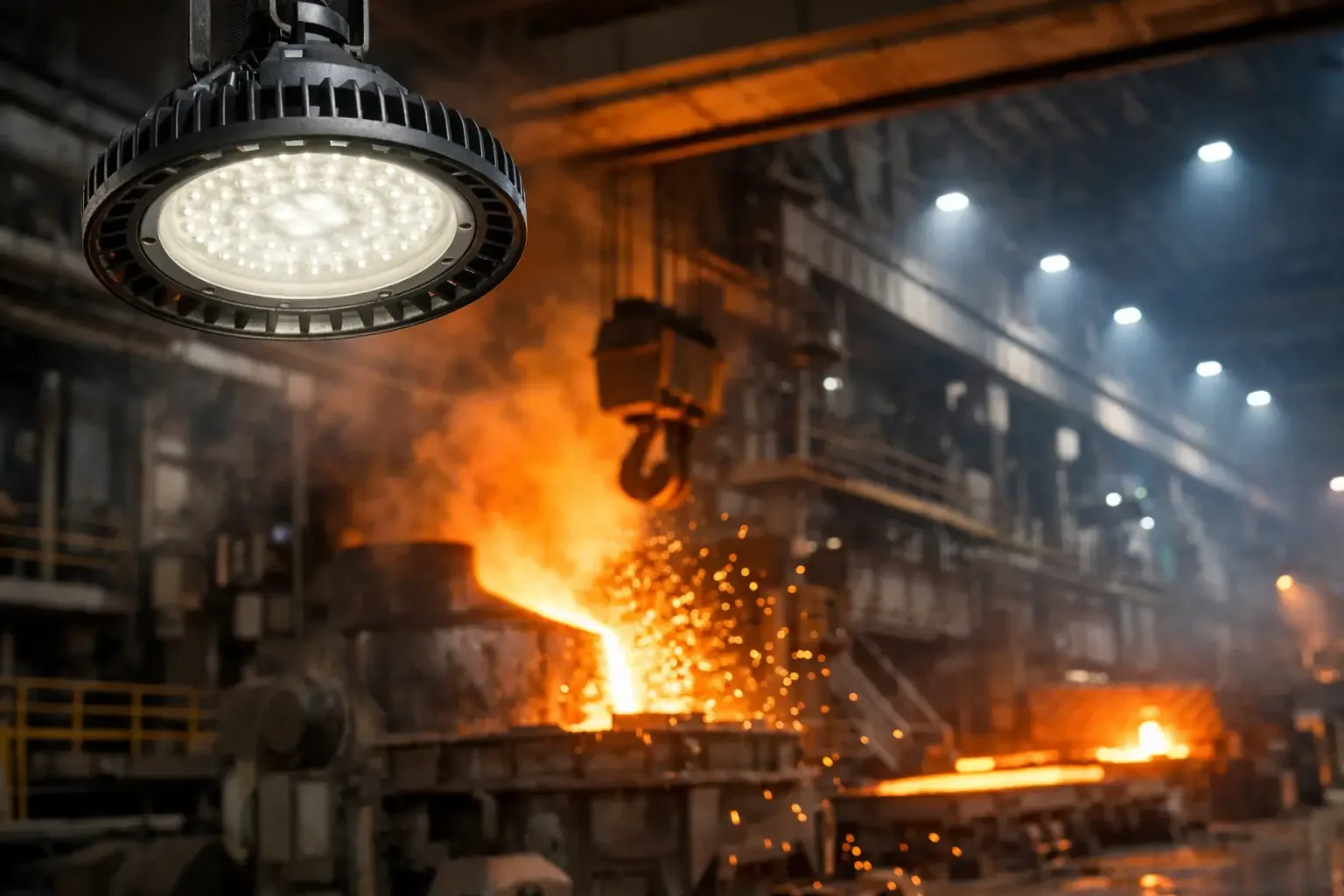
A steel mill can turn an ordinary lighting fixture into a maintenance problem quickly. Furnace heat, scale dust, hydraulic oil mist, vibration, crane movement, steam, and airborne particulates all affect fixture life and light output. Effective LED lighting for steel mills starts with the operating area, not a generic wattage replacement. The fixture installed above a casting line may need a very different thermal, ingress-protection, optical, and electrical specification than the fixture used in a maintenance bay or finished-goods warehouse.
For a steel-mill lighting review, work with Maes Lighting to match industrial LED high bays, floodlights, vapor-tight fixtures, high-temperature lighting, or hazardous-location equipment to documented site conditions. A proper review can identify the required mounting height, ambient temperature, beam distribution, voltage, controls, and certifications before fixtures reach the jobsite. That support is especially useful when a project requires datasheets, photometric files, certificates, and submittal-ready documentation.
Start With the Steel-Mill Environment
Steel production is not one lighting environment. A facility may include scrap handling, melt shops, ladle treatment areas, continuous casting lines, rolling mills, pickling lines, fabrication cells, electrical rooms, shipping bays, and outdoor yards. Each area presents a different combination of heat, contamination, moisture, impact risk, and visibility requirements.
Near furnaces, ladles, reheating operations, or hot rolling equipment, ambient temperature is only part of the concern. A fixture can be exposed to radiant heat from hot product even when the surrounding air is within its published operating range. Mounting location, shielding, distance from the process, and airflow matter. Specifying a standard high bay simply because its listed ambient rating appears adequate can lead to premature driver failure, color shift, or lumen depreciation.
In other areas, dust and contamination drive the selection. Fine metallic dust, scale, and process debris can coat lenses and heat sinks, reducing output and trapping heat. Where moisture, oil mist, or washdown are present, a vapor-tight fixture or a fixture with an appropriate ingress-protection rating may be a better fit than an open industrial high bay. The goal is not to select the highest rating everywhere. It is to select a rating that matches the actual exposure and maintenance plan.
High-Temperature LED Lighting Near Hot Processes
High-temperature LED lighting is often necessary around furnaces, heat-treatment equipment, casting operations, and reheating lines. The fixture must be evaluated for its maximum ambient temperature rating, but that number should not be treated as the whole answer. Confirm the actual temperature at fixture elevation during production, not just at floor level or during a shutdown.
Radiant heat, reflected heat from structural steel, and heat accumulation beneath roof decks can create conditions that differ substantially from the room's average temperature. Fixture placement may need to move farther from the heat source, use a different mounting orientation, or incorporate a remote driver arrangement where appropriate. A higher-rated fixture may cost more upfront, but repeated replacement in an inaccessible crane bay or above active production costs far more in labor, lift access, downtime, and safety exposure.
Thermal performance also affects output. LED fixtures produce less heat than legacy HID systems, but they still rely on drivers and heat-management components that must operate within their rated limits. In hot areas, verify published lumen maintenance and output at the expected operating temperature rather than assuming catalog lumens will be available on the floor.
Use Optics to Put Light Where Operators Need It
Steel facilities frequently have high mounting heights, narrow production aisles, tall equipment, overhead cranes, and deep shadows around machinery. A lighting plan should address horizontal and vertical illuminance, glare, and shadowing instead of relying only on average foot-candle targets.
A wide-distribution high bay can work well in an open maintenance or warehouse area, while a narrower distribution may be necessary for tall-bay mounting or long aisles. Floodlights can provide targeted illumination at crane approaches, loading areas, exterior yards, and process equipment. Their aiming should be coordinated carefully. Poorly aimed high-output fixtures can create glare on control screens, reflective metal surfaces, or the line of sight used by crane and mobile-equipment operators.
Color temperature is another practical choice. Many industrial projects use neutral-to-cool white light to improve visual task performance and the perception of brightness. However, the preferred color temperature depends on the task, existing facility standards, and the amount of reflective dust or smoke in the space. Photometric analysis is the right way to determine fixture quantity, mounting position, beam angle, and expected light levels at critical work planes.
Hazardous Locations Require a Separate Decision
Not every steel-mill area is a hazardous location, and not every durable industrial fixture is suitable for classified space. Where flammable gases, vapors, combustible dusts, or ignitable fibers may be present, the area classification must be established by the responsible facility and engineering team. That classification determines whether explosion-proof or other hazardous-location-rated lighting is required.
The term explosion-proof is often used broadly, but fixture selection must follow the actual Class, Division or Zone, Group, temperature code, and installation requirements. A fixture's hazardous-location marking must correspond to the conditions of the area. It is not enough for a product to be described as industrial-grade, sealed, or weatherproof.
Steel operations can also involve adjacent processes, coating materials, solvents, gas systems, dust collection equipment, and enclosed handling areas that change the risk profile. When the classification is unclear, treat it as a design and compliance question, not a product preference. Review the site conditions with the authority having jurisdiction and the project engineer before finalizing the fixture schedule.
Specify for Vibration, Maintenance, and Access
Rolling operations, conveyors, stamping, material handling, and overhead cranes create vibration that can loosen mounts, damage connections, or shorten component life. Fixtures for these locations should have mounting hardware and construction appropriate for vibration exposure. The installation method matters as much as the fixture housing. A well-rated luminaire can still fail early if it is mounted to a structure that transfers excessive vibration or if conductors and connectors are not properly supported.
Maintenance access should shape the specification. A fixture over a production line may require a crane outage, lift equipment, lockout procedures, and coordination with operations before it can be serviced. In those locations, long service life, serviceable components where appropriate, surge protection, and a dependable warranty have direct operational value.
LED retrofits can reduce relamping compared with metal halide or high-pressure sodium systems, but the savings depend on the existing operating hours, utility rate, control strategy, and the quality of the replacement design. Reducing fixture count too aggressively can lower energy use while introducing shadows and uneven light. The right project balances energy reduction with visibility, reliability, and safe work conditions.
Documentation Keeps the Project Moving
Steel-mill upgrades often move through engineering, safety, maintenance, procurement, and contractor review. The lighting package should provide clear fixture specifications, dimensional information, mounting details, electrical data, photometric files, and applicable certifications. For hazardous or high-temperature applications, the documentation must make the rating and limitations easy to verify.
Voltage deserves early attention as well. Industrial facilities may use 120-277V, 347-480V, or other site-specific systems. Confirm voltage, frequency, branch-circuit protection, and any control compatibility before ordering. If occupancy sensors, daylight controls, or networked controls are planned, assess whether they can perform reliably in the heat, dust, vibration, and line-of-sight conditions of the area.
A better steel-mill lighting project is rarely the one with the lowest fixture price. It is the one that gives operators useful light, gives maintenance fewer failures to chase, and gives the project team documentation they can approve with confidence.