
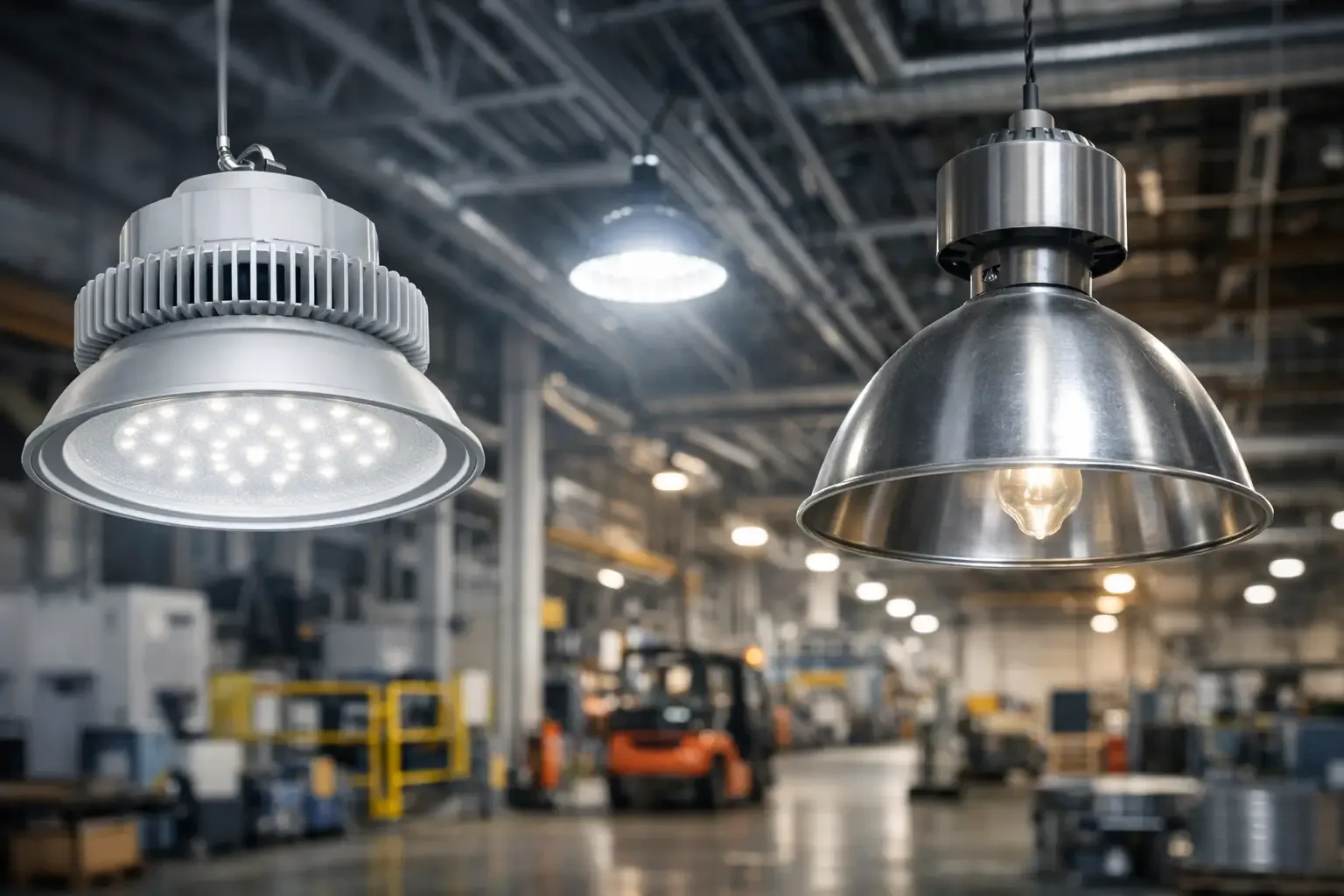
A failed metal halide fixture above a production line is rarely just a lighting problem. It can create a dark work zone, require lift access during a shift, delay maintenance work, and expose the facility to recurring ballast and source failures. An LED metal halide replacement can reduce those service events substantially, but only when the new fixture is selected around the actual environment, mounting height, optical requirement, and electrical classification.
For a fixture review, photometric support, and submittal-ready documentation, contact Maes Lighting with the existing fixture details, mounting height, ambient conditions, and site classification. Industrial LED high bays, floodlights, vapor-tight fixtures, and hazardous-location luminaires are not interchangeable, even when they appear to offer similar lumen packages.
Why LED metal halide conversions need an application review
Metal halide systems were widely installed because they delivered high output for warehouses, fabrication areas, exterior yards, steel facilities, and process spaces. Their limitations become expensive over time: output depreciates, color consistency can shift, restrike after an interruption may be slow, and the system depends on components that age differently. The result is often uneven illumination and a maintenance schedule driven by failures rather than planned upgrades.
LED fixtures address many of these issues through longer useful life, instant restart, tighter optical control, and lower power demand for comparable task illumination. But a watt-for-watt swap is not a sound industrial specification. A 400-watt metal halide fixture does not automatically call for one fixed LED wattage. The right replacement depends on delivered lumens, fixture efficiency, beam distribution, spacing, surface reflectance, dirt accumulation, and the maintained foot-candle level required at the task plane.
The distinction matters most in demanding facilities. A standard high bay may work well in a dry distribution center, yet fail prematurely near furnace heat, chemical vapor, washdown exposure, vibration, or classified gases and dusts. The fixture must be designed for the hazard, not simply bright enough on day one.
Start with maintained illumination, not nameplate watts
The most reliable LED metal halide conversion begins with the existing layout. Record mounting height, row spacing, fixture locations, voltage, controls, and the type of work performed below the fixtures. A photometric layout should evaluate average light levels, minimums, uniformity, glare, and shadows around equipment, racks, catwalks, and access points.
For example, a narrow-aisle warehouse may need a different optic than an open fabrication bay at the same mounting height. A flood optic that produces useful coverage in an exterior loading area can create wasted light and glare when installed over a high indoor ceiling. Higher-output LED fixtures are not automatically better if their distribution pushes light beyond the work area or creates sharp contrast.
Also separate initial output from maintained output. The objective is not to match a new metal halide fixture at commissioning. It is to provide usable illumination through the planned service interval while accounting for lumen maintenance and the site’s light-loss factors. Dust, vapor, lens contamination, high ambient temperature, and limited cleaning access all affect the result.
Confirm electrical and control compatibility
Existing metal halide systems may operate at 120V, 277V, 347V, 480V, or a multi-volt range. Verify the branch circuit, surge environment, emergency-power arrangement, and any occupancy, photocell, or networked control requirements before specifying a replacement.
Controls can increase energy savings, but they must suit operations. Occupancy sensing may be appropriate in intermittent warehouse aisles but problematic over active production lines where personnel and machinery need continuous visibility. In some areas, a simpler switched fixture with an appropriate driver and surge protection is the more dependable choice.
Hazardous locations require a rated fixture, not a retrofit assumption
In oil and gas, refining, chemical processing, grain handling, and similar operations, a general-purpose LED replacement cannot be treated as an explosion-proof solution. The area classification drives the fixture requirement. Under the NEC Division system, Class I addresses flammable gases or vapors, while Class II addresses combustible dust. Division 1 identifies locations where the hazard may exist under normal operating conditions; Division 2 generally covers locations where it is present only under abnormal conditions.
The Zone system uses a different framework, commonly involving Zones 0, 1, and 2 for gas atmospheres and Zones 20, 21, and 22 for combustible dust. A project specification may also require particular protection methods, such as Ex d flameproof, Ex e increased safety, or Ex i intrinsic safety. These designations are not marketing language. They define the equipment and installation approach needed for the classified area.
Do not attempt to convert a non-rated metal halide fixture in a hazardous location with an LED retrofit and assume the installation remains compliant. Select a complete fixture listed and marked for the exact class, division or zone, gas group or dust group, temperature code, ambient range, and electrical conditions. The authority having jurisdiction and the facility’s engineering standard ultimately govern acceptance.
For projects subject to domestic-content requirements, identify compliance needs at the beginning of the submittal process. The Explosion Proof IR1, IR3, IR4, and IR7 series, along with CIT models in the vapor-tight fixture range, are available for Buy America Act-focused applications where the specified configuration and documentation must align with project requirements.
What are the best high temperature lights for industrial use?
The best high temperature lights for industrial use are fixtures engineered and rated for the maximum ambient temperature at the installed location, not simply fixtures placed near a hot process. Kilns, furnaces, foundries, steel mills, and areas above hot equipment can expose luminaires to temperatures far beyond those found at floor level. Radiant heat, airborne scale, vibration, and restricted airflow can compound the stress on drivers, LEDs, seals, and gaskets.
Start by measuring or validating the worst-case ambient temperature at the fixture location during normal production. Then compare it with the fixture’s published ambient rating. A fixture listed for a typical industrial ambient may not be appropriate near a furnace roofline, even if it performs acceptably during a short test. Specify a purpose-built high-temperature luminaire when the environment demands it.
Thermal derating also deserves attention. LED output and driver life can decline as ambient temperature rises. A credible specification accounts for the manufacturer’s stated output, electrical performance, and operating life at the expected temperature, rather than relying solely on ratings measured under ideal laboratory conditions. Housing design, heat dissipation, driver placement, and high-temperature materials all influence long-term performance.
Match enclosure protection to contamination and cleaning practices
Many LED metal halide upgrades occur in wet, dusty, corrosive, or sanitation-sensitive areas. In these applications, fixture ingress protection and construction are as important as light output. A vapor-tight fixture may be appropriate for moisture, hose-down exposure, cold storage, or dusty utility spaces, while a marine-grade fixture may be needed where salt exposure and corrosion are persistent concerns.
Food and beverage facilities require an especially careful review. NSF/ANSI 2 generally relates to food equipment considerations, while NSF/ANSI 51 addresses materials used in food equipment and associated areas. Neither designation should be assumed to replace the need for the correct IP rating, mounting approach, cleaning-chemical compatibility, and sanitation plan. In direct or frequent washdown zones, IP66 or IP69K performance may be central to fixture selection, particularly where high-pressure cleaning can challenge seals and lenses.
A fixture that survives water exposure may still be the wrong choice if its external geometry traps residue, its lens degrades under sanitation chemicals, or its mounting creates inaccessible cleaning areas. Confirm the actual washdown method, chemical concentration, water temperature, and cleaning frequency before releasing the order.
Documentation prevents expensive rework
Industrial lighting upgrades move more efficiently when technical requirements are collected before procurement. A complete submittal package should include the product datasheet, dimensional information, mounting details, electrical data, photometric files, environmental ratings, listing certificates, and Buy America Act documentation where applicable. For hazardous locations, verify every marking against the project schedule rather than relying on a broad product-family description.
Field conditions still matter after approval. Confirm clearances, aiming, junction-box compatibility, mounting integrity, and access for future maintenance. If the project replaces metal halide fixtures in phases, consider how the old and new distributions will interact during the transition so operators are not left with uneven work areas.
The strongest LED metal halide upgrade is not the one with the lowest fixture price. It is the one that gives the facility maintained visibility, appropriate environmental protection, defensible compliance documentation, and fewer reasons to send maintenance crews back up to the ceiling.