
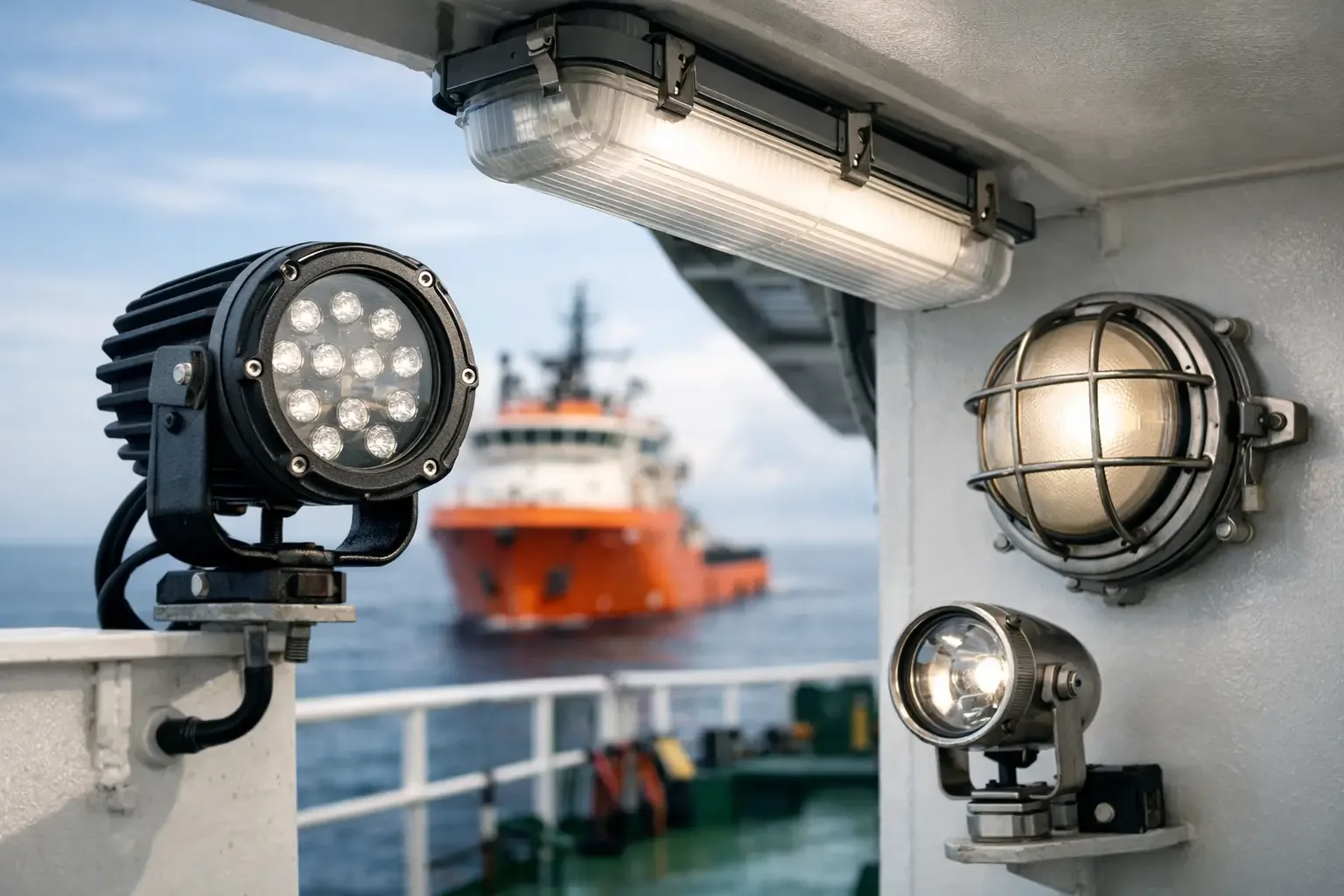
Saltwater rarely causes a lighting failure all at once. It works through cable entries, damaged lenses, unsealed driver compartments, and incompatible metals until a routine outage becomes a safety, maintenance, or inspection problem. This marine luminaire selection guide is built for the conditions that matter on working vessels and waterfront facilities: salt spray, vibration, washdown, temperature swings, fuel exposure, and areas where a fixture’s listing can be as critical as its light output.
For project-specific marine luminaires, Maes Lighting can help match fixture construction, ratings, photometrics, and documentation to the installation. Bring the vessel drawings, mounting heights, area classification details, and operating conditions into the review early. That allows the fixture package to be specified around the actual exposure rather than chosen from a general-purpose catalog after conduit, mounting, and power requirements are already set.
Start With the Exposure, Not the Wattage
A marine fixture is not simply an outdoor fixture installed near water. The operating environment changes by location, often within a few feet. An open deck may see direct spray, UV exposure, wind-driven rain, impact, and aggressive corrosion. An engine room may add elevated ambient temperature, vibration, oil mist, and potentially hazardous vapors. A galley, fish-processing area, or vessel washdown zone can require frequent sanitation and resistance to detergents.
Before comparing lumens or fixture price, define what reaches the luminaire and how often. Ask whether the location sees continuous salt fog or intermittent spray, whether crews use high-pressure washdown, whether the fixture will be mounted where it can be struck by equipment, and whether access for maintenance is limited. A fixture that performs well in a covered passageway may be the wrong choice for an exposed work deck.
Corrosion resistance is a system-level question. Housing material, lens hardware, mounting brackets, cable glands, fasteners, and coating quality all matter. Marine-grade aluminum with an appropriate protective finish is common, while stainless steel components may be necessary in particularly aggressive areas. The correct material depends on the environment and galvanic compatibility with nearby metals. Stainless steel is not automatically the answer if its hardware, mounting interface, or enclosure design introduces another failure point.
Confirm the Required Ratings and Listings
Ingress protection is central to marine luminaire selection, but an IP rating should not be treated as the entire specification. IP66, for example, addresses protection against powerful water jets and dust ingress. IP67 adds temporary immersion protection. The appropriate rating depends on installation conditions, not on a preference for the highest number available. A location exposed to washdown and direct spray may justify a higher water-ingress rating than a protected interior corridor.
The fixture also needs the right electrical safety listing for the jurisdiction and project. For U.S. and Canadian projects, electrical contractors, owners, and inspectors commonly require recognized third-party certification and documentation suitable for the installation. Review the product datasheet and certification marking rather than relying on a broad product description.
Hazardous-location requirements are separate from corrosion and water resistance. Where flammable gases, vapors, combustible dust, or fuel-handling operations create a classified area, specify an explosion-proof or hazardous-location-rated fixture that matches the applicable class, division or zone, group, temperature code, and ambient range. A vapor-tight fixture may resist moisture very well but is not a substitute for hazardous-location equipment. Conversely, an explosion-proof fixture must still be evaluated for the marine exposure, mounting location, and cleaning process.
Match ambient temperature to the real installation
Engine rooms, machinery spaces, and enclosed service areas can run hotter than design assumptions suggest. LED fixtures are efficient, but their drivers and optical components still have operating limits. Verify both the ambient temperature rating and any derating conditions. Heat, vibration, and restricted airflow can shorten driver life long before the LEDs appear to have a problem.
Cold exposure also deserves attention on vessels operating in northern routes or on refrigerated marine facilities. Lens impact performance, gasket flexibility, startup behavior, and driver ratings can change at low temperatures. The specification should cover the full expected temperature range, including startup after the equipment has been cold-soaked.
Choose Optics for the Task, Not Maximum Lumen Output
Deck operations, walkways, ladders, loading zones, engine rooms, and exterior access points need usable light at the work surface. More lumens do not necessarily produce safer conditions. Excess output can create glare on wet deck surfaces, wash out contrast, interfere with visibility toward the water, or cause uncomfortable reflections from painted bulkheads and polished equipment.
Use mounting height, spacing, beam distribution, and target foot-candle levels to develop the layout. Floodlights may suit loading or exterior work zones, while linear vapor-tight luminaires often fit passages, machinery spaces, and service areas. Bulkhead-style fixtures can be practical in compact access areas where impact resistance and low profile are priorities. For navigation-sensitive applications, confirm the required color and placement rules with the vessel authority or project engineer rather than treating general white lighting as a universal solution.
Photometric files are especially useful where decks have uneven geometry, cranes, railings, hatches, or obstructions. They help identify dark areas and glare risks before installation. A lighting calculation is more valuable than an assumed one-for-one replacement when fixture locations, mounting heights, or optics are changing.
Plan for Installation and Maintenance Access
The fixture must work with the vessel’s electrical infrastructure. Confirm voltage, frequency, driver type, surge protection, emergency-power requirements, and wiring method. Marine electrical systems may have conditions that differ from land-based commercial installations, so verify compatibility with the project electrical design rather than assuming a standard driver configuration will fit.
Cable entries deserve close attention. A high-rated enclosure can be compromised by an incorrect gland, poor conduit termination, damaged sealing washer, or incompatible cable diameter. Specify the complete connection method, including glands, plugs, junction boxes, and mounting accessories where applicable. In exposed locations, aim for cable routing that avoids standing water, abrasion, and strain at the entry point.
Maintenance is another design input. A fixture mounted above machinery, over water, or behind guarded equipment needs a longer service interval and practical access. LED reduces relamping labor, but it does not eliminate the need to inspect lenses, gaskets, mounts, and connections. Standardizing compatible fixture families across similar areas can simplify spares, training, and replacement planning.
Document the Submittal Before Ordering
Marine projects move more smoothly when compliance questions are resolved before material reaches the dock or jobsite. A complete submittal package should identify fixture model numbers, electrical characteristics, ingress ratings, environmental limits, certifications, dimensional drawings, mounting details, and photometric information when required. If the application involves hazardous locations, include the relevant classification markings and temperature information.
Procurement requirements may add another layer. For projects requiring Buy America Act coverage, identify qualifying products and supporting documentation during specification, not after a purchase order is issued. Maes Lighting identifies the Explosion Proof IR1, IR3, IR4, and IR7 series, along with CIT models within the vapor-tight product line, as products covered under the Buy America Act. Confirm the exact model, configuration, and project requirement with the submittal documentation, since compliance language and eligibility can depend on the procurement program and requested fixture build.
Common Selection Errors to Avoid
The most expensive marine lighting mistakes are usually specification mismatches. Selecting solely by wattage can leave work surfaces underlit or create glare. Treating IP rating as proof of hazardous-location suitability can create a code issue. Ignoring ambient temperature, vibration, or cable-entry details can turn a well-rated fixture into a premature maintenance item.
Another frequent issue is using a corrosion-resistant housing while overlooking brackets and fasteners. The mounting assembly must be appropriate for the same exposure as the luminaire. Review the full installed assembly, including aiming hardware for floodlights and any external junction boxes.
A well-selected marine lighting package protects more than the fixture budget. It supports safer movement, clearer task visibility, fewer maintenance interruptions, and a cleaner path through submittal review. When operating conditions are unclear, document the exposure and installation details first, then select the luminaire around those facts.