
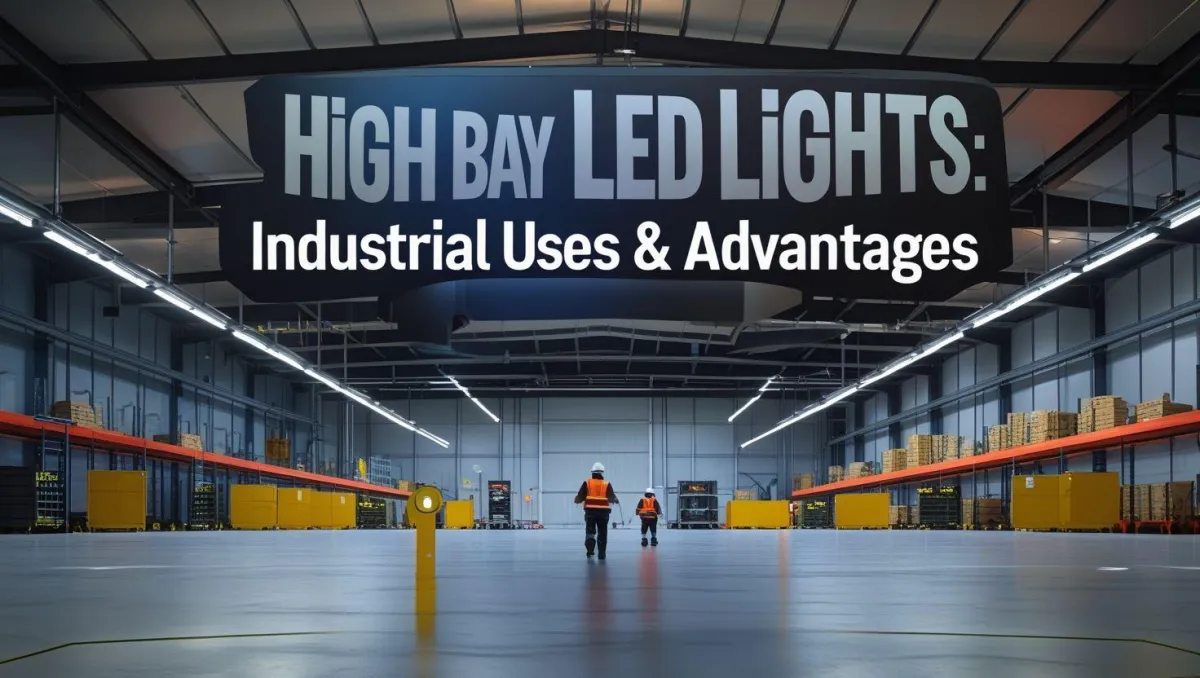
High bay LED lights are built for one specific problem: getting even, usable light down from a ceiling that is too high for standard fixtures to cover well. Warehouses, manufacturing floors, distribution centers and gymnasiums typically run ceilings in the range of 15 to 40 feet, and a fixture mounted that far above the work plane has to deliver enough lumens and the right beam spread to reach it without creating hot spots or dark aisles. This guide covers what high bay LED lighting is, where it fits across industrial applications, and what separates the format options from one another.
What counts as a high bay fixture?
High bay LED lights are designed for spaces with ceilings roughly 20 feet or higher — warehouses, factories, and gymnasiums are the common examples — where the fixture needs to throw light efficiently over a long mounting distance. Maes Lighting's high bay range covers two basic formats: UFO-style round fixtures and linear fixtures, each suited to a different aisle and beam-spread requirement. The high bay lighting category page carries the full family comparison; a few examples illustrate the range. The LS-5EHB UFO high bay is documented at 100–240 W with a 120° wide beam and up to 43,200 lumens. The EDGE Series modular linear high bay spans 120–600 W with optics from a narrow 22° up to a 60×100° aisle distribution, built for warehouses, plants and tall storage aisles. The K5 High Lumen linear high bay is documented at up to 152 lm/W efficacy — a useful number when comparing fixtures on efficiency rather than wattage alone.
Industrial applications of high bay LED lights
High bay LEDs are versatile, meeting the lighting needs of several distinct industrial settings.
Warehouses and distribution centers
Warehouses need bright, uniform lighting for picking, packing and forklift operation across long aisles. A linear high bay's directional optics — the 40×100° and 60×100° aisle distributions documented on the EDGE Series, for example — are built specifically for racked storage rather than open floor space, where a round UFO fixture's wide beam is often the better fit.
Manufacturing facilities
On a production line, high bay LEDs illuminate detailed tasks and inspection points where shadows and uneven light slow work down. Fixtures documented at higher IP ratings — IP54 or IP65 in Maes Lighting's line-up — hold up better in a floor with dust or occasional washdown than a standard open fixture.
Gymnasiums and large indoor spaces
Gymnasiums, aircraft hangars and other large indoor volumes call for the same wide, glare-controlled distribution as a warehouse but with more attention to uniformity at eye level, since the space is occupied rather than just trafficked by equipment. A round UFO high bay's wide beam angle generally suits this kind of open floor better than a narrow-optic linear fixture aimed down an aisle.
Hot or demanding process areas
Some facilities run high bay fixtures near furnaces, kilns or other elevated-heat process equipment, where a standard fixture's operating-temperature rating becomes the limiting factor rather than lumen output. Maes Lighting's RT-HPH round high bay is documented for operation up to 80 °C ambient specifically for that kind of application — confirm any high bay fixture's rated ambient range against the actual conditions before specifying it for a hot process area.
Food processing and cold storage
A standard high bay fixture is the wrong choice for a washdown or cold-storage area, even at high ceilings — the housing and lens need a rating built for repeated cleaning and low temperatures, not just brightness. Maes Lighting's food processing lighting range includes two high-bay-format families built specifically for this: the XSY-HBDU NSF food-grade round high bay, documented for −40 °C to +45 °C operation with NSF and IP69K ratings, and the FY-HB Series NSF linear high bay, documented for −30 °C to +45 °C with the same NSF and IP69K ratings. Either covers the high-ceiling, sanitary-washdown combination that a general industrial high bay does not.
Choosing between UFO and linear formats
The format decision matters as much as wattage. A UFO high bay's round, wide-angle beam suits open floor plans where light needs to spread evenly in every direction from each mounting point. A linear high bay's elongated shape and directional optics suit racked aisles, conveyor lines, or any layout where the fixture should follow a line rather than illuminate a circle. Mixing formats within one facility — UFO fixtures over open receiving areas and linear fixtures down storage aisles — is common and usually the more efficient layout than using one format everywhere.
What to verify before specifying a high bay fixture
- Mounting height and beam angle. Confirm the documented beam spread actually reaches the work plane at the real mounting height — a wide beam mounted too high spreads light thinner than the lumen number alone suggests.
- Ingress and impact rating. Dust, moisture and occasional impact from equipment are common in industrial floors; check the fixture's IP rating against the actual environment rather than assuming a standard rating covers it.
- Operating temperature range. Fixtures near process heat need a documented ambient rating that covers the real conditions, not a general industrial rating.
- Efficacy, not just wattage. Comparing lumens-per-watt across fixture options — documented on Maes Lighting's high bay family pages — gives a clearer efficiency picture than wattage alone.
Why LED over metal halide or fluorescent high bay
Legacy high bay fixtures — metal halide and fluorescent — are still common in older facilities, but LED has become the default for new installations and retrofits for two practical reasons rather than marketing ones. LED sources run at full brightness immediately, where metal halide needs a warm-up period and a re-strike delay after any power interruption, which matters on a production floor that cannot tolerate a dark restart. LED fixtures are also solid state, with no discharge lamp or ballast to fail, which is part of why efficacy in the LED high bay families above reaches well over 100 lumens per watt, up to the K5's documented 152 lm/W. The Department of Energy's overview of solid-state lighting covers the underlying efficiency mechanics in more detail.
The high bay lighting category page carries the complete family comparison table, and each family's own page carries full ordering data, dimensions and the manufacturer's PDF.