
Product family · explosion-proof-lighting
EXD Series explosion proof flood and high bay.
A dual-purpose flood and high bay for Class I Division 1 areas, documented across seven wattage options from 60 W to 300 W.
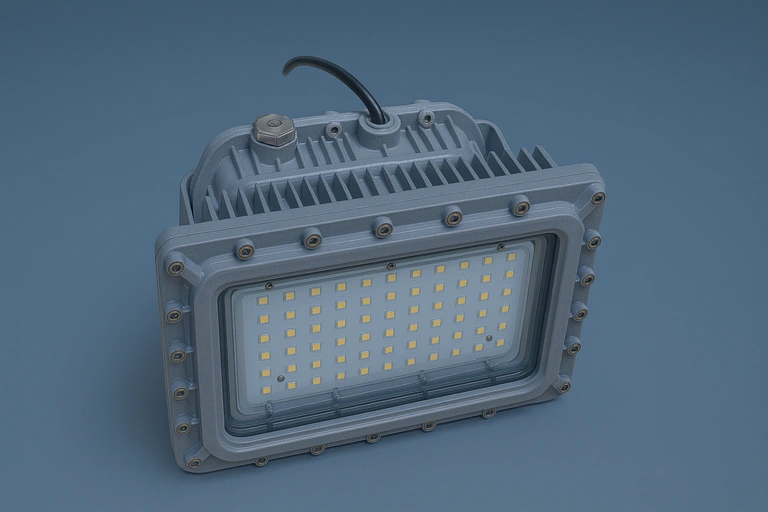
EXD Series selection guide
EXD Series models and options.
Compare the documented models and options below. A family name or model reference may need additional selections before it becomes a complete product order code.
Specification comparison
EXD Series models and specifications.
Compare 1 documented specification row. A row may describe a model, a model group or several selectable options; it does not necessarily represent one complete order code.
On smaller screens, scroll the table horizontally to see every specification.
| Model group | Wattage options | Beam options | Lens options | Mounting | Ratings |
|---|---|---|---|---|---|
| EXD Series | 60, 80, 100, 150, 180, 200, 300 W | D40, D60, D90, D120 | Flat or spherical glass | Wall bracket, ceiling bracket | UL844 C1D1 C, D; C1D2 A, B, C, D; C2D1 E, F, G; C2D2 E, F, G; Class III; ATEX IIC Gb Ex db IIC T6 Gb, IIB T6 Gb, IIIC T80 Db; IECEx Ex db IIC T6 Gb; IP66, IK10 |
Confirm the exact configuration against the current manufacturer specification sheet before approval or purchase.
Engineering reference
Choosing the right EXD Series configuration.
Confirm the mounting first, since wall bracket and ceiling bracket suit different applications of the same fixture. Then wattage, then beam, then lens: flat glass for controlled distribution, spherical where wider spread matters more than cut-off.
EXD is published as one model group rather than a row per configuration, because the wattage, beam, lens and mounting are ordered as a combination rather than selected from a fixed list. The lens choice — flat or spherical glass — is unusual and materially changes the distribution.
Common questions
Frequently asked questions
These answers clarify the selection process without replacing project-specific documentation.
Why is this family listed as one row rather than several?
The family is ordered as a model group with option lists — seven wattages, four beams, two lens types, two mounting brackets — so a configuration is assembled from those choices rather than picked from a fixed catalog list.
What is the difference between flat and spherical glass?
Both are documented lens options. Flat glass gives a more controlled distribution; spherical spreads wider. Confirm against the aiming plan and any glare constraint.
Build the specification
Send us your site conditions. We’ll recommend the right fixture.
Share the classification, temperature, ingress, mounting and timeline for a focused product conversation.