
I22-foot format
20 / 40 / 60 W
- Nominal output
- 2,800–8,400 lm
- Ambient
- -40 to +60°C
Product model · EXI series
A linear hazardous-location platform in I2 and I4 formats, with eight documented output packages, 140 lm/W nominal efficacy and mounting flexibility for industrial and marine projects.
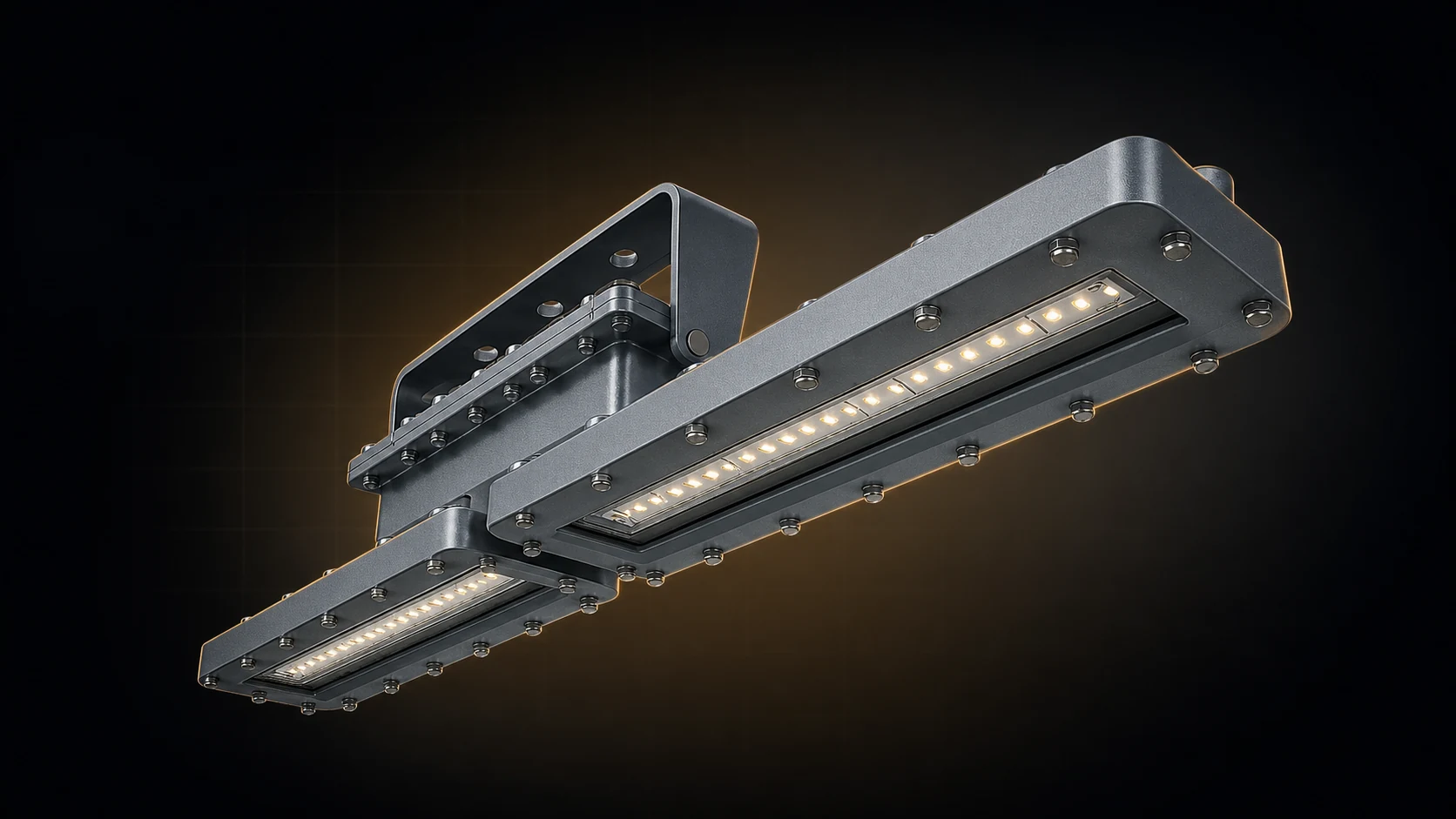
I-Series linear platform
I2 packages a 2-foot body for 20–60 W. I4 extends the platform to 4 feet and 40–120 W, with the same 120° distribution and dual input-voltage ranges.
20 / 40 / 60 W
40 / 60 / 80 / 100 / 120 W
Output selection
Eight documented configurations deliver 140 lumens per watt from 2,800 to 16,800 lumens.
Scroll horizontally to compare all EXI configurations.
| Format | Power | Output | Efficacy | Input | Ambient / T-code |
|---|---|---|---|---|---|
| I2 · 2 ft | 20 W | 2,800 lm | 140 lm/W | 100–277 or 200–480 VAC | -40 to +60°C · T4 |
| I2 · 2 ft | 40 W | 5,600 lm | 140 lm/W | 100–277 or 200–480 VAC | -40 to +60°C · T4 |
| I2 · 2 ft | 60 W | 8,400 lm | 140 lm/W | 100–277 or 200–480 VAC | -40 to +60°C · T4 |
| I4 · 4 ft | 40 W | 5,600 lm | 140 lm/W | 100–277 or 200–480 VAC | -40 to +60°C · T4 |
| I4 · 4 ft | 60 W | 8,400 lm | 140 lm/W | 100–277 or 200–480 VAC | -40 to +60°C · T4 |
| I4 · 4 ft | 80 W | 11,200 lm | 140 lm/W | 100–277 or 200–480 VAC | -40 to +60°C · T4 |
| I4 · 4 ft | 100 W | 14,000 lm | 140 lm/W | 100–277 or 200–480 VAC | -40 to +40°C · T4 |
| I4 · 4 ft | 120 W | 16,800 lm | 140 lm/W | 100–277 or 200–480 VAC | -40 to +40°C · T4 |
Built tough
Copper-free aluminum, tempered glass and stainless-steel hardware protect the optical and power assemblies in demanding industrial and marine locations.
Mechanical reference
I2 is 23.23 inches long; I4 is 46.61 inches long. Open the source drawing to review every dimension before laying out supports and conduit.
Mounting paths
The source documents five installation paths and standard 3/4-inch NPT entries at the top and both sides, with 1/2-inch NPT also available.
Family details
Common questions
These answers clarify the selection process without replacing project-specific documentation.
I2 is available in 20 W, 40 W and 60 W packages. I4 is available in 40 W, 60 W, 80 W, 100 W and 120 W packages.
The current family specification documents 100–277 VAC or 200–480 VAC input and a 120-degree beam.
The current specification documents ceiling, wall, pole, pendant and chain mounting.
Provide the site classification, groups or zone, temperature code, ambient range, voltage, format, wattage, CCT, controls, mounting, entries and any marine or emergency requirements.
Build the specification
Share the classification, temperature, ingress, mounting and timeline for a focused product conversation.