
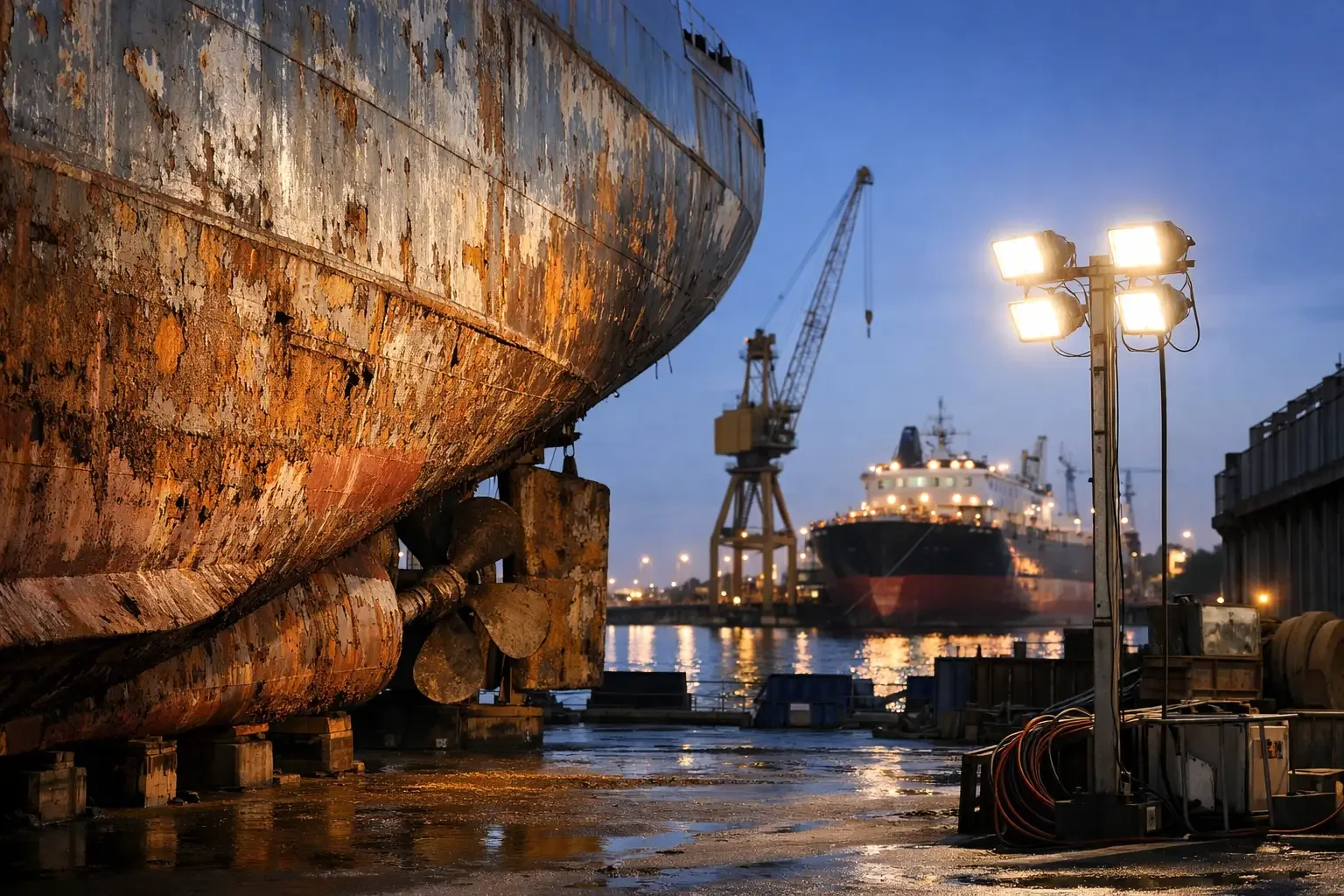
A vessel-repair yard can lose useful lighting long before an LED reaches its rated life. Salt aerosol enters seams, moisture settles on housings, dissimilar metals create galvanic corrosion points, and cranes or dockside equipment add vibration. This shipyard corrosion lighting case study examines how a representative maintenance upgrade addressed those conditions by treating the fixture, mounting hardware, wiring method, and application review as one system.
For a corrosion-exposure review and fixture recommendation, contact Maes Lighting with the area classification, mounting height, available voltage, ambient conditions, and required illumination levels. The right marine, vapor-tight, or hazardous-location fixture depends on whether the work area is open to salt spray, enclosed but humid, subject to washdown, or classified for flammable vapor exposure.
The Shipyard Corrosion Lighting Case Study
The representative project involved a coastal shipyard with three distinctly different lighting environments: open dry-dock service areas, covered fabrication bays, and enclosed machinery spaces. Existing fixtures had failed unevenly. Some showed lens yellowing and water intrusion. Others remained illuminated but had corroded mounting brackets, compromised conduit entries, and reduced output from dirty or damaged optical surfaces.
The immediate request was simple: replace failed fixtures and reduce maintenance calls. The engineering issue was less simple. Replacing fixtures with standard industrial LEDs could improve initial light levels while repeating the same corrosion and ingress failures within a few years. The project team needed a selection process that accounted for salt exposure, washdown, vibration, heat near welding activity, and hazardous-location requirements in specific enclosed spaces.
The first step was to divide the yard by exposure, not by building name. A fixture over a covered assembly station may see high humidity and airborne salt but little direct spray. A luminaire at the edge of a dry dock can receive wind-driven saltwater, rain, UV exposure, and physical impact. An enclosed fuel handling or machinery area may require an explosion-proof fixture based on its NEC classification, regardless of how corrosion-resistant a general-purpose fixture appears.
Why Corrosion Was the Actual Failure Mechanism
Corrosion protection is not a single rating printed on a datasheet. IP ratings address ingress of solids and water under defined test conditions. They do not independently confirm resistance to salt-laden air, galvanic reaction, chemical cleaners, or long-term UV exposure. Marine applications require buyers to look at the full construction package: housing material and coating, gasket design, lens material, stainless hardware, cable glands, driver compartment sealing, and the integrity of conduit connections.
On the dockside fixtures, the project team found that mounting hardware was often the weak point. Even a sealed luminaire can become a maintenance problem if its bracket, fasteners, or aiming joints corrode first. The replacement specification called for corrosion-resistant mounting components appropriate to the fixture location, sealed entries, and installation practices that avoided creating water traps around junction boxes and conduit runs.
The team also reviewed whether fixtures could be serviced without exposing electrical compartments to the weather. In a marine yard, a maintenance-friendly design means more than easy access. It means fewer openings, fewer resealing events, and fewer opportunities for a damaged gasket or improperly tightened entry to become the next failure point.
Matching the Fixture to the Exposure Zone
Open dock and dry-dock perimeters required marine-grade floodlighting with sealed optical and electrical compartments, corrosion-resistant finishes, and hardware suited to persistent outdoor exposure. The goal was controlled, useful light on work surfaces and access paths without excessive glare to crane operators, vessel crews, or adjacent waterfront traffic.
Covered fabrication bays used industrial LED high bays or vapor-tight fixtures where their environmental rating matched the actual moisture and particulate exposure. These areas did not necessarily require the same fixture used at the dock edge. Overspecifying every location can raise project cost and make maintenance unnecessarily complicated. Underspecifying covered areas, however, can be equally expensive when condensation, welding fumes, or salt aerosol are present.
Enclosed machinery and fueling-related areas required a separate hazardous-location review. Explosion-proof lighting is selected for the classified location, gas group, temperature code, and installation requirements - not simply because it has a heavy-duty housing. A Class I Division 1 location generally calls for equipment suitable where ignitable concentrations may exist under normal operating conditions. Class I Division 2 addresses areas where those concentrations are not normally present but may occur under abnormal conditions. The authority having jurisdiction and the facility’s classification drawings should guide the final selection.
Photometrics Changed the Replacement Plan
The initial idea was a one-for-one wattage replacement. That approach was rejected after a photometric review. Older fixtures had broad, poorly controlled distributions that put light into the air and onto reflective vessel surfaces while leaving shadows at stairs, service platforms, and equipment access points.
The revised layout used fewer fixture types but selected distributions by task. Flood fixtures provided controlled reach across dry-dock work zones. High bays supported fabrication tasks under roof structures. Vapor-tight linear fixtures improved visibility along corridors and service areas where condensation and cleaning were routine. The layout also considered glare at low viewing angles, which matters when personnel move between bright waterfront reflections and darker work areas.
Higher lumens were not automatically better. Excessive output can produce glare, reduce visual comfort, and create difficult contrast around wet steel, painted surfaces, and open water. The useful measure was maintained illuminance at the work plane, supported by a realistic maintenance factor for the environment.
Wiring, Mounting, and Documentation Were Part of the Fix
A corrosion-resistant fixture cannot compensate for unsuitable wiring methods. The project review addressed junction box condition, conduit seals where required, gland compatibility, grounding continuity, and the interface between fixture mounts and existing steel structures. Dissimilar-metal contact points received particular attention because marine exposure can accelerate galvanic corrosion.
Documentation helped the contractor avoid last-minute substitution issues. Product datasheets, certifications, mounting details, photometric files, voltage options, and hazardous-location markings were reviewed before procurement. This matters when a project moves from a general fixture schedule to a submittal package that must satisfy engineering review, site safety requirements, and the authority having jurisdiction.
When Buy America Act provisions apply, documentation should be reviewed against the specific contract requirements before release. Maes Lighting identifies the Explosion Proof IR1, IR3, IR4, and IR7 series, along with CIT vapor-tight models, as products covered under Buy America Act requirements. Procurement teams should still confirm the current project-specific compliance language, required certifications, and any domestic-content thresholds with the project owner.
What Are the Best High Temperature Lights for Industrial Use?
The best high temperature lights for industrial use are fixtures selected by verified maximum ambient temperature, not by LED wattage or a standard industrial rating alone. In shipyard work, elevated temperature exposure may occur near welding stations, engine testing, preheat operations, exhaust systems, or metal-processing equipment. A fixture may survive occasional radiant heat while still experiencing accelerated driver failure if its surrounding ambient temperature exceeds its listed limit.
For these areas, review the manufacturer’s maximum ambient rating, thermal design, driver location, lens material, and required clearance from heat sources. LED thermal derating is a practical concern: as ambient temperature rises, electronics and LEDs can experience reduced output and shorter service life. If the high-temperature condition is continuous, a purpose-built high-temperature fixture is usually the correct choice. If heat is intermittent and the fixture can be mounted outside the elevated ambient zone, remote placement may be more economical.
Results That Matter to Maintenance Teams
The representative shipyard plan did not rely on a claim that one fixture could solve every exposure condition. Instead, it established an equipment standard around environmental zones, serviceability, and documented ratings. That gave maintenance teams more consistent replacement parts, reduced the risk of installing a noncompliant fixture in a classified area, and focused capital spending on the areas where corrosion caused the most repeated failures.
For shipyards, the practical lesson is to inspect failed lighting as evidence. Look beyond the dark fixture and identify whether the cause was ingress, corroded hardware, poor thermal fit, vibration, unsuitable mounting, or a hazardous-location mismatch. A lighting upgrade that answers those questions before purchase is far more likely to protect uptime, worker visibility, and the maintenance budget when the next saltwater season arrives.