
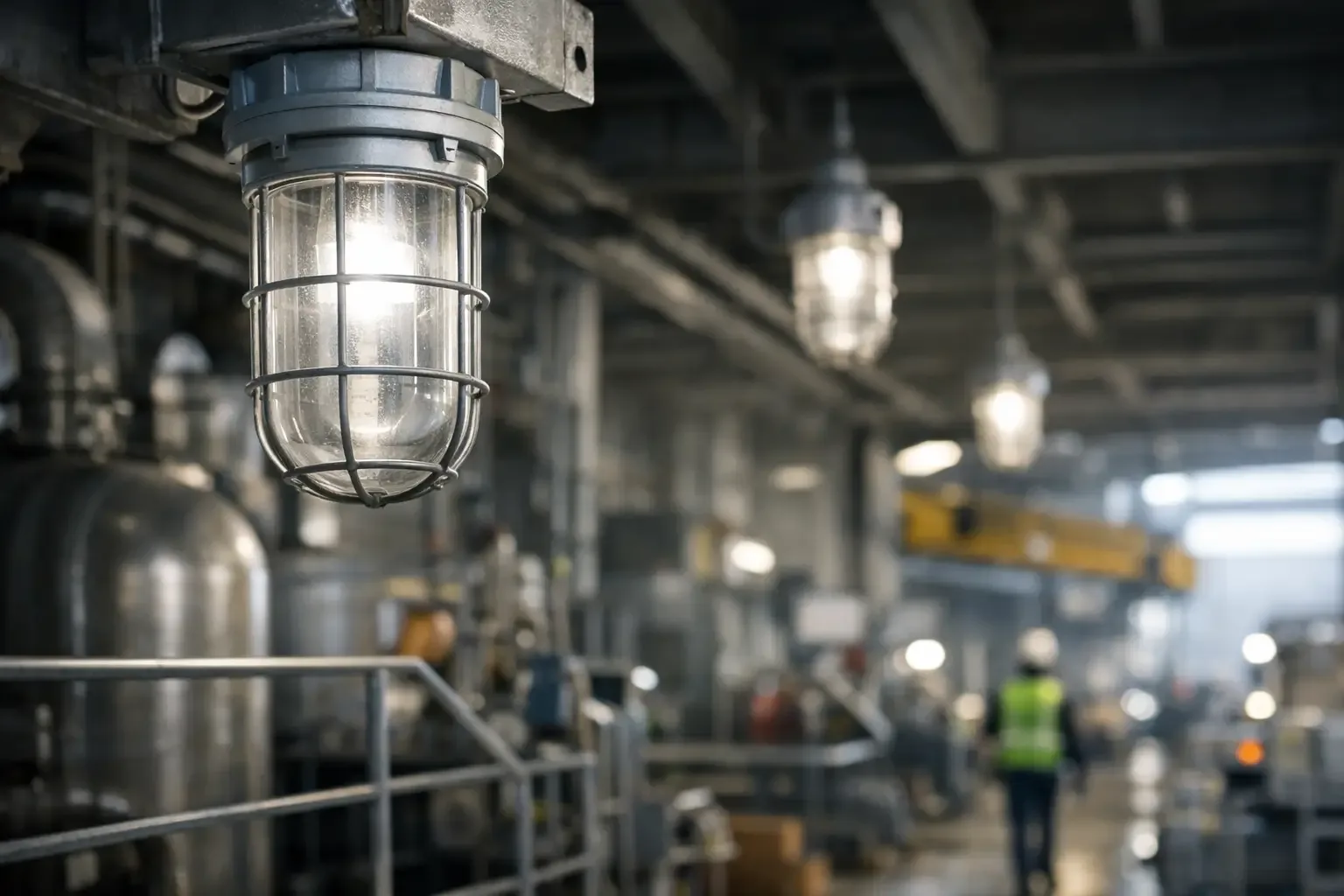
A vaporproof fixture is often selected after a conventional industrial light has already failed. Water intrusion, condensation, airborne dust, corrosive cleaners, and repeated washdown cycles can cloud lenses, corrode hardware, trip drivers, and create maintenance work in areas where access is difficult. This vaporproof fixture review focuses on the details that determine whether a fixture belongs in a demanding facility rather than simply looking suitable on a cut sheet.
For a project-specific review of vapor-tight fixtures, contact Maes Lighting with the operating environment, mounting height, voltage, washdown method, and required documentation. The right selection starts with matching the fixture to the exposure and approval requirements, not just choosing a wattage and lumen package.
What a Vaporproof Fixture Is Designed to Handle
The term vaporproof is commonly used for enclosed linear fixtures built to keep out moisture, dust, and incidental contaminants. In industrial specifications, the more precise product term is often vapor-tight. These fixtures typically use a sealed housing, gasketed lens assembly, protected wiring compartment, and corrosion-resistant latches or fasteners.
That construction makes vapor-tight lighting a practical fit for parking structures, utility corridors, cold storage rooms, food and beverage support areas, car washes, marine spaces, loading docks, processing plants, and covered outdoor locations. It is especially useful where humid air and temperature swings cause condensation inside ordinary luminaires.
A vaporproof fixture is not automatically an explosion-proof fixture. A sealed enclosure can help resist water and dust ingress, but it does not establish suitability for classified hazardous locations containing flammable gas, vapor, combustible dust, or ignitable fibers. Facilities must separate the need for environmental sealing from the need for a hazardous-location listing.
Vaporproof Fixture Review: Ratings Come Before Features
The most useful review begins with the rating on the nameplate. IP ratings identify the degree of protection against solid objects and water. An IP65 fixture is generally protected against dust and water jets, while IP66 adds protection against more powerful water jets. IP67 indicates temporary immersion resistance under defined test conditions. Those distinctions matter when a fixture is mounted near process equipment, under a washdown hose path, or in an area prone to standing water.
For sanitary and aggressive washdown applications, an IP rating alone may not tell the whole story. Food-processing areas may require NSF suitability, IP69K performance for high-pressure, high-temperature washdown, smooth exterior surfaces, and materials compatible with approved cleaning chemicals. A typical vapor-tight strip fixture can be a good choice for a refrigerated warehouse aisle but the wrong choice inside a protein-processing room receiving daily high-pressure sanitation.
Similarly, marine and coastal applications should be evaluated for salt exposure, vibration, and corrosion resistance. Housing material, lens material, gasket chemistry, coating system, cable gland design, and stainless-steel hardware can all affect service life. A fixture that performs well in a dry distribution center may deteriorate quickly on a dock, vessel, or coastal processing site.
What the IP Rating Does Not Confirm
An IP rating does not verify chemical compatibility, impact resistance, hazardous-location compliance, food-zone suitability, or long-term resistance to ultraviolet exposure. It also does not guarantee that every installed component is equally protected. Improper conduit entries, damaged gaskets, loose end caps, and field-drilled holes can defeat the protection intended by the fixture design.
Ask for the complete data package before approving a product. A specification-ready review should include the datasheet, installation instructions, certifications, photometric files when applicable, warranty information, and any material or compliance documentation required by the project.
Housing, Lens, and Hardware Determine Service Life
Many vaporproof fixtures use a polycarbonate lens and a fiberglass-reinforced polyester, polycarbonate, or metal housing. Polycarbonate offers high impact resistance and is widely used in industrial linear lighting, but it should be assessed for chemical exposure and potential discoloration in the application. Certain solvents and cleaners can cause stress cracking or haze over time.
Stainless-steel latches and hardware are a meaningful upgrade where corrosion is expected. Plastic latches may be acceptable in controlled indoor conditions, but repeated cleaning, vibration, and corrosive atmospheres can shorten their useful life. The same principle applies to mounting brackets. A durable fixture body does not solve the problem if the clips, brackets, or fasteners corrode first.
Gaskets deserve equal attention. They must maintain compression through temperature cycling and resist the oils, detergents, sanitizers, or airborne contaminants present in the facility. Cold storage creates a separate challenge: fixtures may experience repeated transitions between refrigerated spaces and warmer loading areas, increasing condensation risk and placing stress on seals.
Light Output and Optics Should Fit the Task
A vapor-tight fixture should provide useful light on the work plane, not just a high lumen number in a catalog. Mounting height, aisle width, racking, ceiling reflectance, obstructions, and the required foot-candle level all influence the correct output and distribution. Linear vapor-tight fixtures are often effective for low- to medium-mounting-height applications, narrow aisles, equipment rooms, and utility spaces because their form factor distributes light along the length of the fixture.
Color temperature is an operational choice. A 4000K source can be appropriate for maintenance areas, back-of-house processing zones, and facilities seeking a neutral appearance. A 5000K source may support visual inspection and detailed tasks, although the higher color temperature can feel harsher in occupied areas. For food-processing and quality-control work, color rendering requirements may also deserve review.
Controls should be selected carefully. Occupancy sensors and daylight dimming can reduce energy use in intermittently occupied spaces, but the sensor location and environmental rating must match the installation. In a freezer, washdown room, or dusty service corridor, a poorly matched sensor can become the component that causes nuisance operation or early replacement.
Installation Details Can Protect or Compromise the Rating
A vapor-tight fixture is only as sealed as its final installation. Review the supply entry method, conduit hubs, cable glands, junction boxes, branch-circuit voltage, and grounding requirements before the crew arrives. If the fixture is surface mounted in a wet location, the mounting surface and entry points must be considered as part of the water-management strategy.
Where fixtures are suspended, verify that the mounting kit is rated for the fixture weight and site vibration. In processing plants and marine facilities, vibration can loosen hardware over time. In low-temperature environments, use installation components and wiring methods suitable for the expected ambient conditions.
Maintenance access also matters. A fixture with field-serviceable drivers may reduce long-term replacement cost, but only if the facility can safely access it and maintain the enclosure seal after service. In some applications, replacing a failed sealed fixture is more practical than opening it in the field. There is no universal answer; the correct approach depends on access, downtime costs, labor practices, and contamination control.
Buy America Act Considerations for Vapor-Tight Projects
Publicly funded and infrastructure-related projects can require domestic-content documentation early in the procurement process. If Buy America Act compliance is part of the specification, do not assume that an industrial fixture qualifies based on brand, warehouse location, or final assembly alone. Confirm the applicable requirement and obtain the supporting documentation required by the owner, engineer, or contractor.
For vapor-tight applications, the CIT models on the vapor-tight fixture page are covered under the Buy America Act. That can make them a practical starting point for projects where domestic-content compliance must be addressed alongside ingress protection, light output, and mounting configuration. Documentation should still be reviewed against the specific contract language because Buy America Act, Buy American, and project-specific domestic-preference provisions are not always interchangeable.
For hazardous-location work, the Explosion Proof IR1, IR3, IR4, and IR7 series are also covered under the Buy America Act. These are not substitutes for vapor-tight fixtures in ordinary wet locations, nor should vapor-tight fixtures be substituted for explosion-proof equipment in classified areas. The application classification remains the first decision.
Questions to Resolve Before Ordering
A useful fixture review should establish whether the location is ordinary or classified, whether water exposure is incidental or high-pressure, and whether chemicals, salt, cold, heat, or vibration are present. It should also identify the mounting height, target illumination, voltage, emergency-lighting needs, control requirements, and any NSF, IP69K, marine, or domestic-content obligations.
This information prevents common errors, such as using a standard IP-rated fixture in a sanitation room, selecting a high-lumen model that creates glare down a narrow aisle, or specifying a vapor-tight product where a listed hazardous-location luminaire is required. It also gives the project team a clearer path to submittal approval and fewer changes during installation.
The best vaporproof fixture is not simply the most sealed option available. It is the fixture whose enclosure, listing, materials, optics, controls, and documentation all match the conditions your crew will face long after the installation is complete.