
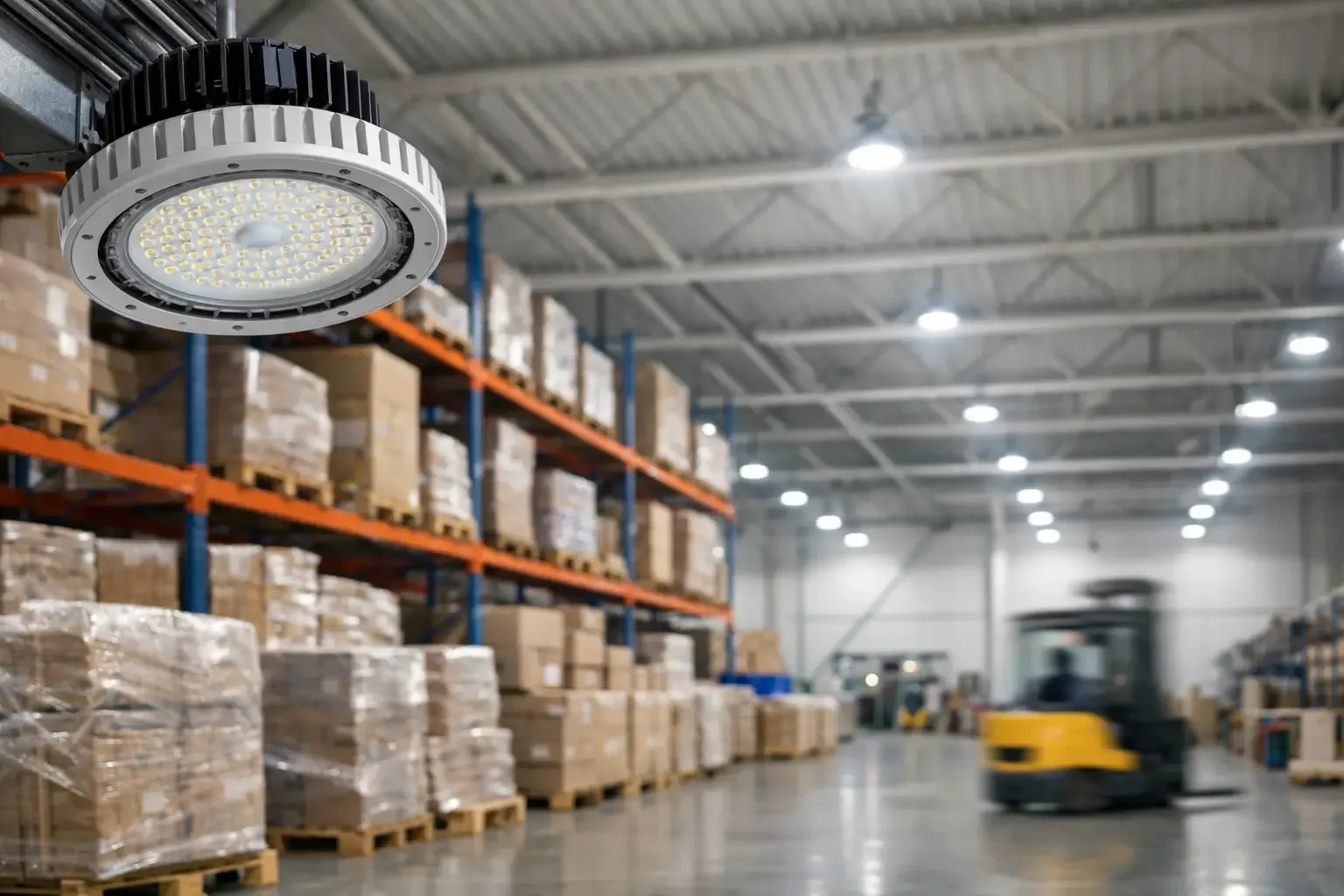
A warehouse lighting retrofit is rarely just a wattage comparison. The fixture must put usable light on rack faces, aisles, docks, and workstations while surviving vibration, dust, switching cycles, and the occasional impact from material-handling equipment. This warehouse energy savings case study uses a representative distribution facility to show how a properly scoped LED high-bay project can reduce electrical demand and maintenance exposure without creating dark aisles or specification problems.
For an application review based on your mounting heights, operating schedule, and facility conditions, contact Maes Lighting for a warehouse energy savings case study tailored to your project. A technical review should begin before fixtures are purchased, when photometrics, voltage, controls, ambient conditions, and required documentation can still be aligned with the bid package.
The Facility and the Baseline
The modeled facility is a 120,000-square-foot dry distribution warehouse with 24-foot mounting heights, selective pallet racking, shipping lanes, and a small packing area. The existing system has 240 metal-halide high bays. Although commonly called 400-watt fixtures, measured input power for the lamp and ballast combination is closer to 458 watts per fixture.
The warehouse operates about 5,500 hours per year across extended shifts. At that schedule, the legacy lighting load is 109.9 kW and annual lighting consumption is approximately 604,560 kWh. The original layout provided acceptable average illumination in open floor areas, but it had familiar operational drawbacks: warm-up delays after outages, lumen depreciation over time, frequent relamping at height, and uneven light on vertical rack faces.
Those baseline details matter. A facility using lighting only one shift per day will produce a different savings result than a 24/7 operation. Likewise, a warehouse with a high utility demand charge may place more value on reduced connected load than one with a low energy-only rate.
The LED High-Bay Retrofit Scenario
The replacement design uses 240 industrial LED high bays rated at 155 watts, with optics selected for the aisle spacing and mounting height. The goal is not simply to replace each legacy unit one-for-one. It is to maintain safe task visibility and uniformity with a photometric layout that accounts for obstructions, rack geometry, and the working plane.
At 155 watts each, the new connected load is 37.2 kW. At the same 5,500 annual operating hours, LED lighting uses approximately 204,600 kWh per year. That is a direct annual reduction of 399,960 kWh, or about 66 percent before controls.
At an electricity rate of $0.11 per kWh, the direct energy reduction is worth roughly $44,000 annually. The actual financial result can be higher or lower depending on blended utility rates, demand charges, rebates, installation cost, and whether old fixtures require special disposal. A credible proposal separates those inputs rather than promising a universal payback period.
Where Controls Add Value
The modeled savings improve when lighting controls match how the building is used. Daylight harvesting may help around dock doors or skylights, but it has limited value in deep interior storage zones. Occupancy sensors are more useful in intermittent aisles, battery-charging areas, restrooms, and low-traffic ancillary spaces than in continually active pick aisles.
If controls reduce LED operating hours or output by a conservative additional 15 percent, annual LED consumption falls by about 30,690 kWh. Total annual reduction reaches roughly 430,650 kWh, or just over 71 percent compared with the legacy baseline. Controls should be commissioned carefully. Aggressive time delays or low standby settings can frustrate forklift operators and create avoidable safety complaints.
Maintenance Savings Are Part of the Business Case
Energy is visible on a utility bill, but maintenance is often the issue that turns a retrofit from a capital request into an operational priority. Replacing failed metal-halide components at 24 feet requires lift access, scheduling, labor, and work-area coordination. A single outage in a high-traffic aisle can disrupt receiving or picking until repairs are complete.
LED high bays reduce the frequency of routine source replacement, but they are not maintenance-free. Buyers should review driver serviceability, surge protection, thermal design, lens material, warranty terms, and the manufacturer’s reported lumen maintenance data. A fixture that performs well in a clean, dry warehouse may not be appropriate above a hot process line, in a washdown area, or near corrosive chemicals.
The most useful maintenance estimate includes labor and access equipment, not just replacement component cost. It should also account for the cost of working around production schedules. In facilities where lift access requires an aisle shutdown, downtime can exceed the price of the replacement part.
Photometrics Prevent False Savings
Reducing fixture wattage while ignoring light distribution can produce a project that looks efficient on paper and performs poorly on the floor. Average foot-candle readings alone do not tell the full story. Distribution-center teams need adequate vertical illumination for labels and rack locations, reasonable uniformity between fixtures, and controlled glare at operator sightlines.
A photometric plan should define mounting heights, fixture locations, aisle widths, rack heights, reflectance assumptions, and target light levels by task. Receiving docks, packing tables, pedestrian crossings, and high-speed picking zones may require different lighting treatment than bulk storage. In some layouts, a narrow aisle optic or a mix of fixture outputs produces better usable illumination than a single universal high bay.
This is also where fixture durability enters the calculation. A basic indoor fixture may be adequate in a conditioned warehouse. If the space is dusty, damp, unheated, or subject to washdown, the enclosure and ingress-protection rating must match the exposure. Vapor-tight fixtures can be appropriate for utility rooms, cold-storage transitions, dock canopies, and wet support spaces, but the final selection depends on mounting, temperature, and cleaning methods.
When a Warehouse Needs More Than a Standard High Bay
A warehouse may contain locations that demand a different classification of fixture. Battery rooms, solvent storage, fuel-transfer areas, and spaces with flammable vapors or combustible dust cannot be treated as ordinary storage areas. The site classification, not fixture appearance, determines whether explosion-proof lighting is required.
For hazardous locations, the electrical engineer or authority having jurisdiction should confirm the applicable NEC class, division, group, and temperature-code requirements. A Class I Division 1 space has a different risk profile than Class I Division 2, and combustible-dust environments bring their own classification requirements. Submittals should include relevant certifications, temperature ratings, installation instructions, and photometric files.
Procurement requirements can also shape the approved fixture list. Where Buy America Act coverage is required, request project-specific documentation for the Explosion Proof IR1, IR3, IR4, and IR7 series, as well as CIT models on the vapor-tight product line. Availability and compliance documentation should be reviewed before the fixture is released for purchase, particularly on publicly funded or schedule-sensitive work.
What are the best high temperature lights for industrial use?
The best high-temperature lights for industrial use are fixtures rated for the actual maximum ambient temperature at the mounting location, not merely the temperature of the process nearby. Kilns, furnaces, steel mills, and hot manufacturing zones can expose luminaires to sustained radiant and convective heat that accelerates driver and LED degradation.
Start with the manufacturer’s maximum ambient rating, then verify the expected temperature during peak production, air movement around the fixture, mounting distance from the heat source, and maintenance access. LED output and service life can decline as ambient temperature rises, a behavior known as thermal derating. A higher-rated industrial fixture may cost more upfront, but installing a standard high bay in an overheated location often creates early failures, repeat labor, and safety concerns.
Food and beverage warehouses require another level of review. In refrigerated storage, washdown corridors, or processing-adjacent areas, NSF requirements and IP ratings may matter as much as efficiency. An IP69K-rated fixture can be appropriate where high-pressure washdown exposure is expected, while NSF-rated construction may be required where sanitation standards govern the installation. The cleaning chemicals, water temperature, and fixture mounting details should all be part of the selection discussion.
Turning the Case Study Into a Project Decision
The representative project shows a 66 percent reduction in lighting energy before controls and more than 71 percent with a conservative controls assumption. Those figures are useful starting points, not a substitute for a facility-specific audit. The strongest projects verify existing fixture input wattage, operating hours, utility costs, and light-level requirements before a savings model is presented.
A well-specified retrofit gives operations more than lower kWh. It provides dependable illumination where work happens, reduces avoidable maintenance at height, and gives the project team the documentation needed to move from review to approval. Start with the conditions on the floor, then select the fixture built to keep working there.