
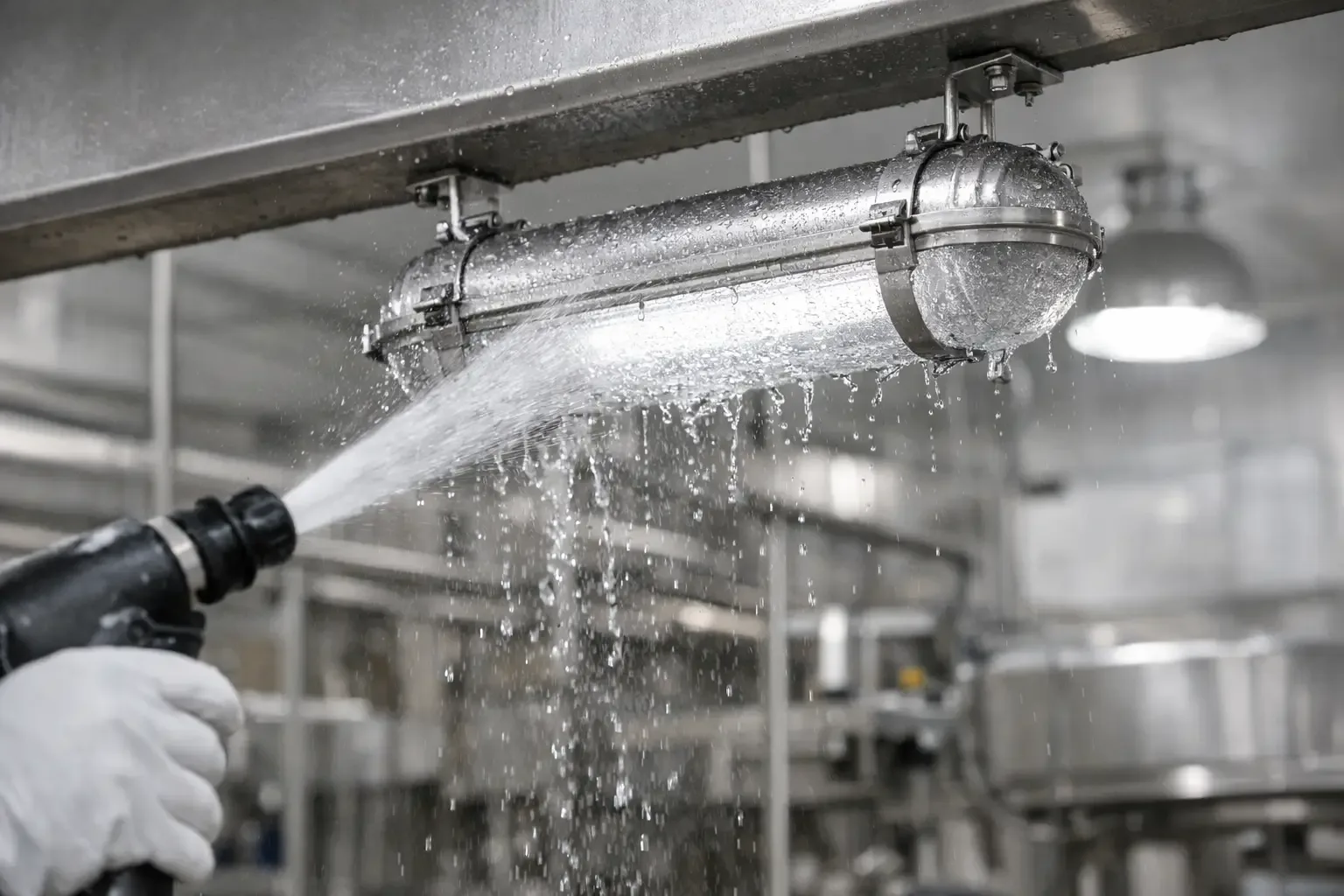
A fixture can look acceptable after installation and still fail its first sanitation cycle. High-pressure water, hot rinse-downs, caustic chemicals, and repeated thermal changes find weak lens seals, poorly protected cable entries, and housings not designed for the process area. That is why washdown rated light fixtures should be selected around the actual cleaning method, contaminants, and compliance requirements, not simply because a product is described as industrial.
For a planned upgrade or a new sanitary process line, request a washdown application review from Maes Lighting before fixtures are released for purchase. A review can match fixture ratings, mounting conditions, light levels, and required documentation to the area being cleaned. For projects with domestic-content requirements, the Buy America Act-covered options include the Explosion Proof IR1, IR3, IR4, and IR7 series, along with CIT models within the vapor-tight fixture range.
What Washdown Rated Light Fixtures Are Built to Handle
Washdown lighting is intended for locations where equipment and surrounding surfaces are routinely cleaned with water, foam, steam, or chemical solutions. Common applications include food and beverage processing, dairies, meat and poultry operations, commercial kitchens, pharmaceutical support areas, cold storage facilities, packaging lines, and sanitary warehousing zones.
The defining issue is not moisture alone. A fixture above a process line may face directed spray at close range, chemical residue, temperature swings, vibration from nearby equipment, and airborne particulate between wash cycles. Over time, each exposure can compromise a fixture that was designed only for damp or wet locations.
A properly selected fixture uses an enclosed construction that protects electrical components from ingress while maintaining usable illumination. Housing material, lens design, gasket quality, driver compartment sealing, mounting hardware, and cord grips all affect whether the installation remains serviceable after repeated washdowns.
Start With the Cleaning Process, Not the Fixture Catalog
The most useful specification begins with a direct description of how the area is cleaned. Facilities should identify whether crews use low-pressure rinse-downs, high-pressure spray, steam, foaming chemicals, or aggressive sanitizer solutions. The angle and distance of spray matter as much as the presence of water.
A fixture mounted 25 feet above an open production floor may experience a different exposure than one installed directly over a conveyor, mixing vessel, or wash station. Fixtures near ceiling-mounted pipework can also collect condensation or residue that later enters through compromised seals. These details determine whether a vapor-tight product is suitable or whether an IP69K-rated fixture is the more appropriate choice.
Chemical compatibility deserves the same attention. Chlorinated cleaners, quaternary sanitizers, acids, and alkaline solutions can affect coatings, gaskets, exposed hardware, and certain lens materials. Stainless steel housings and corrosion-resistant mounting components are often appropriate in severe sanitary environments, but material selection still depends on the cleaning agent and concentration used at the facility.
IP Ratings Explain Water Protection, but They Are Not the Full Specification
Ingress Protection ratings provide a useful baseline for comparing enclosure resistance. The first digit addresses solid-particle protection, while the second indicates protection against water. For washdown applications, the water-protection digit is usually the deciding factor.
IP66 or IP67 may be suitable where fixtures receive heavy spray or temporary immersion risk, depending on the installation. However, an IP69K rating is designed for high-pressure, high-temperature water jets from multiple angles. This rating is frequently specified where sanitation crews use close-range, high-pressure cleaning equipment and fixture exposure is unavoidable.
An IP rating does not automatically establish suitability for every facility condition. It does not by itself confirm NSF acceptance, hazardous-location compliance, ambient-temperature capability, chemical resistance, or corrosion performance. A fixture can carry a strong IP rating and still be wrong for a room that has flammable vapors, extreme heat, or a specific sanitation standard.
Why NSF Can Matter in Food Processing
NSF-related requirements are commonly considered when fixtures are installed in food zones or other areas subject to sanitary design expectations. The correct requirement depends on the facility’s standards, the fixture location, and the project specification. Procurement teams should confirm the required listing or certification rather than treating the label as a general-purpose indicator of washdown durability.
The practical goal is straightforward: lighting should not create a sanitation concern. Smooth, cleanable surfaces, sealed construction, and materials that withstand the cleaning routine reduce the chance that fixtures become a recurring inspection or maintenance issue.
Match the Fixture Type to the Area
Vapor-tight linear fixtures are often a practical choice for corridors, processing rooms, refrigerated areas, utility spaces, and covered production zones. Their enclosed form factor can provide uniform general lighting while protecting internal components from moisture and dust. They are not automatically the answer for every high-pressure wash area, so the rating and cleaning exposure still need to be verified.
High-bay washdown fixtures are often used in larger production rooms and cold storage spaces where mounting heights require higher output and controlled distribution. The photometric plan should account for equipment shadows, rack aisles, conveyors, and the light lost when lenses become dirty over time. More lumens do not always solve a poor layout.
Hazardous locations require a separate decision path. If flammable gases, vapors, combustible dust, or classified process conditions are present, the fixture must meet the applicable hazardous-location classification in addition to the washdown requirement. An ordinary vapor-tight fixture is not a substitute for explosion-proof lighting in a classified location, even if it has a high ingress-protection rating.
Marine-grade or corrosion-resistant construction may also be justified where salt exposure, persistent humidity, or corrosive atmospheres are part of the operating environment. Processing plants near coastal areas and facilities using aggressive chemical processes should consider corrosion as a service-life issue, not an afterthought.
Installation Details Can Defeat a Good Fixture Choice
A rated fixture performs only as well as its installation. Incorrectly sealed conduit entries, damaged gaskets, incompatible mounting hardware, and field-drilled holes can undermine the enclosure protection the fixture was tested to provide. Electrical contractors should follow the manufacturer’s installation instructions and avoid modifications that affect the fixture’s rating or warranty.
Mounting orientation is also relevant. Some fixtures are tested in specific orientations, and drain paths can be affected when products are suspended, surface mounted, or attached to angled structures. In washdown areas, the preferred installation should minimize ledges where residue can collect and allow the fixture exterior to be cleaned effectively.
Consider maintenance access before installation. A fixture placed above fixed process equipment may require line shutdowns, lift access, or sanitation rework for routine service. Long-life LED systems reduce relamping frequency, but drivers, seals, and external components still need inspection. The best fixture is one that meets the duty cycle and can be maintained without creating unnecessary downtime.
Documentation Should Be Part of the Buying Decision
For industrial projects, a product description alone is rarely enough. Engineering teams and contractors may need cut sheets, photometric files, installation instructions, certification information, voltage details, mounting options, and hazardous-location markings before approving an order. These documents support submittals, confirm code alignment, and reduce the chance of field changes after fixtures arrive.
The same is true for Buy America Act requirements. If the project includes domestic-content provisions, identify the compliant fixture models at the specification stage and retain the supporting documentation with the submittal package. The Explosion Proof IR1, IR3, IR4, and IR7 series and the designated CIT vapor-tight models should be evaluated against the project’s exact procurement language and documentation needs.
A Better Way to Specify Washdown Lighting
A strong specification describes the environment rather than relying on a broad phrase such as “wet location.” Include the cleaning method, spray pressure where known, cleaning chemicals, ambient temperature, mounting height, room classification, required certifications, voltage, light-level target, and control requirements. This gives the lighting supplier and electrical team the information needed to recommend a fixture that fits the facility rather than a generic substitute.
When conditions are unclear, treat the uncertainty as a reason to review the application, not a reason to select the cheapest enclosure. The cost difference between fixture types is usually small compared with water intrusion, failed inspections, interrupted production, or replacing lights over an active process line. A fixture that survives the sanitation program and supports the facility’s documentation requirements keeps lighting where it belongs: out of the maintenance backlog and out of the way of production.