
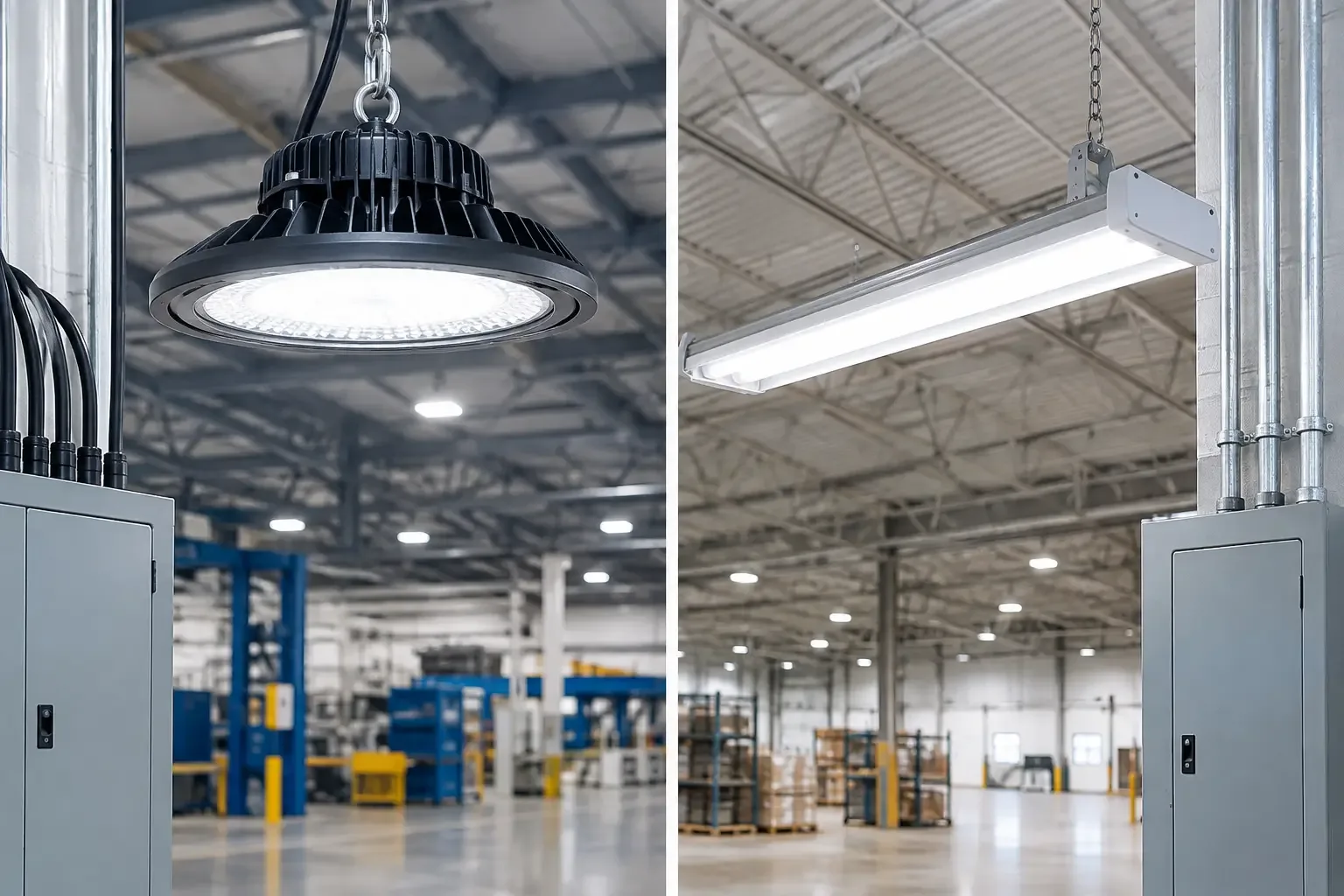
A voltage question can become a shutdown-risk question when a lighting fixture arrives with the wrong driver, the wrong branch-circuit assumptions, or incomplete submittal documentation. In 480V versus 277V industrial lighting, the most useful answer is rarely that one voltage is universally better. The right choice depends on the facility distribution system, fixture input rating, branch-circuit design, maintenance practices, and the operating environment.
We have found that many projects are not truly choosing between two unrelated lighting systems. They are working from an existing 480Y/277V service and deciding whether luminaires should be served phase-to-neutral at 277V or phase-to-phase at 480V. That distinction matters. A 480Y/277V system provides 480V between phases and 277V from any phase to neutral. A 480V delta system, by contrast, does not provide a 277V neutral voltage.
Start With the Facility Distribution System
Before comparing fixture efficacy, conductor size, or driver options, confirm the source. The electrical single-line diagram should identify whether the site uses 480Y/277V wye, 480V delta, or another arrangement. This step prevents a common specification error: selecting 277V-only fixtures for a facility where 277V is not available.
In a 480Y/277V wye system, 277V lighting is supplied from one ungrounded conductor and a neutral. This has long been common in warehouses, manufacturing areas, and large commercial-industrial buildings because it supports practical lighting branch circuits without requiring a step-down transformer for each area.
A 480V fixture is typically connected phase-to-phase and requires a driver specifically rated for that input. Do not assume a fixture labeled “480V” can operate at 277V, or that a 277V fixture can operate at 480V. The fixture datasheet and driver label control. Many industrial LED high bays and floodlights are offered with 120-277V or 277-480V input ranges, but those ranges must be verified at the time of submittal.
277V Lighting: A Practical Standard for Large Facilities
For standard high-bay and general-area lighting in a 480Y/277V building, 277V often provides a straightforward path. Because the voltage is higher than 120V or 208V, lighting circuits can carry the same wattage with lower current. Lower current can reduce voltage drop and may allow longer circuit runs, subject to conductor ampacity, overcurrent protection, and project-specific design requirements.
Consider a 200W LED high bay. At 277V, its operating current is materially lower than it would be at 120V. Across dozens of fixtures, that lower current can simplify branch-circuit planning in a large warehouse or fabrication area. It also aligns well with existing 480Y/277V panelboards, where lighting circuits are already designed around phase-to-neutral loads.
The trade-off is the neutral. The neutral conductor and its terminations must be properly designed, installed, and maintained. In facilities with aging distribution equipment, mixed loads, or poorly documented modifications, electrical contractors should verify neutral availability and condition rather than treating 277V as automatic.
For many industrial LED applications, 277V is also familiar to maintenance teams and electrical contractors. Familiarity does not replace verification, but it can reduce avoidable installation mistakes when fixtures, panels, breakers, and wiring conventions are consistent across the plant.
Where 277V Fits Best
277V is frequently appropriate for indoor high bays, aisle lighting, general production areas, warehouses, and covered loading zones served from a 480Y/277V system. It can also be suitable for vapor-tight fixtures in wet or dusty areas, provided the voltage rating is only one part of a broader application review.
In a food processing room, for example, the electrical decision must be paired with sanitation and ingress-protection requirements. A 277V-compatible fixture still may not be appropriate if it lacks the required washdown construction, NSF suitability, or IP rating for the cleaning process. Voltage compatibility gets the fixture energized. Environmental suitability helps keep it operating and acceptable to the facility.
When 480V Lighting Makes Sense
480V lighting can be a strong choice where phase-to-phase power is readily available, fixture drivers are specifically listed and rated for 480V operation, and the project benefits from reduced current on long runs. Large exterior yards, high-mast applications, remote process structures, and expansive industrial campuses may justify a 480V lighting approach when distribution architecture supports it.
At a given wattage, 480V draws less current than 277V. That can help manage voltage drop on long feeder and branch-circuit runs. The benefit is not theoretical in facilities such as steel operations, marine terminals, aggregate plants, and refinery support areas, where luminaires may be positioned far from electrical rooms.
But 480V is not automatically the lower-cost or simpler option. A phase-to-phase 480V circuit has different wiring and disconnect considerations than a 277V phase-to-neutral circuit. Fixture availability can also narrow, especially when a project needs specialized optics, emergency-driver options, controls, or environmental certifications. The lighting package should be evaluated as a complete system rather than as a voltage label.
We have found that 480V is most compelling when it follows the facility’s established electrical strategy. Retrofitting an otherwise 277V lighting installation to 480V simply because higher voltage appears more efficient can introduce unnecessary changes to panelboards, circuiting, drivers, and maintenance documentation.
Driver Ratings Are the Deciding Detail
The driver is where many voltage assumptions fail. Industrial LED fixtures may be offered with several input-voltage configurations, such as 120-277V, 200-480V, 277-480V, or a dedicated 480V option. Those labels are not interchangeable.
A driver rated 120-277V must not be connected to 480V. A 277-480V driver may be suitable for either system, but installers still need to follow the manufacturer’s wiring instructions and confirm whether the stated voltage range applies to phase-to-neutral, phase-to-phase, or both. Product documentation should also identify frequency, dimming compatibility, surge protection, ambient-temperature limitations, and any restrictions on emergency operation.
This is particularly significant in severe environments. A vapor-tight fixture in a wastewater area, a high-temperature luminaire near a furnace, or a hazardous-location fixture near flammable vapors must be selected first for its listing and environmental construction, then for the available electrical supply. A voltage match does not make a fixture explosion-proof, washdown-rated, or suitable for elevated ambient temperatures.
For hazardous locations, verify the fixture marking against the classified area. The National Electrical Code classification, including Class, Division or Zone, gas group, dust group, and temperature code, must align with the site’s area classification documentation. Testing and certification organizations such as UL and Intertek provide listing and certification information, but the final selection must match the exact fixture marking and project requirements.
Safety, Switching, and Maintenance Considerations
Both 277V and 480V demand qualified installation and maintenance practices. Higher-voltage lighting systems can present greater shock and arc-flash exposure than lower-voltage systems. OSHA work practices, the facility’s electrical safety program, and NFPA 70E procedures should guide lockout/tagout, verification of absence of voltage, PPE selection, and troubleshooting.
Maintenance leaders should also consider how the lighting system will be serviced five or ten years after installation. Can replacement drivers be obtained in the required input-voltage range? Are spare fixtures standardized by area? Do drawings clearly identify 277V versus 480V circuits? Is the disconnecting means accessible where required? These questions matter more than a small theoretical gain in conductor efficiency.
Controls deserve the same review. Occupancy sensors, photocells, networked controls, and 0-10V dimming components must be compatible with the fixture driver and circuit configuration. Control wiring is generally separate from line voltage, but installation errors can occur when teams assume every fixture uses the same driver or dimming scheme.
A Better Selection Process
The most dependable approach is to begin with the electrical source, then evaluate the fixture’s complete application fit. Confirm the system configuration, available voltage, branch-circuit design, fixture driver rating, control requirements, and environmental classification. For demanding facilities, also review photometric files, cut sheets, certifications, ambient-temperature ratings, ingress protection, mounting method, and lead times before approving a submittal.
For food and beverage facilities, sanitation requirements should be documented alongside the voltage requirement. NSF standards and certifications, including those administered through NSF, can be relevant depending on the location and cleaning exposure. In washdown areas, verify whether the fixture’s construction and IP rating are appropriate for the actual chemicals, pressure, temperature, and frequency of cleaning.
For corrosive, high-heat, marine, or hazardous areas, the voltage decision should be made after the fixture’s environmental rating is established. Selecting a 277V or 480V driver is straightforward compared with correcting a fixture that cannot withstand heat, vibration, salt exposure, chemical washdown, combustible dust, or classified-location conditions.
The best voltage choice is the one that matches the facility’s distribution system and supports a documented, serviceable lighting design. When the project team confirms that foundation early, the installation is easier to approve, safer to maintain, and far less likely to create an expensive field correction.