
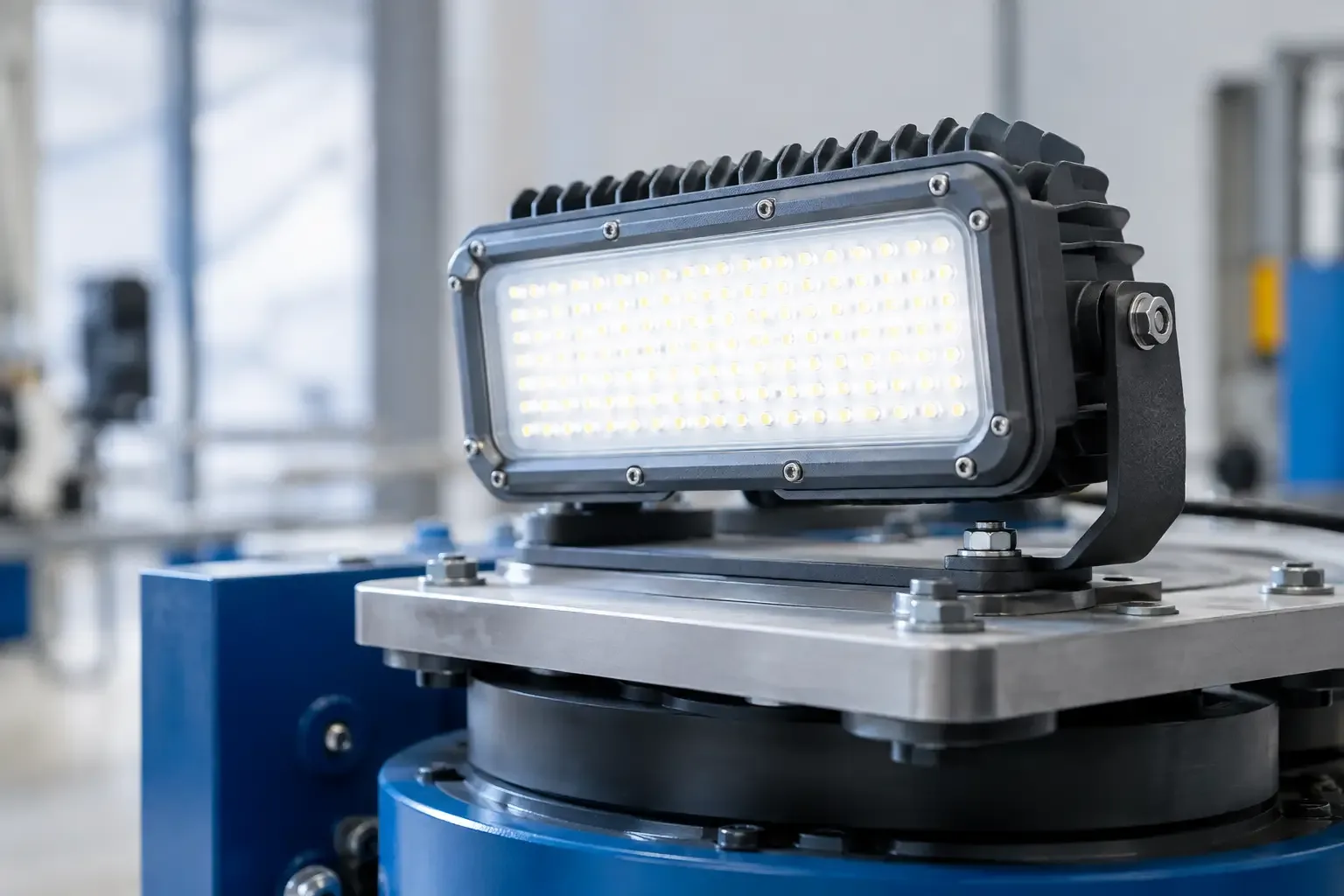
A fixture mounted above a stamping press, conveyor transfer point, crusher, or marine engine room experiences a different kind of service than one installed in a quiet warehouse aisle. Can LED lights withstand vibration? Often, yes - but only when the complete fixture, its mounting method, and its internal electronics are selected for the actual vibration exposure. An LED source has no filament to break, but that does not make every LED luminaire suitable for continuous mechanical shock.
At Maes Lighting, we have found that vibration-related lighting failures usually trace back to an application mismatch rather than the LED itself. The housing may remain intact while a driver connection loosens, a mounting bracket fatigues, a wire abrades, or repeated movement transfers stress into the circuit board. Industrial buyers should evaluate vibration as a fixture-system requirement, alongside ingress protection, ambient temperature, corrosion exposure, and hazardous-location classification.
Why LEDs Handle Vibration Better Than Legacy Sources
Traditional HID and fluorescent systems contain components that are inherently sensitive to repeated motion. Lamps, filaments, electrodes, glass tubes, ballasts, and lamp-holder connections can all be affected by vibration. An LED module is solid-state, with no filament or arc tube, so it generally tolerates vibration better than these legacy technologies.
That advantage is real, especially in facilities where relamping is difficult or disruptive. A properly engineered industrial LED fixture can reduce failures near rotating equipment, overhead cranes, processing lines, rail-loading areas, pumps, and heavy-duty conveyors. It can also reduce the maintenance exposure associated with accessing fixtures over active production areas.
However, “solid-state” is not a vibration rating. The LED package is only one part of the luminaire. The driver, wiring terminations, heat sink, lens retention, gasket system, mounting hardware, and junction-box connections all have to survive the same mechanical environment. A low-cost fixture may use LEDs that are capable of handling movement while relying on a driver or bracket that is not.
Can LED Lights Withstand Vibration in Severe Applications?
They can, provided the fixture is built and installed for the severity, frequency, and direction of motion present at the site. Vibration is not a single condition. A high-bay mounted near a rolling mill experiences a different loading profile than a floodlight on a bridge structure, a vapor-tight fixture on a food-processing conveyor frame, or a luminaire installed on a vessel.
Engineers commonly look at acceleration, frequency range, duration, and resonance. Acceleration may be expressed in g-force. Frequency is typically expressed in hertz. A fixture that performs well under low-frequency building movement may fail when exposed to the higher-frequency vibration generated by a motor, gearbox, fan, compressor, or reciprocating machine.
Resonance matters because a fixture or mounting arm can amplify input vibration when its natural frequency aligns with equipment vibration. This is why two similar fixtures can produce very different field results on the same floor. One may be mounted directly to a rigid structural member, while the other is suspended from a long pendant or flexible conduit that permits greater movement.
For sites with meaningful vibration, request the manufacturer’s test documentation rather than relying on a general statement that a product is “industrial grade.” The appropriate documentation depends on the project, but it may include vibration test results, mechanical drawings, mounting limitations, environmental ratings, and safety certifications from recognized organizations such as UL Solutions or Intertek. The project specification should also identify whether the reported test condition matches the installation environment.
The Components Most Likely to Fail
The driver is often the weak point in a vibration-prone LED fixture. Drivers contain electronic components and terminations that can be affected by repeated mechanical stress and elevated temperature. Heat accelerates the issue. A driver positioned in a hot fixture body near a furnace line or steel-processing operation is already under thermal load; vibration can compound the risk of premature failure.
Printed circuit boards and solder joints deserve similar attention. Repeated movement can fatigue solder connections, particularly when a board is poorly supported or when the fixture is subject to shock. Wire routing also matters. Conductors that contact sharp edges or move against metal surfaces can wear through insulation over time.
External hardware cannot be overlooked. Lens frames, captive screws, hinges, latches, yokes, trunnion mounts, and pendant adapters must remain secure. In wet, corrosive, or washdown locations, vibration can also work against seals and cable-entry fittings. A fixture may continue producing light while no longer maintaining the ingress protection that the application requires.
Start With the Mounting, Not Just the Fixture
A high-quality luminaire can still fail early if the mounting arrangement allows it to shake, sway, or flex. Before selecting a fixture, identify where the vibration originates and how it reaches the mounting point. Is the luminaire attached to the equipment frame itself? Is it mounted to building steel that receives transmitted vibration? Is it suspended from chain, aircraft cable, conduit, or a pendant stem?
Direct mounting to a stable structural surface is generally more favorable than a long, flexible suspension in a high-vibration area. That does not mean every fixture should be rigidly mounted. In some applications, isolation may be appropriate. The choice depends on the equipment motion, the fixture weight, maintenance access, and the manufacturer’s mounting instructions.
Do not improvise with brackets, clamps, or adapters that were not evaluated for the fixture. Substituting hardware can change heat dissipation, reduce enclosure integrity, compromise a hazardous-location listing, or create a point of fatigue. Torque mounting hardware correctly, use thread-locking methods where permitted, and inspect the installation after the equipment has operated under normal load.
Hazardous Locations Add a Compliance Requirement
In refineries, grain-handling operations, chemical processing areas, and similar hazardous locations, vibration resistance is only one part of the selection process. The fixture must first be suitable for the identified Class/Division or Zone, gas or dust group, temperature code, and ambient temperature.
An explosion-proof fixture is not automatically vibration-rated for every application, and a vibration-tested fixture is not automatically approved for hazardous locations. Both requirements need to be addressed. Enclosures, threaded joints, conduit entries, lenses, and mounting assemblies must remain intact under service conditions to preserve the equipment’s listed protection method.
This is particularly relevant on pump skids, compressor stations, offshore platforms, rail-loading systems, and equipment packages where vibration, corrosive air, and classified atmospheres may occur together. Documentation should be reviewed as a package: the listing mark, installation instructions, applicable certificate, mounting details, ambient limits, and any restrictions on orientation or cable entry.
Vibration, Washdown, and Corrosion Can Work Together
Food and beverage plants present a different but equally demanding scenario. Fixtures around packaging lines, mixers, conveyors, refrigeration equipment, and sanitation zones may encounter vibration while also being exposed to moisture, chemicals, and thermal cycling. A fixture selected only for washdown may not deliver the needed mechanical durability near vibrating equipment.
For sanitary areas, buyers should evaluate housing material, lens construction, gasket design, cable-entry sealing, and the appropriate IP rating for the cleaning process. NSF certification can be relevant where the application or customer standard requires it, but it does not replace a separate review of vibration conditions. NSF requirements, IP ratings, and mechanical test evidence each address different aspects of fixture suitability.
A stainless-steel, sealed fixture with a smooth exterior may be appropriate for frequent sanitation, yet its mounting method still needs to prevent repeated movement that can loosen hardware or stress the cable entry. Maintenance teams should include lighting in post-sanitation and preventive-maintenance inspections, especially when fixtures are mounted close to process equipment.
Questions to Ask Before Specifying a Fixture
The best specification begins with operational details. Identify the vibration source, whether the fixture is directly attached to machinery, the expected hours of exposure, and whether shock events occur during starts, stops, impacts, or material transfer. Include ambient temperature, moisture, chemical exposure, dust, corrosive atmosphere, and required electrical classification.
Ask the supplier for the fixture’s relevant test data and installation instructions. Confirm whether the driver is field-replaceable, what mounting configurations are approved, and whether the published ratings apply at the required ambient temperature. For larger projects, request datasheets, photometric files, certificates, and dimensional drawings early enough to resolve mounting and compliance questions before installation.
Field observation is valuable. Maintenance personnel often know which existing fixtures repeatedly flicker, loosen, or fail near particular machines. That information can reveal whether the issue is vibration, heat, power quality, washdown damage, or a combination of conditions. Replacing a failed fixture with the same mounting arrangement and no application review often repeats the problem.
LED lighting is well suited to vibration-prone industrial work when it is treated as engineered equipment rather than a commodity. Specify the fixture around the actual mechanical environment, protect its mounting integrity, and require documentation that supports the conditions your facility expects it to endure.