
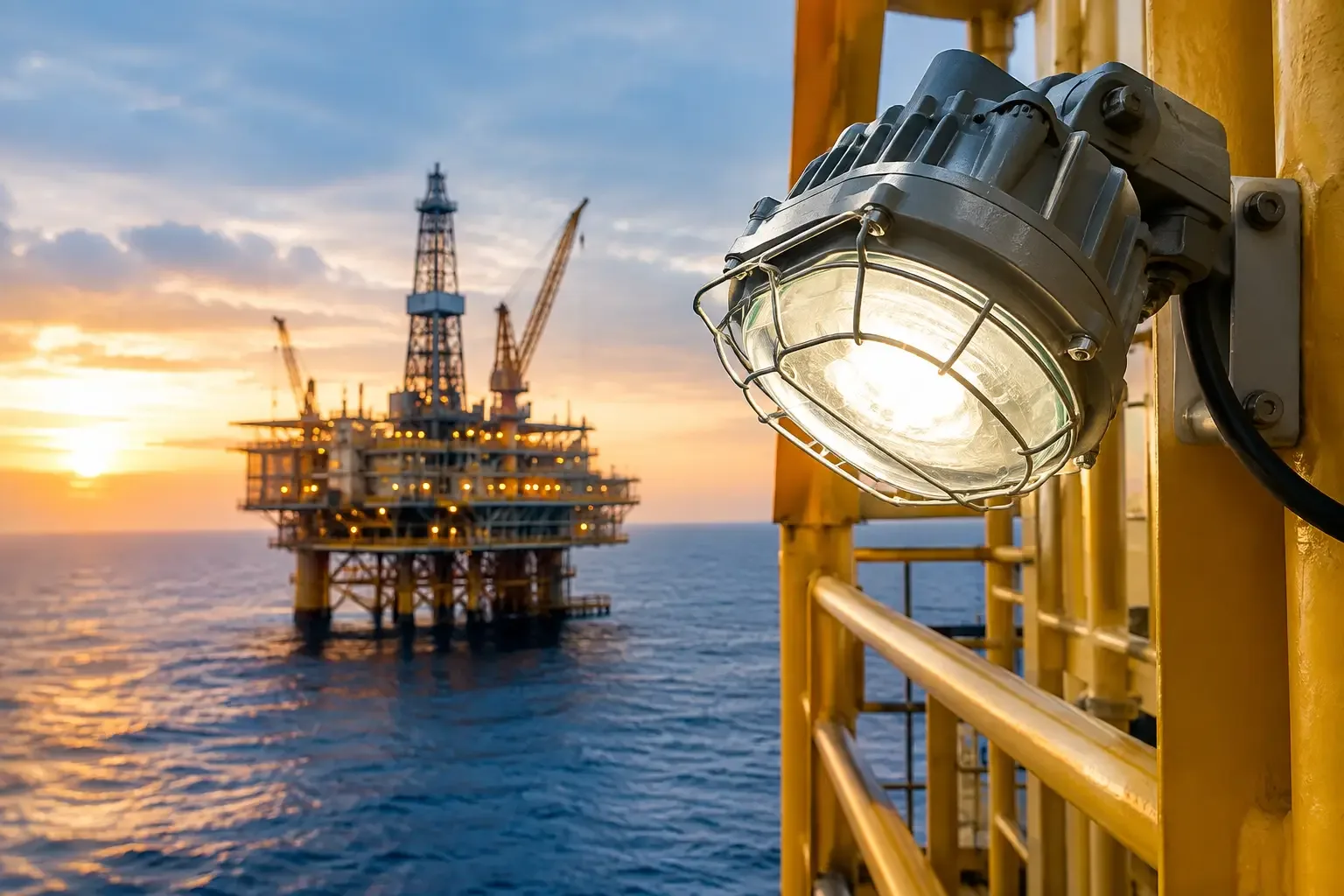
An offshore fixture can have the correct hazardous-location marking and still become a maintenance problem within a few seasons. Salt spray finds gasket weaknesses, vibration loosens poorly designed mounting hardware, and a poorly chosen optic can leave critical access routes or valve stations in shadow. The best explosion proof lights offshore are selected for the actual classified area, marine exposure, mounting location, maintenance access, and required illumination level - not simply by wattage or a generic “marine-grade” label.
For current fixture options and application support, review Maes Lighting’s explosion-proof lighting products when developing an offshore lighting schedule. A technical review should confirm hazardous-area certification, ambient-temperature limits, ingress protection, mounting configuration, photometric distribution, and the documentation needed for engineering submittals. That process is especially valuable when replacement fixtures must match an existing installation while improving energy use and maintenance intervals.
How to Select the Best Explosion-Proof Lights Offshore
The first selection question is not whether a fixture is bright enough. It is whether the fixture is approved for the location’s classified hazard. On U.S.-governed offshore facilities, the National Electrical Code classification commonly drives the specification. Class I locations involve flammable gases or vapors, while Class II locations involve combustible dust. Offshore oil and gas facilities most often require Class I equipment, but dust classifications can apply around material handling or specialized process areas.
A Class I, Division 1 fixture is intended for areas where ignitable concentrations may exist during normal operations, such as locations near wellheads, separators, vent areas, and some process equipment. Class I, Division 2 equipment is used where hazardous gases or vapors are normally contained but could be present under abnormal conditions. The difference affects acceptable fixture construction, installation cost, and available product choices. Specifying Division 1 equipment across an entire platform may add unnecessary cost and weight; specifying Division 2 equipment in a Division 1 space creates a safety and compliance issue.
Zone classifications may also appear on multinational projects. NEC Division and Zone systems address similar hazards but are not simple label substitutions. Zone 0, Zone 1, and Zone 2 classifications use a different methodology based on the likelihood and duration of hazardous atmospheres. IECEx and ATEX certifications can be relevant to project requirements, vessel operations, or international equipment packages, but the authority having jurisdiction and governing code determine what is acceptable for the installation.
The protection method matters as well. Ex d equipment contains an internal ignition within a flameproof enclosure. Ex e equipment relies on increased safety principles to reduce the chance of arcs, sparks, or excessive temperatures. Ex i intrinsically safe systems limit electrical energy so ignition is not possible under prescribed fault conditions. A lighting fixture’s marking must be read as a complete approval, including gas group, temperature code, ambient range, and the applicable class, division, or zone.
Marine Durability Is a Separate Requirement
Hazardous-location approval does not automatically prove that a fixture will tolerate offshore corrosion. The best explosion-proof lights offshore need enclosure materials, coatings, lenses, seals, cable entries, and fasteners suited to continuous salt-laden air. Die-cast aluminum with a quality marine-grade finish is common, while stainless-steel hardware can help limit corrosion at mounting points. Material compatibility still matters. Dissimilar metals, damaged coatings, and trapped moisture can accelerate galvanic corrosion.
Ingress protection should reflect the installation point. An IP66 rating addresses powerful water jets and airborne particulates, while higher protection such as IP67 may be valuable where temporary immersion or standing water is plausible. The rating should not be treated as a complete marine-performance statement. Review the manufacturer’s salt-spray testing, gasket design, drainage features, and temperature limitations alongside the IP rating.
Offshore vibration is another practical concern. Fixtures installed on handrails, pipe racks, crane structures, and equipment skids need mounting brackets designed to resist movement without concentrating stress on the housing. A fixture that is easy to mount on a warehouse ceiling may be a poor choice for a vibrating platform structure. Specify the mounting style early: pendant, ceiling, wall, stanchion, yoke, or pole mount. The wiring method, junction-box arrangement, and aiming access should follow that decision.
Light Distribution Determines Whether Crews Can Work Safely
Raw lumen output does not define useful offshore lighting. A high-output fixture with the wrong beam pattern can create glare across wet grating, reflective piping, and painted equipment. Conversely, a narrow floodlight may provide excellent long-throw coverage for a crane boom or landing area while leaving nearby walkways underlit.
For process decks and equipment zones, a broad distribution may provide more consistent horizontal illumination. For perimeter areas, access routes, pipe bridges, and vessel approaches, directional optics and controlled aiming often perform better. Photometric files allow designers to model fixture spacing, mounting height, light levels, and glare before equipment is ordered. This helps prevent the common outcome of adding more fixtures after commissioning because the original layout looked adequate on paper but did not account for obstructions.
Color temperature also deserves attention. Neutral white light is often selected for visual clarity and color recognition around process equipment, labels, and safety markings. Extremely cool light can appear harsh in fog or mist, while warmer color temperatures may reduce perceived contrast in certain work areas. The right choice depends on the task, existing facility standards, camera systems, and operating conditions.
Emergency coverage must be considered separately from normal illumination. Egress routes, muster areas, control access points, and critical shutdown equipment may need battery backup, emergency circuits, or a documented connection to the platform’s emergency power system. Do not assume that a standard hazardous-location fixture provides emergency operation unless the assembly is specifically designed, listed, and installed for that purpose.
Temperature, Heat, and LED Life Offshore
Ambient heat is easy to underestimate offshore, particularly near turbines, exhaust systems, compressors, process heaters, and enclosed equipment spaces. LEDs generally reduce energy use and maintenance compared with legacy sources, but they still require thermal management. Driver and LED junction temperatures affect lumen maintenance and service life.
What are the best high temperature lights for industrial use? The answer is the fixture with a documented maximum ambient rating that exceeds the real temperature at the mounting location, with margin for radiant heat, solar loading, and restricted airflow. A fixture rated for a moderate ambient may not survive above a hot process line simply because it carries a hazardous-location approval. Thermal derating data and maximum ambient specifications should be included in the submittal review.
Documentation and Procurement Details That Prevent Delays
Offshore projects move faster when the lighting schedule identifies the exact certification, voltage, mounting, optic, finish, cable entry, and emergency requirement for each location. Procurement teams should request datasheets, certification documents, photometric files, installation instructions, and lead-time confirmation before releasing an order. If a fixture will be used in Canada, ensure its approvals and labeling fit the governing Canadian requirements rather than assuming a U.S. listing alone is sufficient.
For projects with domestic-content obligations, confirm coverage at the individual model level. Maes Lighting identifies the Explosion Proof IR1, IR3, IR4, and IR7 series as products covered under the Buy America Act. CIT models within the vapor-tight product line are also covered. Requirements can differ by funding source and project terms, so contractors and owners should obtain the applicable compliance documentation during the submittal stage rather than after material has been delivered.
The right offshore fixture is the one that aligns hazardous-area approval with the platform’s corrosive exposure, mounting realities, thermal conditions, and lighting design. A careful application review before purchase is far less disruptive than replacing unsuitable equipment over open water after the facility is operating.