
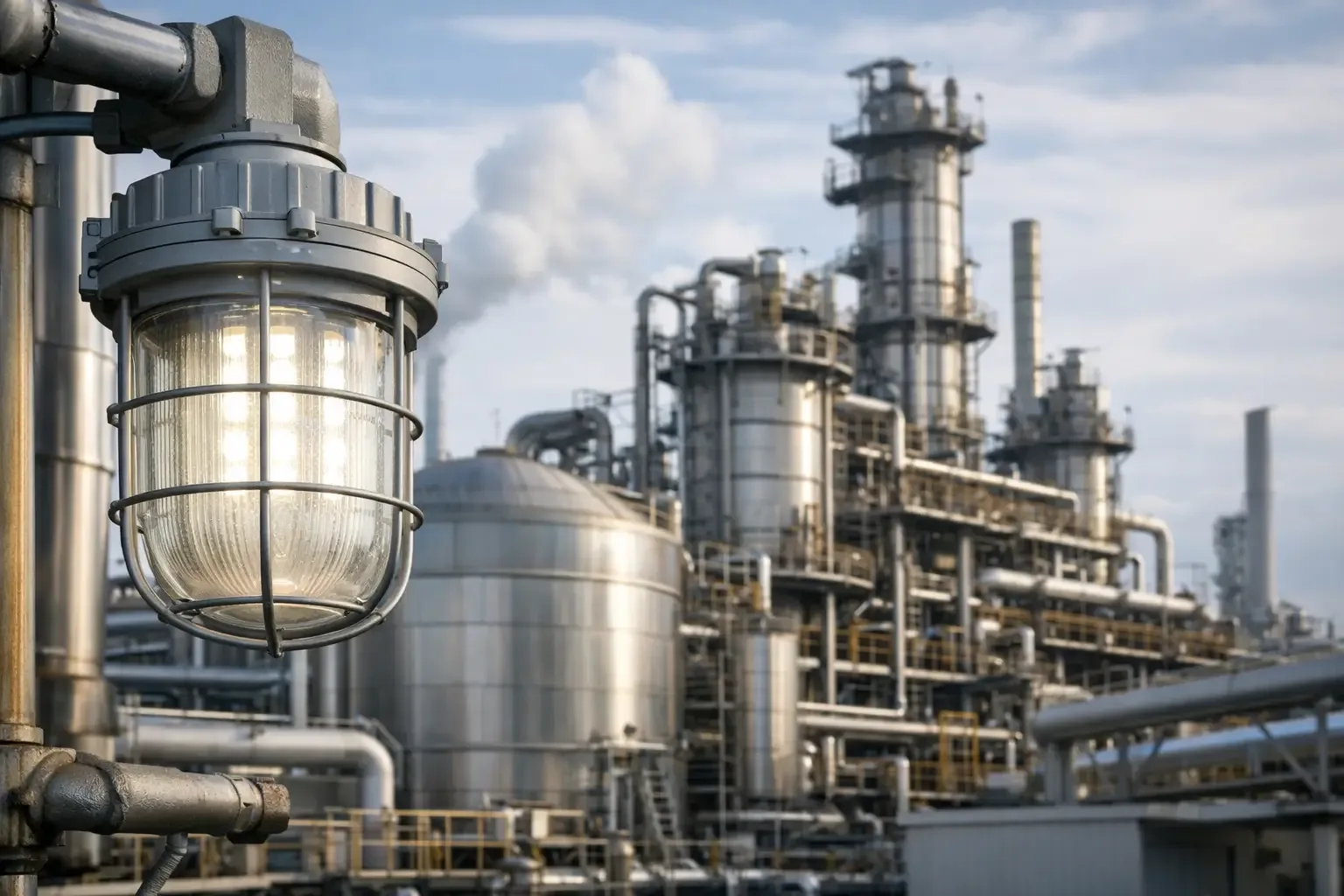
A chemical plant lighting failure rarely begins with a dramatic event. More often, it starts as discoloration at a housing seam, a corroded conduit hub, a clouded lens, or water intrusion around a compromised gasket. Corrosion resistant lighting for chemical plants must withstand more than moisture. It must perform through vapor exposure, airborne contaminants, washdown, temperature cycling, vibration, and, in many process areas, hazardous-location requirements.
For help matching fixtures to chemical exposure, area classification, mounting conditions, and project documentation, contact Maes Lighting for corrosion-resistant lighting guidance tailored to your facility. A fixture that appears suitable on a cut sheet can still be the wrong choice if its housing alloy, lens, coating, cable entry, or gasket material is incompatible with the actual process environment.
Why Corrosion Changes the Lighting Specification
Corrosion is not one condition. Acids, alkalis, salts, oxidizers, solvents, chlorine compounds, sulfur-bearing gases, and process vapors attack materials differently. A fixture that lasts for years in a damp utility room may degrade quickly above a chemical tank, near an unloading rack, or in a wastewater treatment area.
The practical risk is larger than cosmetic damage. Corrosion can weaken mounting hardware, compromise ground continuity, damage seals, reduce light output through lens degradation, and create paths for moisture or contaminants to enter the enclosure. In hazardous locations, degradation also raises concerns about whether the fixture continues to protect its internal ignition sources as intended.
This is why a general-purpose industrial LED fixture is not automatically a chemical-plant fixture. The selection must begin with exposure conditions, not wattage or initial lumen output.
Identify the Exposure Zone
A useful application review separates the facility into exposure zones. Exterior pipe racks may face rain, UV, salt air, and industrial fallout. Indoor processing areas may see acidic vapor or intermittent chemical splash. Loading areas can combine vehicle vibration, weather, and flammable vapor classification. A room with no direct washdown may still have corrosive airborne compounds that settle on housings and hardware over time.
Ask what reaches the fixture during normal operation, cleaning, upset conditions, and maintenance. Also ask how long the exposure remains on the surface. Brief incidental splash and continuous vapor exposure can require very different material and sealing strategies.
Material Selection Is the First Line of Defense
Housing material matters, but it is only one part of the assembly. The best choice depends on the chemical, its concentration, temperature, contact duration, and the presence of mixed contaminants.
Copper-free aluminum with a quality protective finish is widely used for industrial and hazardous-location luminaires. It offers manageable weight, good thermal performance, and broad availability in explosion-proof designs. Its limitation is chemical compatibility. Certain acids, alkalis, or damaged coatings can accelerate attack on the substrate, especially around fasteners, threads, and edges.
Stainless steel can provide better resistance in many corrosive applications, particularly where washdown, moisture, or chlorides are present. However, not all stainless grades perform equally, and stainless is not immune to chemical attack. Chloride-rich conditions, elevated temperature, and crevice locations can still create problems. For severe chemical service, a material compatibility review should address the complete fixture, including brackets, glands, latches, screws, and exposed hardware.
Fiberglass-reinforced polyester and other engineered polymer housings are common in vapor-tight and nonmetallic industrial fixtures. They can resist many chemicals effectively and avoid some metal-corrosion concerns. Their trade-offs include temperature limits, UV performance, mechanical impact requirements, and suitability for the intended hazardous classification. A nonmetallic enclosure should never be selected solely because it will not rust.
Lens material deserves the same scrutiny. Polycarbonate handles impact well but may craze or discolor with some solvents and chemical vapors. Acrylic, borosilicate glass, and tempered glass each bring different benefits and limitations. A clear lens that turns hazy can reduce delivered illumination long before the LED driver reaches the end of its expected life.
Seals, Entries, and Hardware Often Determine Service Life
A corrosion-resistant housing cannot compensate for a failed gasket or poorly selected conduit entry. Chemical plants should evaluate the full path from the electrical system to the enclosed components.
Gaskets and O-rings may be silicone, EPDM, nitrile, fluorocarbon, or other compounds. Each has different resistance to oils, solvents, acids, heat, and cleaning agents. The correct elastomer depends on the exposure profile, not on a generic claim that a fixture is "chemical resistant."
Cable glands, conduit hubs, drain provisions, and mounting interfaces also need attention. Condensation can collect inside conduit runs and migrate toward luminaires. In outdoor installations, standing water at a horizontal entry or mounting point can shorten fixture life. Specify suitable fittings, sealing methods, and mounting orientation as part of the installation, not as afterthoughts.
Fasteners are another common weak point. If the housing survives but brackets, hinges, latches, or aiming hardware corrode, the installation still becomes a maintenance problem. This is especially relevant for floodlights, wall packs, and fixtures mounted in difficult-to-access process areas.
Corrosion Ratings Do Not Replace Hazardous-Location Compliance
Ingress protection and enclosure ratings provide useful information, but they do not answer every selection question. An IP rating addresses resistance to ingress of solids and water under defined test conditions. A NEMA enclosure rating may indicate environmental protection characteristics. Neither rating by itself confirms that a fixture is suitable for a classified area or compatible with a specific chemical.
Where flammable gases, vapors, combustible dust, or ignitable fibers are present, the luminaire must match the area classification. That may require explosion-proof lighting, intrinsically safe equipment, or another approved protection method based on the site design and applicable code. Class, Division, Zone, gas group, temperature code, ambient temperature, and mounting arrangement all matter.
Corrosion and hazardous-location requirements frequently overlap, but they are separate design questions. A high-quality explosion-proof fixture may need an upgraded finish or different material for corrosive service. Conversely, a vapor-tight fiberglass fixture may resist chemical exposure well but lack the required hazardous-location listing. The correct answer is the fixture that satisfies both conditions.
Verify Temperature at the Fixture, Not Just the Room
Chemical processes can create localized heat near vessels, piping, dryers, furnaces, and ceiling pockets. Heat speeds chemical reactions, affects gasket life, and can push drivers or LEDs beyond their rated ambient limits. It also affects hazardous-location temperature-code compliance.
Document the expected ambient temperature at the mounting point, including radiant heat and abnormal operating conditions. High-temperature lighting may be necessary where a conventional LED fixture would suffer accelerated driver failure, lumen depreciation, or listing limitations.
A Practical Specification Process for Chemical Plant Lighting
Start with a site-specific exposure description. List the chemicals, concentrations if available, whether exposure is vapor, splash, immersion, or washdown, and the expected frequency. Include cleaning agents. Many fixtures fail because the cleaning chemical was not considered during initial procurement.
Next, establish the electrical and regulatory requirements: voltage, mounting height, emergency-lighting needs, area classification, temperature code, ingress protection, and required approvals. Then define photometric needs. Corrosion resistance does not eliminate the need for adequate vertical illumination at valves, gauges, stairs, platforms, and egress routes.
Finally, compare fixture assemblies rather than headline features. Review the housing, lens, gasket, finish, driver compartment, entries, mounting hardware, and available documentation. For project submittals, request datasheets, certifications, dimensional drawings, photometric files, and hazardous-location markings early. This reduces the chance that a fixture is approved electrically but rejected by engineering or operations due to material concerns.
Maintenance Still Protects the Investment
Even correctly specified corrosion-resistant fixtures benefit from inspection. Establish a routine that checks lens clarity, gasket condition, coating damage, loose mounting hardware, corroded fittings, water accumulation, and changes in light level. In high-exposure areas, cleaning procedures should use agents verified as compatible with the fixture materials.
Do not treat repeated fixture failures as a lamp or driver issue alone. A pattern of failed seals, oxidized hardware, or cracked lenses usually points to an environmental mismatch. Correcting the specification may cost more initially, but it can prevent repeated lifts, shutdown coordination, replacement labor, and lighting gaps in safety-critical areas.
The right chemical plant luminaire is not simply the fixture with the highest ingress rating or the heaviest housing. It is the documented, code-appropriate assembly whose materials and construction match the chemical reality at the exact point where it will operate.