
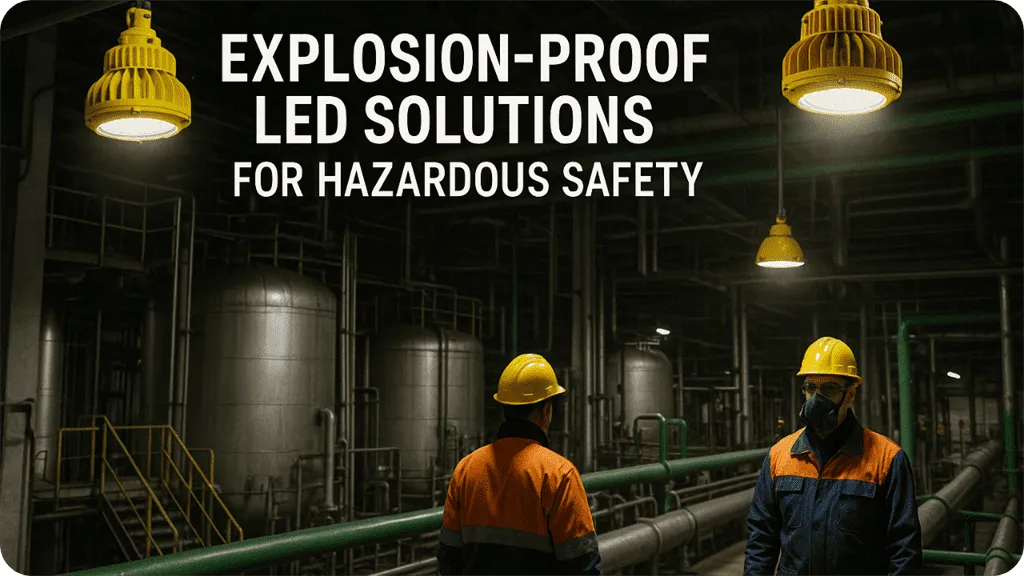
Explosion proof LED lighting exists to do one job without fail: keep a spark or a hot surface inside the fixture from reaching a flammable gas, vapor, or combustible dust cloud outside it. Getting that right is a matching exercise — the documented classification, wattage, and environmental rating of the fixture against the actual conditions in the space — not a search for the toughest-looking housing on the page. Oil and gas facilities, chemical and petrochemical plants, grain and milling operations, and paint booths are the settings where this decision comes up most often, and where getting it wrong carries the highest cost. This guide works through how Maes Lighting's explosion proof LED families are classified and rated, what separates LED from the fluorescent fixtures many facilities are still running, and what a specifier or facility engineer should check before an order goes in.
Explosion proof is a specific answer, not a general one
"Explosion proof" describes a particular method of containment: a sealed, rated enclosure built to withstand and contain an internal ignition so it cannot reach the surrounding atmosphere. It is one category within the broader hazardous-location lighting field, alongside intrinsically safe and purged/pressurized designs, and it is not automatically interchangeable with a vapor-tight or washdown-rated fixture that solves a moisture problem rather than an ignition one. If the project brief uses "hazardous location" and "explosion proof" as if they mean the same thing, resolve that before ordering — the wrong enclosure type for the actual hazard is a compliance failure even if every other spec matches.
Start with the area's classification, not the fixture
Before comparing products, confirm the hazard classification for the space itself: Class, Division (or Zone), Group, and the required temperature code. That determination comes from the facility's hazardous-area classification study, not from a lighting catalog, and it decides which families are even eligible for the job. Selecting LED Hazardous Location Lighting works through the Class I, II and III system and the Division/Zone distinction in detail. This guide picks up from there and focuses on matching a documented Maes Lighting family to that classification once it is known.
What to check before specifying explosion proof lighting
Once the classification is known, four things separate a fixture that will pass inspection from one that will not.
- Certification match. The fixture's UL844, ATEX or IECEx marking has to cover the exact Class, Division/Zone, Group and temperature code documented for the space — not a related classification from the same family. A Division 2 listing does not cover a Division 1 area.
- Environmental resistance. Ingress protection (IP66 is standard across the families below) and impact resistance (IK10 on several of them) matter as much in a washdown or corrosive process area as the electrical classification does.
- Voltage compatibility. Most of these families run on a dual 100–277 V or 200–480 V input, which simplifies specifying across sites with different service voltages — confirm the exact range on the family's own page before ordering.
- Application fit. A linear fixture, a flood light, a portable work light and an exit/emergency combo solve different problems even within the same classification. Match the form factor to the task before comparing wattage.
- Mounting and access. Confirm the fixture's mounting method — wall bracket, ceiling bracket, pendant or surface — against the structure it will attach to, and account for how it will be reached for the seal and lens inspections covered below. A fixture that is technically correct but impossible to service safely creates its own maintenance risk.
Light output and color rendering belong on this list too, but only where the family's own spec sheet publishes a number — several of the families below do not, and a generic "high CRI" or "high lumen" claim is not something a submittal reviewer can verify against anything.
Which explosion proof LED family fits the application?
Maes Lighting publishes ordering data for eight explosion proof LED families, each with its own documented wattage range, output and ratings. The linear families (EXI, IR4, IR7, EXH) generally serve corridors, process areas and general illumination inside a classified building or enclosure; the flood families (EX-C, EXD) serve tank farms, exterior process equipment and other large outdoor areas; and EX-MV01 and EX-ES03 solve two narrower problems — temporary work light for maintenance inside a classified space, and code-required emergency/exit illumination that itself has to be rated for the hazard around it. The table below summarizes what is published for each; the linked family page carries the full ordering table, dimensions and the manufacturer's PDF.
| Family | Type | Wattage | Lumens | Voltage | Documented ratings |
|---|---|---|---|---|---|
| EXI | Linear | 20–120 W (5 configurations) | 2,800–16,800 lm | 100–277 V or 200–480 V | UL844 C1D1, C1D2, C2D1, C2D2, Class III; IP66; IK10 |
| IR4 | Linear · 2 ft and 4 ft | 40–80 W | 5,000–13,000 lm | 120–277 V AC; 347 V / 480 V options | UL595, UL844, UL924, UL1598 Marine (C-UL Canada); 5-year warranty |
| IR7 | Linear | 80–240 W (4 configurations) | 8,800–26,400 lm | 120–277 V AC | UL844 Class I Division 2, Groups A–D; UL1958; 5-year warranty |
| EXH | Linear | 10–60 W (7 configurations) | 1,400–8,400 lm | 100–277 V or 200–480 V | UL844 Class I Div 2 Groups A–D; Class II Div 1 & 2 Groups E–G; Class III; NEMA 4X/IP66; 5-year warranty |
| EX-C | Flood | 20–300 W (7 configurations) | Published for 100 W, 200 W and 300 W only: 14,000 / 28,000 / 42,000 lm | 100–277 V or 200–480 V | ATEX/IECEx Ex db IIC T6 Gb; IP66; UL1598A marine; ABS and DNV type approved |
| EXD | Flood / high bay | 60–300 W (7 wattage options) | Not published per wattage | 100–277 V or 200–480 V | UL844 C1D1 Groups C,D; C1D2 Groups A–D; C2D1/C2D2 Groups E–G; Class III; ATEX/IECEx; IP66, IK10 |
| EX-MV01 | Portable work light | 5–19.5 W | Up to 1,600 lm (high mode) | 10.8 V battery, up to 10 h runtime; AC 100–277 V charger | UL844 C1D1 Groups A–D, T4; Class I Zone 0 AEx ia IIC T4 Ga; IP66 |
| EX-ES03 | Exit / emergency combo | 2×5 W heads, plus a 3–5 W legend on combo models | Not applicable to this fixture type | 120–277 VAC, or 100–277 VAC / 12–48 VDC on the combo model | UL844, UL924 (ETL); NEMA 4X; IP66, IK10; C1D1/C1D2, C2D1/C2D2, Class III; 3-hour battery backup; 50,000-hour documented lifespan |
EXI, EX-C, EXD, EX-MV01 and EX-ES03 are documented for Class I Division 1 service; EXH and IR7 are documented for Class I Division 2 only. IR4 is documented for Class I, Division 1 (Groups C, D) and Class II, Division 1 and 2 (Groups E, F, G) service, with UL 844 among its listings — see the IR4 family page for the full marking and model table.
Why LED has replaced HID and fluorescent in hazardous areas
Three properties make LED the default choice for new explosion proof installations. LEDs are solid state, so there is no filament or gas discharge to fail and no mercury to manage at disposal — a real difference from fluorescent tubes, which contain mercury and are regulated as universal waste under EPA rules at end of life. LEDs also run at full output the instant power is applied, where HID sources need a warm-up period and a re-strike delay after any interruption, which matters in an area where the lighting is also part of the emergency egress path. The U.S. Department of Energy's overview of solid-state lighting covers the underlying efficiency and lumen-maintenance mechanics in more detail than a product page can.
None of that substitutes for checking the numbers on the family you are actually specifying. The table above is the place to start: confirm wattage, lumen output and voltage against the fixture schedule before assuming a general LED advantage carries over to a specific model.
LED or fluorescent: how long do the two actually last?
This is the specific question that keeps coming up on fluorescent-to-LED retrofits, and it deserves a straight answer rather than a single headline number. Fluorescent tubes are commonly rated in the range of 10,000 to 20,000 hours of service before replacement, a figure the Department of Energy has published in its lighting research. LED light sources are typically evaluated differently, against an L70 threshold — the point at which output has fallen to 70 percent of initial lumens — and general-purpose LED fixtures are commonly rated on the order of tens of thousands of hours to that point.
Where the fixture's own documentation states a number, that is the figure to use. Maes Lighting's EX-ES03 explosion proof exit and emergency combo is the one family in this line-up with a lifespan explicitly stated on its spec sheet: 50,000 hours. The general-illumination families above it in the table — EXI, IR4, IR7, EXH, EX-C and EXD — do not publish a lifespan-hours figure in their current spec sheets, so treat any specific number for those families as unconfirmed until it appears on the manufacturer's documentation, rather than carrying over a figure from a different product line.
Installing and maintaining explosion proof LED fixtures
The fixture only performs to its rating if it goes in correctly and stays that way.
- Use a qualified electrician familiar with the wiring methods NFPA 70 (the National Electrical Code) requires for the specific Class and Division, including conduit sealing at the fixture and at any boundary between classified and unclassified areas.
- Verify the temperature code against the actual ambient at the mounting location, not a standard office-temperature assumption — a fixture near a furnace, kiln or process line can run hotter than its rating assumes.
- Inspect seals, lenses and gaskets on a schedule. An explosion proof enclosure only contains an internal event if it is fully closed and its seals are intact; a cracked lens or a loose cover compromises the rating even if the fixture still lights.
- Ground every fixture per NFPA 70 requirements, and keep mounting hardware torqued to the manufacturer's specification rather than a field-judgment amount.
- Keep the documentation on file — the exact catalog number ordered, its classification markings, and the manufacturer's spec sheet — so a future audit or an insurance review can confirm what is actually installed against what the area requires.
Where explosion proof LED technology is heading
A few directions are consistent across the hazardous-location lighting industry, independent of any one manufacturer's current catalog:
- Higher ingress and impact ratings as a baseline. IP66 and IK10 are increasingly the starting point rather than a premium option, driven by washdown and outdoor exposure requirements alongside the explosion rating itself.
- Better thermal management. As drivers and LED arrays are pushed for more lumens per fixture, heat-sink and thermal design inside a sealed enclosure becomes the limiting factor — UL's hazardous-location listing work reflects this in the temperature-code testing it requires.
- Continued efficacy gains. Lumens-per-watt for LED sources has moved consistently upward for over a decade, tracked in the Illuminating Engineering Society's ongoing lighting research, which is part of why a modern LED replacement can match or exceed the output of the fluorescent or HID fixture it replaces at a lower wattage.
- Longer warranty terms as a proxy for confidence. Several of the families above already carry five-year manufacturer warranties, a meaningfully longer term than the one- to two-year terms common on legacy fluorescent hazardous-location fixtures.
Treat any dimming, control or connectivity feature as unconfirmed for a specific family until it appears on that family's own spec sheet — the ratings and features that matter for a hazardous-location purchase are the ones documented for the exact catalog number being ordered, not a general trend claimed for the category.
Putting it together
Start with the area's classification, confirm it against Selecting LED Hazardous Location Lighting if the Division or Zone distinction is not already settled, then match that classification to one of the eight families above. The explosion proof lighting category page carries the full product range and comparison data; each family's own page carries its complete ordering table, dimensions and the manufacturer's PDF. A documented installation — the Chemical Plant IR4 upgrade covered in this Class I Division 1 project — shows what that classification-first process looks like in a real facility.