
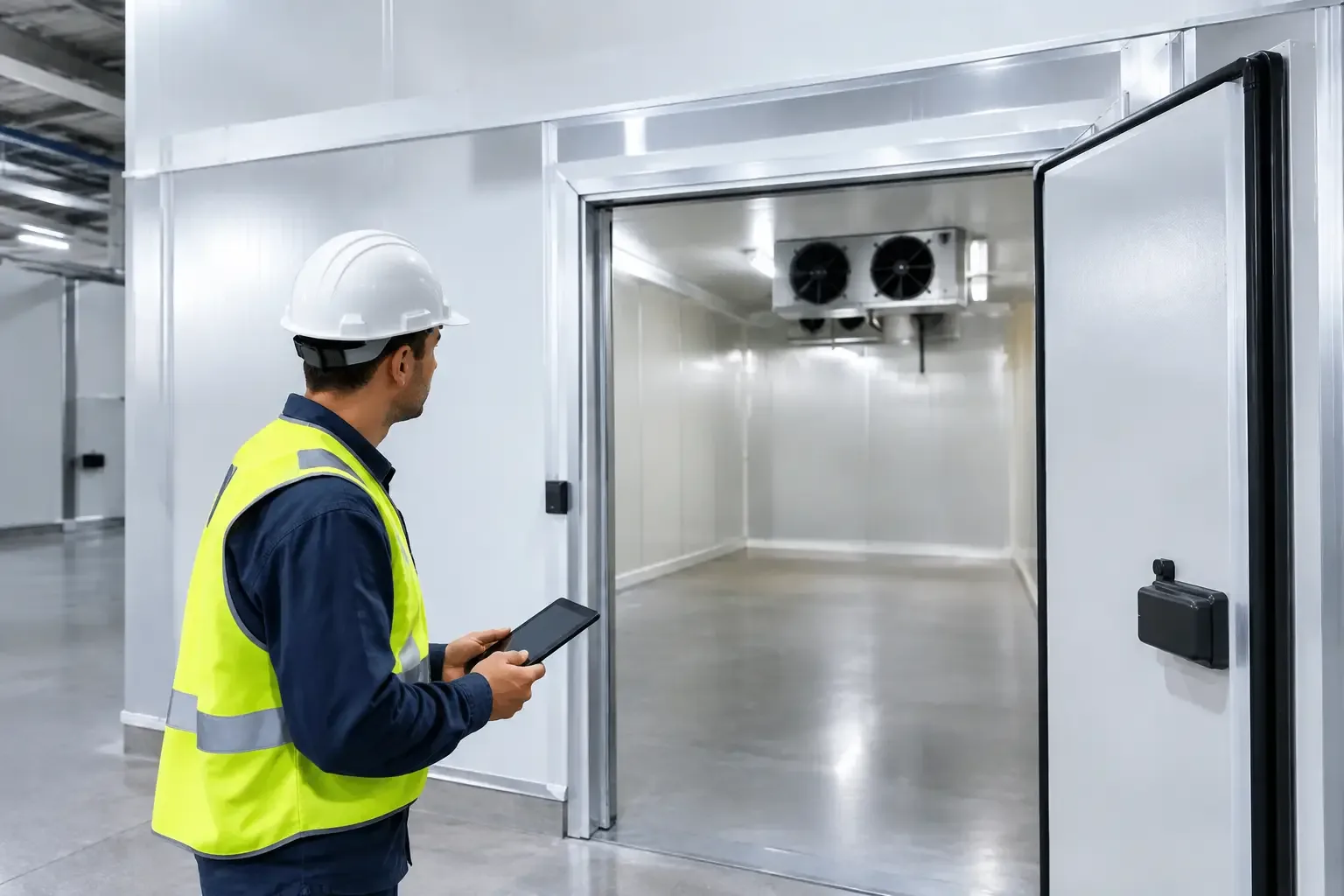
A freezer room retrofit is rarely just a fixture replacement. A facility may be trying to reduce maintenance calls, improve visibility around racks and dock doors, correct condensation-related failures, or meet a customer’s food-safety expectations. In each case, the lighting system has to perform through low ambient temperatures, frequent door cycling, moisture migration, washdown exposure, and the practical realities of maintenance access.
At Maes Lighting, we have found that successful cold-storage projects begin with a site-condition review rather than a wattage comparison. The lowest-priced fixture can become the most expensive choice if seals fail, drivers struggle at startup, optics create glare on frost, or crews need lifts repeatedly to replace fixtures above occupied storage areas. The following steps help facilities scope a freezer room retrofit around operating conditions, compliance requirements, and long-term uptime.
1. Define the actual temperature zones
A freezer complex is not one environment. The receiving area, ante-room, blast freezer, storage room, loading dock, and evaporator corridor can each present different ambient temperatures, humidity levels, and maintenance constraints. Document the normal and minimum ambient temperature in each area, along with how rapidly conditions change when doors open or product moves through the facility.
This distinction matters because a fixture that operates reliably in a 25°F loading area may not be suitable for a -10°F storage room or a blast-freeze application. LED drivers, gaskets, lenses, and battery-backed emergency components all have temperature limitations. Review the manufacturer’s published minimum operating temperature, not simply the fixture’s general product category.
Temperature also affects light output and startup behavior. LEDs often produce strong output in cold conditions, but the electronic driver must be rated to start and operate at the actual ambient temperature. A fixture with an unverified low-temperature driver can cycle, fail to start, or experience shortened component life when the room is at its coldest.
2. Treat moisture and condensation as primary design conditions
Water rarely stays where a freezer room design intends it to stay. Warm, humid air enters during door openings, then condenses on cold surfaces. Defrost cycles can introduce water and vapor. Cleaning procedures may add further exposure. These conditions make ingress protection and enclosure design central to fixture selection.
For many refrigerated and freezer areas, vapor-tight lighting with an appropriate IP rating is a practical baseline. The right rating depends on the exposure. An IP65 fixture may resist dust and low-pressure water jets, while IP66 provides stronger protection against powerful water jets. In sanitation-intensive food operations, IP69K-rated food processing lighting may be appropriate where fixtures are exposed to high-pressure, high-temperature washdown.
The rating alone does not tell the whole story. Inspect how the lens, conduit entry, end caps, mounting hardware, and gasket system work together. A fixture can carry a suitable IP rating yet still be a poor application fit if its cable glands, mounting points, or external fasteners are not suited to the cleaning chemistry and moisture level on site.
3. Match the sanitation requirement to the fixture construction
Freezer rooms serving food and beverage operations need lighting that supports the facility’s sanitation program, not equipment that becomes a difficult-to-clean contamination concern. Smooth external surfaces, sealed housings, corrosion-resistant materials, and protected fasteners can reduce places where debris and moisture collect.
Facilities should distinguish between a fixture designed for damp or cold environments and one intended for direct washdown in food-processing spaces. NSF standards are often part of that conversation. NSF/ANSI 2 addresses food equipment, while NSF/ANSI 51 covers materials used in food equipment and can be relevant when evaluating construction materials and cleanability. The exact standard required depends on the facility’s process, customer requirements, and inspection criteria.
Consult the current documentation from NSF, UL Solutions, or Intertek when a project specification calls for a particular certification or listing. The compliance file should match the fixture being purchased, including its model number and applicable configuration. Generic claims of being “food grade” do not replace a project submittal package.
4. Design lighting levels around tasks, not empty-floor averages
A cold room can appear adequately illuminated in a simple footcandle calculation while still creating operational problems. Forklift operators need to see rack labels, pedestrians need to identify icy patches and pallet obstructions, and order selectors need vertical illumination on cartons and pick faces. Dock transitions need particular attention because workers’ eyes are adapting between brighter and darker areas.
A lighting layout should consider horizontal light on the floor, vertical light on storage faces, glare control, shadows created by racking, and the reflectance of frost-covered surfaces. High-output industrial LED fixtures may reduce fixture count, but high mounting heights or narrow optics can create harsh contrast and shadowing if they are not modeled for the rack arrangement.
Photometric files are useful here. A competent layout uses the fixture’s actual distribution, mounting height, spacing, and obstructions rather than assuming a nominal lumen figure will produce usable visibility. This is especially valuable when racks are reconfigured or when a retrofit shifts from older linear fixtures to LED high bays.
5. Plan for cold-room maintenance before choosing the mounting method
Maintenance in a freezer is more disruptive than maintenance in a typical warehouse. Lift access may require product moves, workers may need specialized PPE, and the time spent inside the room is limited by safety and productivity considerations. A retrofit should reduce the frequency and difficulty of future service calls.
Choose mounting and wiring methods that maintain the enclosure integrity. Conduit entries must be properly sealed, and mounting hardware should resist corrosion in the room’s moisture conditions. Where vibration from refrigeration equipment is present, verify that fixture mounts and hardware are suitable for the expected movement.
Drivers are a common point of concern. Remote-driver arrangements can make service easier in some applications, but they add wiring complexity and must be designed around voltage drop, access, and environmental protection. Integral drivers simplify installation but may require replacement of the entire fixture or service at elevation. Neither approach is automatically better. The right answer depends on room layout, fixture location, and maintenance practices.
6. Address emergency lighting and controls separately
Emergency egress requirements do not disappear because a room is cold. Yet battery performance is reduced in low temperatures, making standard emergency units a poor fit for many freezer applications. Verify both the ambient rating of the emergency equipment and the method used to maintain required illumination during a power loss.
Some facilities locate emergency power components outside the freezer envelope, while others use equipment specifically rated for cold ambient service. The installation must align with the adopted electrical and life-safety codes, authority having jurisdiction requirements, and the facility’s emergency-power strategy.
Controls deserve the same scrutiny. Occupancy sensors can reduce energy use in intermittently occupied rooms, but they must detect movement reliably through racking aisles, PPE, and forklift traffic. Time delays should support safety and operations rather than switching lighting off while personnel are still working in an aisle. In high-traffic freezer rooms, continuous operation may be the more practical choice despite the theoretical energy savings from aggressive controls.
7. Build a submittal package before equipment arrives
The best time to find a certification gap is before purchase orders are released. For a freezer room retrofit, the submittal package should typically include product datasheets, photometric files, applicable listing or certification documentation, ingress-protection information, operating-temperature limits, warranty details, and installation instructions.
Confirm voltage, mounting, lens material, color temperature, surge protection, and any options that affect the final fixture configuration. If the room is part of a food-processing operation, document how the selected product supports the facility’s sanitation and washdown requirements. If an area has combustible dust, flammable vapor, or other hazardous-location conditions, the classification must be evaluated independently and the fixture must be selected for that classified location.
A practical retrofit also includes a commissioning walk-through. Check for dark rack faces, glare at forklift intersections, condensation around entries, and fixtures obstructed by new equipment. Those observations often identify small installation corrections that protect the value of the entire project.
A freezer room does not give lighting equipment many chances to recover from a poor specification. Select fixtures around the true cold, moisture, sanitation, and maintenance conditions, then verify the documentation before installation. That approach helps keep crews productive, product areas visible, and maintenance work out of the freezer where it belongs.