
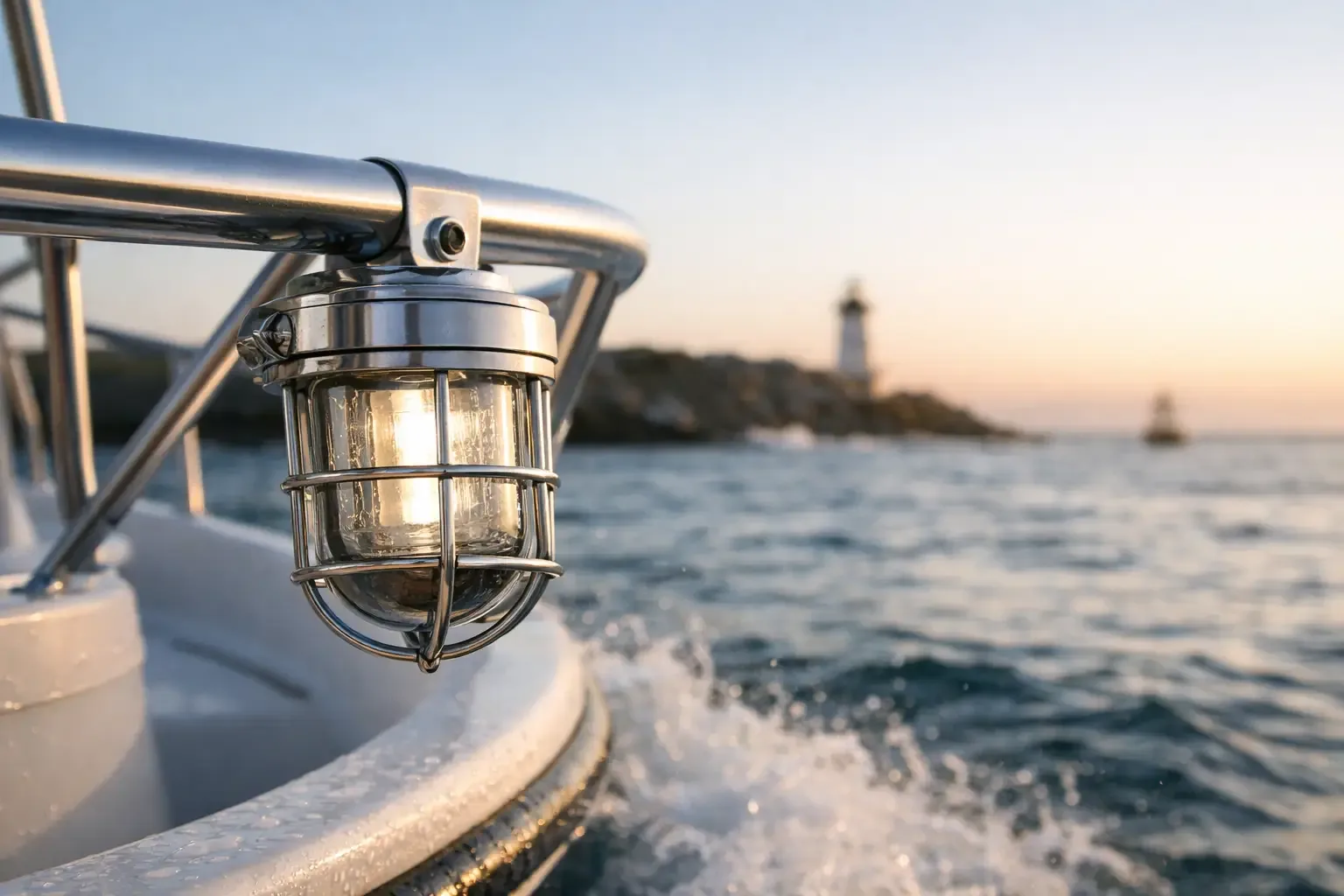
Saltwater does not need a large opening to shorten a fixture’s life. It works into gasket joints, fasteners, cable entries, heat sinks, and dissimilar-metal connections, then combines with vibration, UV exposure, and temperature swings to create failures that may not be visible during initial commissioning. Marine grade lights for saltwater must therefore be selected as a system of housing materials, seals, mounting hardware, electrical protection, and documented ratings - not simply as an LED fixture with a marine label.
For applications on vessels, docks, terminals, shipyards, and coastal process facilities, Maes Lighting can assist with marine fixture selection, technical documentation, photometric files, and application review. The right specification starts with the exposure level and installation location, then confirms the product’s ingress protection, corrosion resistance, mounting arrangement, voltage, and any hazardous-location requirements before equipment is released for the project.
Why Saltwater Changes the Lighting Specification
Marine exposure is more demanding than ordinary wet-location service. Freshwater and rain can cause problems, but chlorides in saltwater accelerate corrosion and can remain on surfaces after water evaporates. A fixture installed under a canopy near a berth may never be submerged, yet windblown salt spray can still collect in crevices and on mounting points every day.
The result is often not a sudden fixture failure. More commonly, the installation develops a chain of smaller problems: corroded hardware makes service difficult, a compromised gasket allows moisture into the driver compartment, a cable gland loses its seal, or oxidation reduces thermal performance. LEDs may continue operating while light output, reliability, and safe maintainability decline.
This is why a standard outdoor fixture is not automatically suitable for marine duty. Its wet-location listing may address rain exposure, but it may not address sustained salt spray, deck washdown, vibration, or the material compatibility issues found at docks and aboard vessels.
What “Marine Grade” Should Mean in a Submittal
Marine grade is frequently used as a product description, not a single universal certification. Project teams should look past the phrase and verify the construction details and ratings that support the claimed service environment. A credible submittal identifies the fixture housing, lens, gasket, hardware, cable-entry method, electrical ratings, and applicable listings.
Corrosion-resistant housing and hardware
Die-cast aluminum can perform well in marine installations when it has a high-quality marine-duty coating system and the design prevents standing water. The coating matters because bare or damaged aluminum can corrode in chloride-rich environments, especially around edges, fasteners, and mounting interfaces.
For more severe exposure, 316 stainless steel is generally preferred over 304 stainless steel because its molybdenum content improves resistance to chloride corrosion. That does not make 316 maintenance-free. Deposits can still accumulate, surface contamination can occur, and poor drainage can create localized corrosion. But it provides a more appropriate material baseline for many coastal and offshore applications.
Fasteners deserve the same attention as the luminaire body. A marine-rated fixture secured with incompatible bolts, washers, or brackets can develop galvanic corrosion at the mounting interface. Specify compatible hardware and isolate dissimilar metals where the installation design requires it. This detail is especially important on aluminum structures, railings, and vessel superstructures.
Ingress protection for the actual exposure
IP ratings indicate how well an enclosure resists solids and water intrusion. IP66 is commonly appropriate where fixtures face powerful water jets, while IP67 indicates temporary immersion protection under defined test conditions. Neither rating, by itself, proves long-term saltwater durability. It does, however, provide a useful part of the enclosure-protection picture.
The right rating depends on location. A mast-mounted floodlight may need strong weather sealing and drainage but never encounter washdown. A fixture installed near a processing deck, fish handling area, or dockside service point may be exposed to routine hose-down procedures. In those environments, cable glands, conduit hubs, lens seals, and housing closures must be evaluated as carefully as the published IP rating.
Do not assume an IP67 product is automatically best for every installation. A fully sealed fixture can be valuable, but long-term performance also depends on thermal management, gasket quality, pressure equalization design, and serviceability. The better choice is the fixture that fits the actual exposure and maintenance plan.
Electrical ratings are separate from corrosion resistance
A marine luminaire may need to meet vessel, shore-power, or facility electrical requirements in addition to resisting saltwater. Voltage must be confirmed early, particularly on vessels and at port facilities where 12VDC, 24VDC, 120VAC, 277VAC, and other systems may exist side by side.
Where flammable vapors, combustible dust, fuel transfer, battery charging, paint operations, or chemical handling are present, the fixture also may require hazardous-location classification. Marine construction does not replace an explosion-proof or hazardous-location listing. Conversely, an explosion-proof fixture should not be assumed to have the coating, hardware, and mounting provisions needed for severe saltwater exposure without checking its documentation.
For regulated vessel work or port projects, the authority having jurisdiction, owner standards, insurer, and class requirements can each influence the approved fixture. Confirm the required listing or certification before procurement, rather than relying on a general marine-grade description after the equipment has been delivered.
Selecting Marine Grade Lights for Saltwater by Location
The exposure zone is often the most useful starting point. A protected engine-room passage, an open-deck work area, a vessel exterior, and a dock approach may all be part of the same operation, but they do not require identical fixtures.
Protected interior spaces may prioritize vapor-tight construction, vibration resistance, appropriate beam control, and compatibility with the electrical system. Open-deck areas need greater attention to salt spray, UV exposure, drainage, glare control, and corrosion-resistant mounting components. Dock and pier lighting may require optics that put light on walking surfaces and work zones without creating reflected glare across the water.
For crane booms, loading areas, shipyard work cells, and berth-side operations, floodlighting should be designed around task visibility rather than fixture wattage alone. Higher output can create harsh contrast, operator discomfort, and wasted light if the beam pattern is wrong. Photometric data helps project teams place fixtures at suitable mounting heights and verify maintained illumination where crews actually work.
Emergency and egress lighting require their own review. Battery operation, charging temperature limits, enclosure sealing, inspection access, and backup duration can become more complicated in corrosive environments. A fixture that is difficult to inspect or test will not support a dependable life-safety program.
Common Specification Errors That Create Early Failures
One common mistake is selecting by IP rating alone. An IP66 fixture with non-marine hardware, marginal coating quality, or an unsuitable cable-entry design may still become a maintenance issue near saltwater. Another is specifying stainless steel without identifying the grade. The difference between 304 and 316 stainless steel is material to chloride exposure, especially in continuously wet or splash-prone areas.
Teams also underestimate installation details. Penetrations should be properly sealed, conduit and fittings should match the environmental duty, and the mounting orientation should allow drainage. If a fixture is installed with a gland facing upward or a bracket that traps water against the housing, even a well-designed product can be placed at a disadvantage.
Finally, avoid treating salt-spray testing as a lifetime guarantee. Tests such as ASTM B117 can help compare coating and material performance under controlled conditions, but they do not perfectly reproduce UV exposure, mechanical damage, thermal cycling, electrical loading, biological growth, or the maintenance practices of a working marine site. Use test data as supporting evidence, alongside construction details, listings, warranty terms, and field suitability.
Documentation Is Part of the Equipment
For industrial marine projects, the fixture is only one part of an approvable purchase. Electrical contractors, engineers, owners, and inspectors may need cut sheets, installation instructions, certifications, photometric files, dimensional drawings, and wiring information. Missing documentation can delay a submittal even when the product itself is appropriate.
Documentation also makes later maintenance easier. Maintenance teams need to know replacement-driver availability, lens and gasket service procedures, torque or sealing requirements, and the correct replacement hardware. In a saltwater environment, a small repair performed with the wrong gasket or fastener can undo the protection built into the original fixture.
A practical marine lighting specification acknowledges that exposure varies across the site. Define the saltwater risk at each location, verify ratings and materials against that risk, and require documentation that supports installation and future service. That approach gives maintenance teams fewer corrosion surprises and gives project teams a stronger basis for approving fixtures before they reach the dock or deck.