
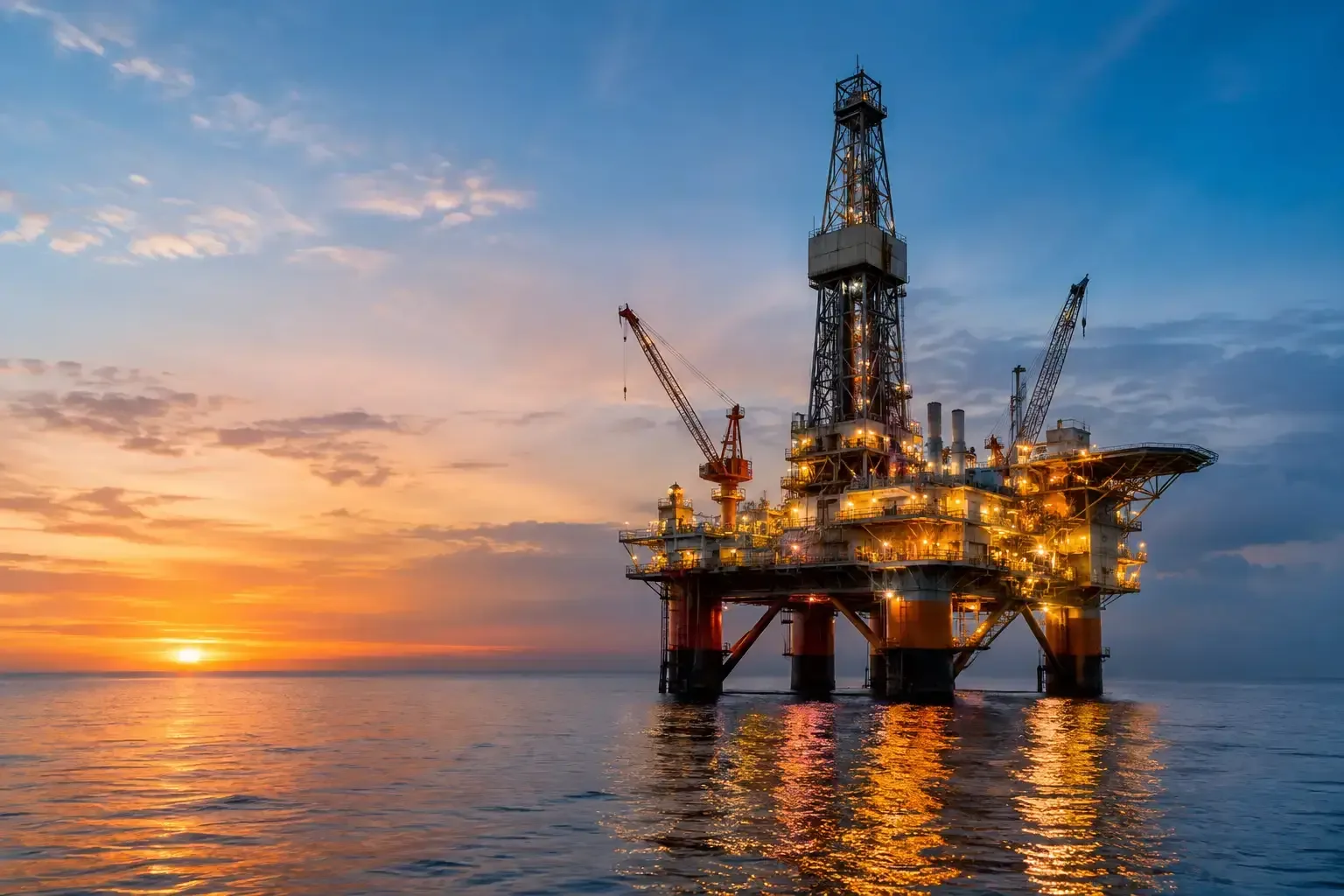
A failed fixture on a drilling deck is more than a maintenance ticket. It can leave crews working around moving equipment, pressurized lines, and wet walking surfaces with inadequate visibility. This oil rig lighting guide focuses on the conditions that should drive fixture selection: hazardous-area classification, marine corrosion, vibration, weather, optical performance, and maintainability.
Offshore and land-based rigs present different exposures, but neither is a standard industrial lighting application. We have found that the best results come when the electrical contractor, facility team, and lighting supplier review the area classification drawings, mounting conditions, and maintenance access before fixtures are ordered. A fixture that looks suitable on a cut sheet can still be the wrong choice if its temperature code, ingress protection, or mounting arrangement does not fit the installation.
1. Start With the Hazardous-Location Drawing
The first question is not how many lumens the rig needs. It is whether the installation point is classified as hazardous and, if so, how the Authority Having Jurisdiction identifies that hazard.
Under the National Electrical Code, many U.S. oil and gas facilities use the Class I Division system. Class I addresses flammable gases or vapors. Division 1 locations are areas where ignitable concentrations may exist during normal operations, while Division 2 locations are areas where they are handled in closed systems or may be present only under abnormal conditions, such as a leak or equipment failure.
Some projects instead use Class I Zones. Zone 0 represents a continuous or long-duration hazard, Zone 1 covers areas where a hazard is likely during normal operation, and Zone 2 covers areas where it is not likely under normal conditions and persists only briefly if it occurs. Do not assume a Zone-marked fixture is automatically acceptable for a Division-classified job, or the reverse. The listing, marking, installation code, and project specification must align.
UL and Intertek documentation can help confirm a fixture has been evaluated to the applicable standards, but the final selection still depends on the classification shown on the site drawing and accepted by the AHJ. Request the listing documentation early rather than treating it as a closeout item.
2. Match the Fixture to the Actual Gas Group and Temperature Code
An explosion-proof enclosure is not a universal approval for every hazardous location. Equipment markings identify the gas group and temperature limitations for which the luminaire is suitable. Those markings must be read against the materials that may be present on the rig.
The temperature code, or T-code, deserves particular attention. It indicates the maximum surface temperature the equipment may reach under its rated conditions. A lower numerical T-code corresponds to a lower maximum surface temperature. For example, a T6 marking limits the maximum surface temperature more tightly than a T3 marking.
Ambient temperature changes the decision. A fixture may carry an acceptable hazardous-location marking but have a reduced operating range in direct sun, near process equipment, or in an enclosed module with limited airflow. LED drivers and optics are affected by heat, and thermal derating can reduce output or shorten service life. Confirm the fixture's rated ambient temperature, not only its initial lumen output.
3. Specify Marine Corrosion Resistance, Not Just a High IP Rating
Ingress protection and corrosion resistance solve related but different problems. An IP66 or IP67 rating indicates a fixture's resistance to dust and water intrusion under defined test conditions. It does not, by itself, prove that the housing, hardware, coating, lens gasket, and cable entries will tolerate long-term salt spray.
On an offshore platform, salt-laden air reaches handrails, junction boxes, floodlight yokes, and mounting hardware even where direct spray is limited. Specify materials appropriate to the exposure, commonly marine-grade aluminum with a durable protective finish, stainless-steel hardware where appropriate, and corrosion-resistant cable glands. Dissimilar-metal contact also deserves review because galvanic corrosion can develop at brackets and fasteners.
For washdown-prone or exposed deck areas, look beyond the fixture body. The integrity of conduit seals, glands, junction boxes, and mounting penetrations often determines whether moisture reaches the electrical system. A high-rated luminaire installed with unsuitable accessories is still a weak point.
4. Light the Work Plane, Not the Fixture Schedule
A rig needs different lighting distributions for different tasks. Floodlights may provide useful coverage on an open drill floor or pipe-handling zone, but they are often inefficient or glare-heavy when used along narrow walkways. Linear hazardous-location fixtures can provide more controlled horizontal illumination in corridors, stair towers, and equipment modules.
The work plane matters. Maintenance crews need vertical illumination to read gauges, labels, valve positions, and control interfaces. Operators moving across grated decking need uniform horizontal light that reveals trip hazards and changes in surface condition. Crane operators and crews working near suspended loads need visibility that supports depth perception without putting high-intensity glare directly into their line of sight.
Photometric files are useful here. A point-by-point calculation can reveal dark transitions between fixtures, excessive contrast at stairs, or light spilling toward adjacent work areas. It can also prevent over-lighting. More output is not always safer if it creates reflected glare on wet steel, painted surfaces, or instrument displays.
5. Control Glare Around Helidecks, Navigation Areas, and Control Stations
Not every exterior fixture should be selected strictly for maximum output. Glare can interfere with safe movement, camera performance, and operational visibility. Near helidecks, navigation lighting, or operator sightlines, the project team may need to consider beam control, shielding, fixture aiming, and applicable aviation or marine requirements.
Avoid using broad-beam floodlighting as a default solution for every exterior zone. A narrower distribution, lower mounting height, or different aiming angle may provide better task illumination with less stray light. The correct approach depends on deck geometry, railings, equipment shadows, and the position of frequently used access routes.
During commissioning, evaluate the installation at night from the crew's actual operating positions. Desktop calculations are necessary, but they cannot fully show reflected glare from wet deck plates or temporary shadows created by pipe racks and mobile equipment.
6. Design for Vibration, Wind, and Real Maintenance Access
Rig lighting is exposed to vibration from drilling equipment, rotating machinery, pumps, and structural movement. It may also experience wind loading, shock, and repeated adjustments during maintenance. The fixture, bracket, yoke, mounting base, and wiring method must be considered as one assembly.
A heavy luminaire mounted on an undersized or poorly supported bracket can shift its aiming, loosen over time, or complicate inspections. Verify mounting orientation limits, torque requirements, weight, wind exposure, and the condition of the supporting structure. For pole-mounted or elevated fixtures, access equipment and relamping-free service life become especially important.
LED fixtures reduce routine maintenance compared with legacy systems, but they do not eliminate it. Drivers, gaskets, surge-protection components, and external hardware still require inspection. Select fixtures with serviceable design where maintenance access is practical, and standardize models when possible so crews are not stocking multiple incompatible components.
7. Protect Against Power Quality Problems and Surge Events
Offshore and remote oilfield power systems can experience switching transients, generator-related disturbances, and lightning exposure. Lighting drivers are sensitive electronic components, so surge protection should be part of the specification discussion rather than an assumed feature.
Review the fixture's stated surge-protection rating and determine whether supplemental protection is needed at distribution panels or branch circuits. The right approach depends on the electrical architecture, exposure level, grounding system, and owner standards. Surge devices are not a substitute for proper grounding and bonding, but they can reduce the risk of repeated driver failures.
Emergency lighting also requires a separate plan. Identify evacuation routes, muster points, egress stairs, control locations, and critical work zones. Some facilities use dedicated emergency luminaires; others use fixtures supplied from emergency circuits or backup power. The method must satisfy the site design basis and applicable code requirements.
8. Require Submittal-Ready Documentation Before Purchase
For oil rig projects, a fixture description and a lumen number are not enough. Procurement teams and engineers typically need documentation that supports technical review, installation, and future maintenance. This should include cut sheets, hazardous-location markings, certification information, ambient-temperature ratings, photometric files, installation instructions, and warranty details.
If the project calls for specific third-party certifications, verify the exact model and configuration. Options such as emergency battery backup, mounting style, voltage, cord set, or optical distribution can affect approval status. Certifications from organizations such as UL or Intertek should be matched to the actual ordered configuration, not assumed from a related product family.
Maes Lighting works with industrial buyers to identify fixtures that fit the hazardous classification and physical environment while providing the documentation needed for submittals. That technical review is most valuable before a purchase order is released, when there is still time to address mounting conflicts, ambient limits, and approval questions.
The practical goal is simple: specify lighting that crews can rely on when weather worsens, equipment is operating, and maintenance has to be completed safely. A disciplined review of classification, corrosion exposure, optics, mounting, and documentation gives the project a much better chance of delivering that result.