
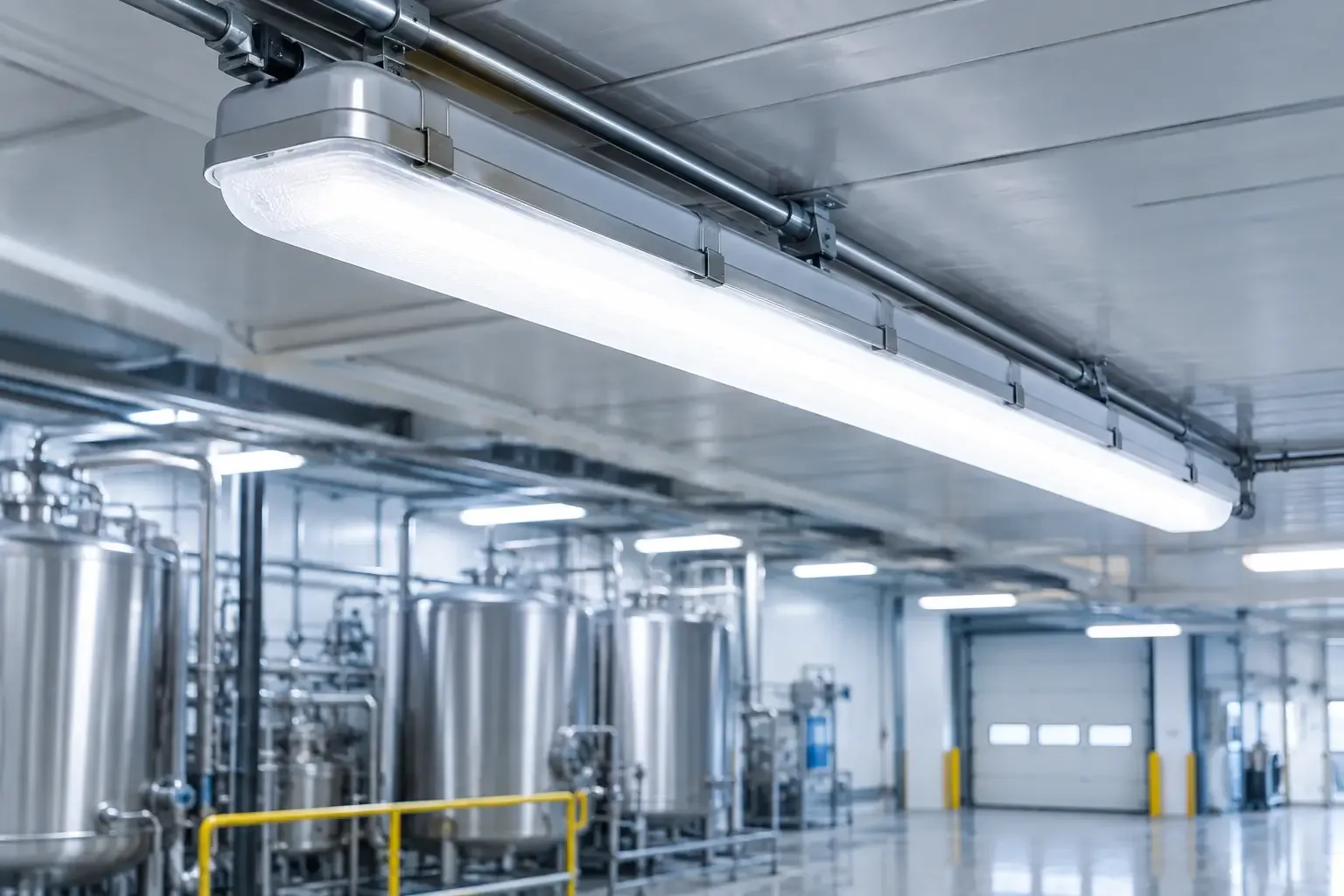
A leaking gasket, a cracked lens, or a corroded housing can turn an ordinary lighting fixture into a recurring maintenance problem. In processing plants, cold storage rooms, loading docks, marine spaces, and washdown areas, vapor tight lighting is built to keep moisture, dust, and contaminants from reaching the electrical components that must remain protected. The right fixture can reduce outages, improve visibility, and help the facility maintain a cleaner, more dependable operating environment.
For fixture options, technical data, and application support, review Maes Lighting's vapor-tight lighting product page. The page includes CIT vapor-tight models covered under the Buy America Act, an important consideration for public projects and specifications requiring documented domestic-content compliance. Product selection should still be verified against the project requirements, installation location, mounting method, voltage, and applicable code.
What Vapor-Tight Actually Means
Vapor-tight describes an enclosure designed to limit the entry of water vapor, moisture, dust, and similar contaminants. It does not automatically mean a fixture is approved for every wet, corrosive, washdown, or hazardous location. That distinction matters when a specification simply calls for a “sealed fixture” without identifying the actual exposure.
A typical industrial vapor-tight LED fixture uses a gasketed housing, sealed end caps, protected wiring entry points, and a durable diffuser. Many are evaluated to ingress-protection ratings such as IP65, IP66, or higher. The first IP digit addresses resistance to solids, while the second addresses water. An IP66 rating, for example, indicates protection against powerful water jets, but it is not a substitute for confirming chemical compatibility or washdown requirements.
The National Fire Protection Association's NFPA 70, commonly called the National Electrical Code, provides the governing installation framework for many U.S. projects. Fixture ratings, wiring methods, branch-circuit protection, mounting, and the classification of the area all need to work together. A vapor-tight luminaire may be appropriate in a wet location without being suitable for a classified hazardous location.
Where Vapor Tight Lighting Delivers Value
Vapor-tight fixtures are often selected where conventional industrial luminaires fail early from moisture intrusion or frequent cleaning. The operating environment determines whether the investment is justified.
In a refrigerated warehouse, condensation can form as warm, humid air enters through dock doors and meets cold surfaces. A gasketed fixture helps protect internal components while maintaining light output in aisles, staging areas, and freezer-adjacent rooms. The fixture must also be rated for the expected ambient temperature. Cold conditions affect drivers, seals, and startup performance differently than a temperate warehouse.
Food and beverage facilities present a different challenge. Areas near packaging lines may only need protection from humidity and routine cleaning, while raw processing rooms can see high-pressure sanitation, caustic detergents, and thermal cycling. For direct food-zone or sanitation-sensitive applications, buyers should review NSF requirements in addition to the IP rating. NSF/ANSI 2 addresses food equipment, while NSF/ANSI 51 addresses materials used in food equipment. Neither designation should be assumed from a fixture's wet-location rating alone.
Marine terminals, wastewater facilities, and exterior canopies also benefit from vapor-tight construction. Salt air, airborne contaminants, vibration, and changing weather can shorten fixture life if housings and hardware are not selected for the exposure. In these applications, the housing material, lens construction, gasket chemistry, and corrosion resistance can matter as much as lumen output.
Selecting Vapor Tight Lighting by Exposure
A reliable selection process starts with the environment, not wattage. Ask what reaches the fixture during normal operation and during cleaning: humidity, condensation, dust, oil mist, direct hose-down, chemicals, salt, or vibration. Then identify the highest and lowest ambient temperatures at the mounting height, including heat from nearby process equipment.
For a damp warehouse corridor, a standard wet-location-rated vapor-tight fixture may be the practical choice. For a sanitation room, the analysis should include washdown pressure, cleaning frequency, chemical concentration, and fixture geometry. Crevices, exposed fasteners, and difficult-to-clean surfaces can create avoidable maintenance burdens in hygienic operations.
Mounting also changes the result. Suspended fixtures over conveyor lines need adequate clearance and stable mounting hardware. Surface-mounted fixtures beneath a canopy may require different conduit entries and drainage considerations. In a freezer, placement near door openings can expose fixtures to repeated condensation and rapid temperature change.
The Illuminating Engineering Society emphasizes that industrial lighting quality is not just a lumens-per-square-foot calculation. Task visibility, glare, uniformity, and maintenance conditions affect whether workers can safely identify labels, spills, moving equipment, and product defects. A brighter fixture that creates glare on stainless equipment or wet floors may be less useful than a properly distributed fixture with controlled output.
Do Not Use Vapor-Tight Fixtures in Place of Hazardous-Location Lighting
This is one of the most consequential specification errors in industrial lighting. A vapor-tight fixture can resist moisture and dust, but it is not necessarily explosion-proof or listed for a Class I, Division 1, Class I, Division 2, Class II, or Zone location.
Facilities handling flammable gases, vapors, combustible dust, or ignitable fibers require a hazardous-location review. Refineries, pump stations, grain elevators, solvent rooms, and certain chemical operations may need purpose-built explosion-proof lighting with the correct listing for the classified area. The applicable classification is determined by the authority having jurisdiction and the facility's process-safety evaluation, not by visual similarity between fixture housings.
For projects with domestic-preference requirements, Maes Lighting also offers Buy America Act-covered hazardous-location options, including the Explosion Proof IR1, IR3, IR4, and IR7 series. Documentation should be requested early in the submittal process. A fixture can be technically suitable yet still delay approval if certificates, photometric files, dimensional drawings, and compliance documents are incomplete.
What Are the Best High Temperature Lights for Industrial Use?
The best high temperature lights for industrial use are fixtures specifically rated for the maximum ambient temperature at the installation point, with thermal management designed for that condition. They are not simply vapor-tight fixtures installed near heat.
Steel mills, kiln areas, foundries, furnace platforms, and high-heat manufacturing lines can expose luminaires to radiant heat, elevated ambient temperatures, airborne scale, and vibration. LED performance is closely tied to junction temperature. As heat rises, driver life and LED output can decline unless the fixture is engineered and rated for the actual ambient condition. This is commonly described as thermal derating.
A useful project example is a fabrication plant that replaces failed fixtures above a heat-treatment line with standard sealed LEDs because they appear protected from dust. The fixtures may initially operate, then show premature driver failures after prolonged exposure to elevated heat. The correction is not a higher-IP rating. It is a high-temperature fixture with a documented ambient rating, suitable materials, and photometric performance evaluated for the mounting height and task area.
When heat and moisture occur together, evaluate both conditions. A high-temperature luminaire may not tolerate washdown, and a washdown-rated vapor-tight fixture may not tolerate the process heat. Specialized applications sometimes require separate fixtures for adjacent zones rather than one compromised product choice.
Documentation Is Part of the Fixture Decision
Industrial buyers should request the documents that support installation and approval before material is released. At minimum, this usually means a datasheet, photometric file, dimensional drawing, installation instructions, voltage information, listing details, and warranty terms. For specialized environments, add certificates for hazardous-location suitability, NSF status, ingress protection, Buy America Act coverage, or marine requirements as applicable.
This discipline prevents common field problems: a fixture that cannot fit the existing mounting pattern, a voltage mismatch discovered after delivery, a listing that does not match the classified area, or a photometric layout based on an output configuration that was never ordered. The lowest initial fixture price rarely offsets the cost of rework in an operating facility.
Vapor tight lighting earns its place when it is matched to the exposure, cleaning process, temperature, and code requirements of the space. Start with the conditions workers and equipment actually face, then select the enclosure, rating, optics, and documentation that will keep the installation performing when the facility is under pressure.