
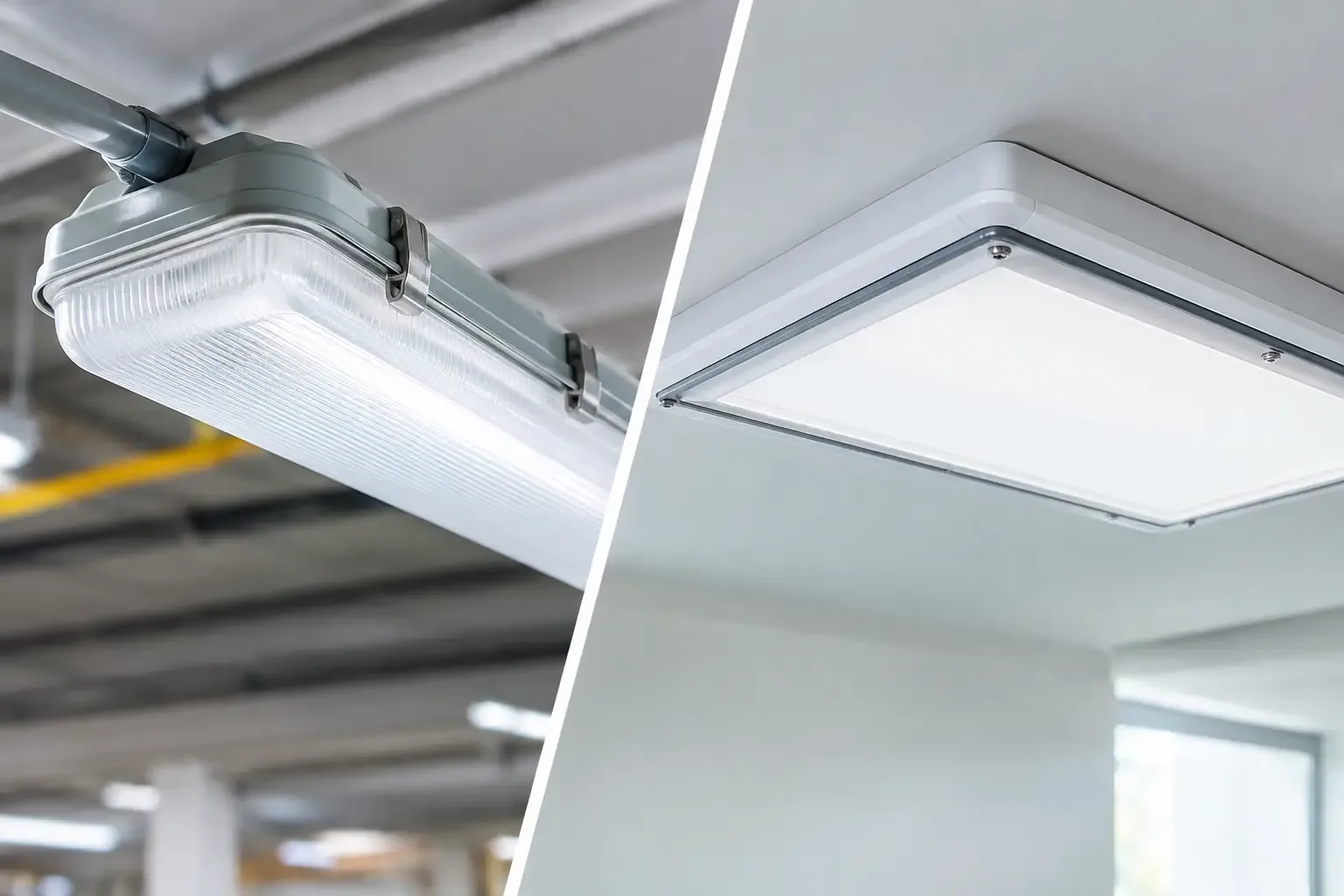
A fixture can have a gasket and still fail early in a wet process room. It can be marketed as vapor-tight and still be unsuitable for high-pressure sanitation, chemical exposure, or a classified hazardous location. That distinction is where specification errors begin.
When comparing vapor tight versus gasketed fixtures, start with the actual exposure, not the fixture label. We have found that plant teams get better long-term results when they assess water pressure, cleaning chemistry, airborne contaminants, mounting orientation, ambient temperature, and required certifications before selecting an enclosure. The right fixture is the one whose construction and documented ratings match the operating environment.
Vapor tight versus gasketed fixtures: the central difference
A vapor-tight fixture is generally designed as an enclosed luminaire intended to limit the entry of moisture, vapor, dust, and other contaminants. These fixtures commonly use a sealed housing, captive lens, gaskets at enclosure joints, and sealed or protected entry points. In industrial settings, vapor-tight luminaires are frequently used in parking structures, utility corridors, loading areas, cold storage, mechanical rooms, car washes, and moderately wet manufacturing spaces.
A gasketed fixture describes one part of the enclosure strategy: a fixture that uses a compressible seal between mating surfaces, such as the lens and housing or access cover and body. A gasket helps maintain the enclosure seal, but the word “gasketed” alone does not define the level of environmental protection. Gasket material, compression, latch design, cable-entry sealing, housing construction, and verification testing all affect real-world performance.
Put simply, nearly every properly sealed vapor-tight fixture is gasketed, but not every gasketed fixture is genuinely vapor-tight at the level a harsh facility requires. “Gasketed” is a construction description. “Vapor-tight” is a commonly used product description that should be supported by specific enclosure ratings and test documentation.
Ratings matter more than marketing language
For industrial buyers, the practical question is not whether a fixture carries a vapor-tight label. The question is what independent rating verifies its resistance to the hazards present at the installation point.
IP ratings are often the most useful starting point. Under the IEC 60529 framework, the first IP digit addresses protection against solid objects and dust, while the second addresses water ingress. An IP65 fixture is dust-tight and protected against water jets. IP66 adds protection against powerful water jets. IP67 addresses temporary immersion, while IP69K is intended for severe high-pressure, high-temperature washdown conditions.
NEMA enclosure classifications are also common in North American industrial specifications. A NEMA rating can address environmental exposure beyond water and dust, depending on the classification. The exact meaning matters, so a NEMA designation should be reviewed against the project specification rather than treated as interchangeable with an IP rating.
Organizations such as UL and Intertek evaluate and certify products to applicable safety standards, while NSF provides standards and certification programs relevant to sanitary environments. A fixture bearing a recognizable certification mark is not automatically right for every application, but its documentation provides a more reliable basis for approval than a broad product claim.
What a gasket must withstand
A gasket is only as effective as its material and installation. In a refrigerated loading area, the concern may be condensation and temperature cycling. In a poultry processing room, the seal may face repeated high-pressure washdown and alkaline or acidic cleaners. In a coastal marine application, salt-laden air can attack exposed hardware, latches, and imperfectly protected joints.
EPDM, silicone, neoprene, and other elastomeric materials have different temperature, chemical, and aging characteristics. A gasket that performs adequately around normal indoor humidity may harden, swell, crack, or lose compression after repeated exposure to sanitizers, oils, heat, or cold. The fixture housing and lens also need to resist the environment. A durable gasket cannot compensate for corroding latches, a warped lens, or an unsealed conduit entry.
Where vapor-tight fixtures are a strong fit
Vapor-tight LED fixtures are often a practical choice where moisture, condensation, dust, and routine washdown are expected but the location is not classified as hazardous. Their enclosed construction helps reduce internal contamination and simplifies maintenance compared with open industrial strip fixtures.
A cold-storage aisle is a typical example. The fixture may be exposed to condensation during door openings, temperature shifts, forklift traffic, and periodic cleaning. Here, an appropriately rated enclosed fixture with a cold-capable driver, impact-resistant lens, and corrosion-resistant hardware can support dependable operation.
Covered docks, wastewater utility rooms, tunnels, garages, and food storage areas may also be suitable applications. However, the degree of washdown makes a major difference. A fixture installed well above a splash zone may have very different needs from one mounted directly over an equipment line washed daily with high-pressure water.
For food and beverage operations, sanitation requirements should lead the decision. Facilities should verify whether NSF certification is required, whether the fixture has a cleanable exterior geometry, and whether its IP rating matches the washdown procedure. NSF standards and facility sanitation programs should be considered alongside the electrical specification. A general vapor-tight fixture may be appropriate in dry packaging or cold storage, while an NSF-rated, IP69K-capable luminaire may be the better fit in a high-care washdown zone.
When a gasketed fixture is not enough
A basic gasketed industrial fixture can be acceptable in dry or lightly damp areas where the gasket primarily limits incidental dust and humidity. Problems arise when buyers extend that assumption to applications involving pressurized water, chemical foam, corrosive atmospheres, or combustible gases and dusts.
For example, a gasketed lens door does not establish that the conduit hub, driver compartment, and cable entry are protected against washdown. Likewise, a gasketed fixture is not explosion-proof simply because it is enclosed. Hazardous locations require luminaires specifically listed and marked for the site classification under the National Electrical Code. The classification may involve Class I flammable gases or vapors, Class II combustible dust, Division 1 or Division 2, or a Zone designation.
In a grain-handling area, a food ingredient dust room, a refinery pump station, or a solvent storage operation, fixture selection must begin with the area classification completed by qualified personnel. Enclosure protection and hazardous-location protection are separate requirements. A vapor-tight fixture can resist moisture yet be entirely inappropriate where an ignition-capable electrical device is prohibited.
Assess the full enclosure, not just the lens seal
During a submittal review, we recommend examining the complete luminaire assembly. Focus on the housing-to-lens seal, access-cover seal, conduit hubs or cord grips, driver compartment, mounting hardware, lens retention, and any penetrations created in the field. A well-rated fixture can lose its intended protection if installers use an incorrect fitting, omit a sealing washer, damage the gasket, or leave a cover improperly latched.
Mounting orientation also affects service life. Water can pool on horizontal surfaces, collect around entry points, or repeatedly strike the same side of a fixture during washdown. Vibration from conveyors, pumps, and overhead doors can loosen latches over time. In corrosive areas, stainless hardware and compatible materials may matter as much as the ingress rating itself.
Maintenance teams should inspect gaskets during relamping-free LED maintenance intervals, particularly after a chemical change, major shutdown, or repeated washdown exposure. Look for flattened seals, cracks, discoloration, damaged latch points, clouded lenses, and evidence of moisture inside the enclosure. Early replacement of a compromised gasket is less disruptive than replacing a failed fixture during production.
A practical specification path
Start by documenting the exposure: dust type, water source and pressure, washdown temperature, chemicals, ambient temperature, corrosion risk, vibration, and whether the location is classified. Then match those conditions to a documented IP or NEMA enclosure rating, required safety listing, and any NSF or sanitary requirements.
Request the datasheet, certification details, photometric file, temperature range, and installation instructions before release. This is especially valuable when the project involves food processing, cold storage, marine exposure, or a facility with strict maintenance-access requirements. If the specification calls for a vapor-tight fixture, define the performance level behind that term rather than leaving it open to interpretation.
The most useful decision is rarely “vapor-tight or gasketed.” It is whether the complete luminaire, including its seals, entries, materials, ratings, and installation method, is built for the conditions your facility will impose on it every shift.