
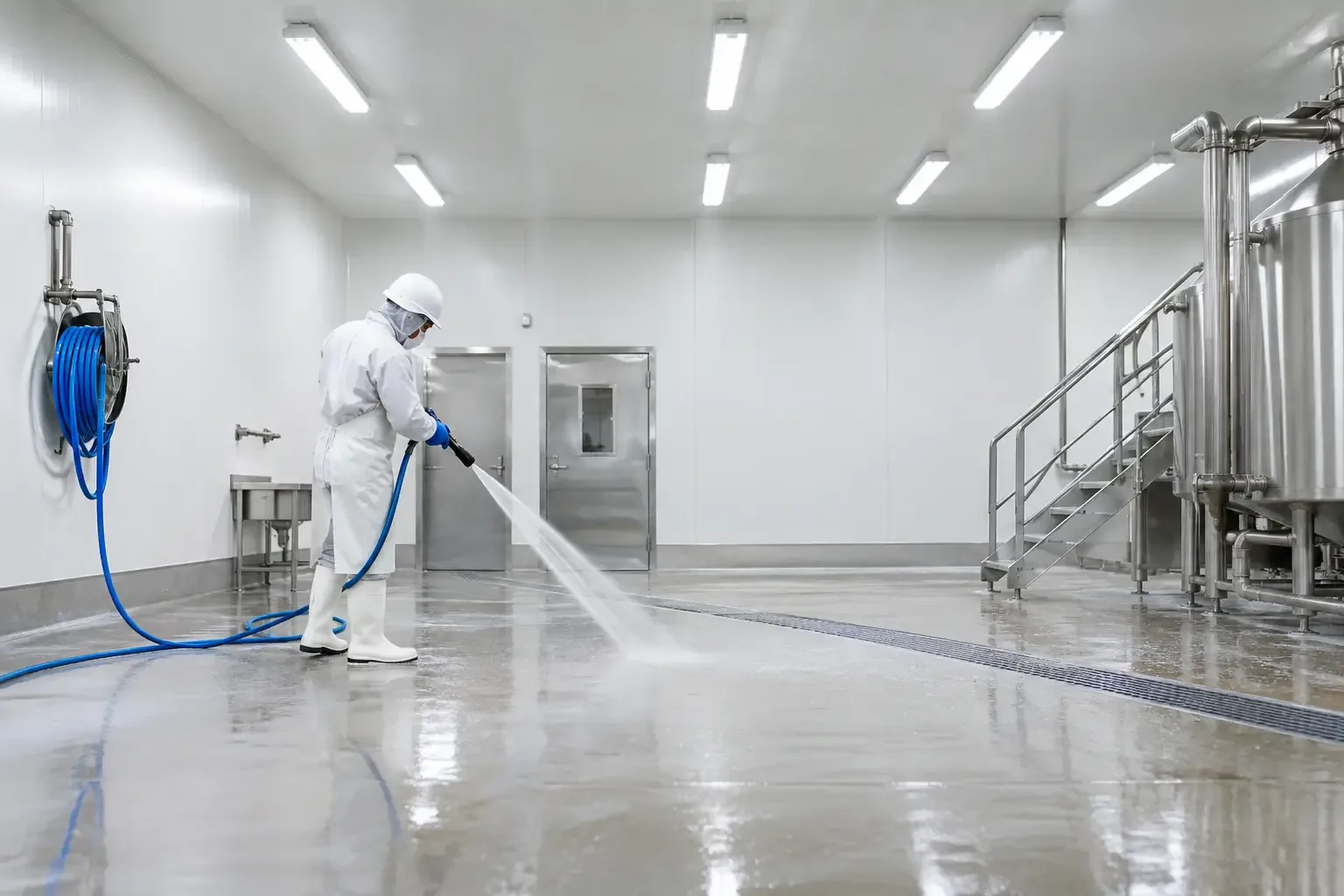
A washdown room can look clean at the end of a sanitation cycle while its lighting system is already failing internally. Caustic foam, chlorine-based sanitizers, peracetic acid, high-pressure water, steam, and repeated temperature swings attack gaskets, lenses, cable entries, coatings, and mounting hardware. When moisture reaches a driver compartment or corrosion compromises a seal, the result is not merely reduced light output. It can mean an unplanned shutdown, an inspection finding, or a safety exposure for the sanitation crew.
The best lighting for chemical washdown rooms is therefore not simply the fixture with the highest ingress-protection rating. The correct selection begins with the actual cleaning chemistry, washdown pressure and temperature, mounting location, required illumination, and any food-zone or hazardous-location requirements. We have found that projects succeed when the fixture specification is treated as part of the sanitation design, not as a late electrical substitution.
What Makes Chemical Washdown Lighting Different?
Chemical washdown areas place several failure mechanisms on a fixture at once. Pressurized water can force its way past weak seals. Chemical residues can embrittle polycarbonate, discolor lenses, degrade elastomeric gaskets, or corrode exposed metal. Thermal cycling can loosen interfaces that appeared secure during initial installation. Vibration from conveyors, pumps, and process equipment adds another variable.
A standard damp-location fixture may survive occasional moisture but is not designed for direct, repeated sanitation. Even a fixture described as vapor-tight should be evaluated carefully. Vapor-tight construction addresses moisture and contaminants, but it does not automatically establish resistance to aggressive chemicals or high-pressure, high-temperature washdown.
This distinction matters in poultry processing, beverage filling, dairy, prepared-food production, pharmaceutical support spaces, and industrial chemical rooms. A fixture mounted above a packaging line may see a mild rinse. One positioned over an open processing tank, foam station, or floor drain path can receive concentrated chemical spray and direct impingement during every sanitation shift. Those are different applications and should not receive the same fixture specification.
Best Lighting for Chemical Washdown Rooms: The Core Requirements
For most washdown rooms, the baseline is an industrial LED fixture with a sealed housing, corrosion-resistant external materials, a lens compatible with the cleaning agents, and a documented rating suited to the wash procedure. The word documented is critical. A catalog description is not equivalent to a third-party listing, test report, or manufacturer statement covering the installed configuration.
Start With the Correct IP Rating
Ingress Protection ratings identify how an enclosure resists solids and water. For chemical washdown rooms, IP66 is commonly suitable for powerful water jets, while IP69K is intended for protection against high-pressure, high-temperature water jets. An IP69K rating can be valuable in sanitation-intensive applications, but it should not be treated as a universal chemical-resistance rating.
IP testing evaluates ingress under defined conditions. It does not tell a buyer whether a particular sanitizer will attack the lens, gasket, cable jacket, finish, or stainless hardware over time. A fixture can have a strong IP rating and still be a poor choice for a room using aggressive oxidizers or solvents.
Specify the rating based on the cleaning procedure. If crews use low-pressure rinsing and foaming, IP66 may be appropriate when the fixture is mounted outside the direct spray path. If sanitation involves hot, close-range pressure washing, an IP69K-rated fixture is usually the more defensible starting point. Review nozzle distance, water temperature, pressure, dwell time, and wash frequency before finalizing the decision.
Match Materials to the Chemical Exposure
Material compatibility is often where washdown installations are won or lost. Stainless steel housings and hardware are generally preferred where corrosion resistance and cleanability are priorities, especially in food and beverage environments. However, stainless steel grade, surface finish, fastener selection, and crevice geometry all affect field performance.
The lens deserves the same scrutiny. Polycarbonate provides excellent impact resistance but may not tolerate every chemical program. Acrylic, tempered glass, and specialized lens materials each bring different trade-offs involving impact resistance, optical clarity, thermal performance, and chemical compatibility. Do not approve a lens based only on its appearance or initial clarity.
Ask for a chemical compatibility review using the specific products and concentrations used on site. Include cleaners, sanitizers, descalers, degreasers, and any intermittent chemicals used during deep cleaning. Peracetic acid, quaternary ammonium compounds, sodium hypochlorite, and caustic solutions can have very different effects on fixture components. The same is true for chemical vapor exposure, which can be significant even when a fixture is not directly sprayed.
Require a Cleanable Fixture Geometry
Washdown lighting should minimize ledges, exposed threads, gaps, and horizontal surfaces where residue can collect. A smooth, enclosed profile makes sanitation faster and reduces the chance that soil remains around mounting interfaces. This is especially relevant in areas subject to food-safety audits, where cleanability can be as meaningful as the enclosure rating.
Mounting method is part of this decision. Pendant stems, junction boxes, and field-installed cord grips can create weak points if they are not rated and sealed for the environment. In many projects, the fixture itself is compliant but the installation accessories are not. The complete assembly must withstand the washdown process.
NSF, UL, and Intertek Documentation That Supports Approval
Facilities subject to sanitary design requirements should distinguish between a fixture that is generally suitable for wet industrial use and one carrying the applicable food-equipment certification. NSF is widely recognized for standards and certification programs related to food equipment and sanitation. For lighting around food processing, buyers frequently evaluate NSF/ANSI 2 and NSF/ANSI 51 based on the fixture's location and material contact considerations.
NSF/ANSI 2 addresses food equipment, including requirements related to cleanability and sanitation. NSF/ANSI 51 focuses on materials used in food equipment. The appropriate requirement depends on whether the fixture is installed in a food zone, splash zone, or non-food area and on the facility's own sanitation and customer requirements. An NSF mark should be verified against the exact product family and configuration rather than assumed from a similar model.
Electrical safety documentation also matters. UL and Intertek provide product testing and certification services used throughout industrial construction and facility upgrades. A recognized listing can help confirm that the fixture has been evaluated to the relevant electrical safety standard. For a submittal package, request the datasheet, certification information, installation instructions, photometric files, ambient-temperature limitations, and chemical-compatibility guidance. These documents help engineering teams, contractors, and inspectors evaluate the fixture before it arrives on site.
Do Not Overlook Temperature and Light Levels
Washdown rooms often experience conditions that complicate LED selection. Hot-water sanitation can elevate ambient temperatures near the ceiling, while cold processing environments can create condensation and thermal shock. The fixture's rated ambient temperature must cover the actual installed condition, not just the room thermostat setting.
LED output and driver life are temperature-sensitive. A fixture installed above steam-generating equipment may operate in a substantially hotter microenvironment than a fixture on the opposite wall. Verify the maximum ambient rating, thermal management design, and any lumen derating at elevated temperatures. If a room is refrigerated or subject to frequent washdown-to-cold transitions, confirm performance across the full temperature range.
Photometrics also require a practical review. Stainless surfaces, wet floors, steam, and airborne mist can produce glare and reduce visual contrast. Higher fixture output is not always the answer. A balanced layout using properly distributed luminaires may provide better visibility at drains, valves, sanitation stations, and inspection points than a small number of high-output fixtures. Consider vertical illumination where workers read gauges, labels, and control panels.
When Hazardous Location Requirements Apply
Some chemical washdown rooms also handle flammable vapors, combustible dust, solvents, or process chemicals that trigger hazardous-location rules. In that case, an IP rating and food-grade construction alone are not enough. The fixture must be properly classified for the area under the National Electrical Code, including the relevant Class, Division, or Zone designation, gas group, and temperature code.
Explosion-proof lighting is designed for specific hazardous-location conditions and should never be selected by appearance or marketing language alone. The area classification should come from the facility's electrical drawings, process safety analysis, or qualified engineering authority. A chemical washdown room without flammable exposure may not need hazardous-location equipment, while a solvent handling or chemical blending area might. Over-specifying can increase cost and maintenance complexity; under-specifying creates a much more serious risk.
A Specification Process That Holds Up in the Field
Before issuing a purchase order, document the wash procedure and map direct-spray zones. Identify every chemical, concentration, wash temperature, pressure, and frequency. Then review fixture housing, lens, gasket, hardware, cable entry, mounting system, and electrical rating as a complete assembly.
A common real-world failure occurs when a facility replaces a corroded fixture with a higher-rated model but retains an unsuitable junction box or uses a field penetration that defeats the enclosure seal. Another occurs when maintenance substitutes a visually similar lens or gasket that is not approved for the original fixture. Standardizing approved parts and installation methods prevents these avoidable failures.
Maes Lighting can help project teams align fixture ratings, photometrics, sanitation conditions, and submittal documentation before equipment is specified. The objective is not to choose the most expensive fixture. It is to select lighting that remains safe, cleanable, and serviceable after the hundredth wash cycle, not just the first one.