
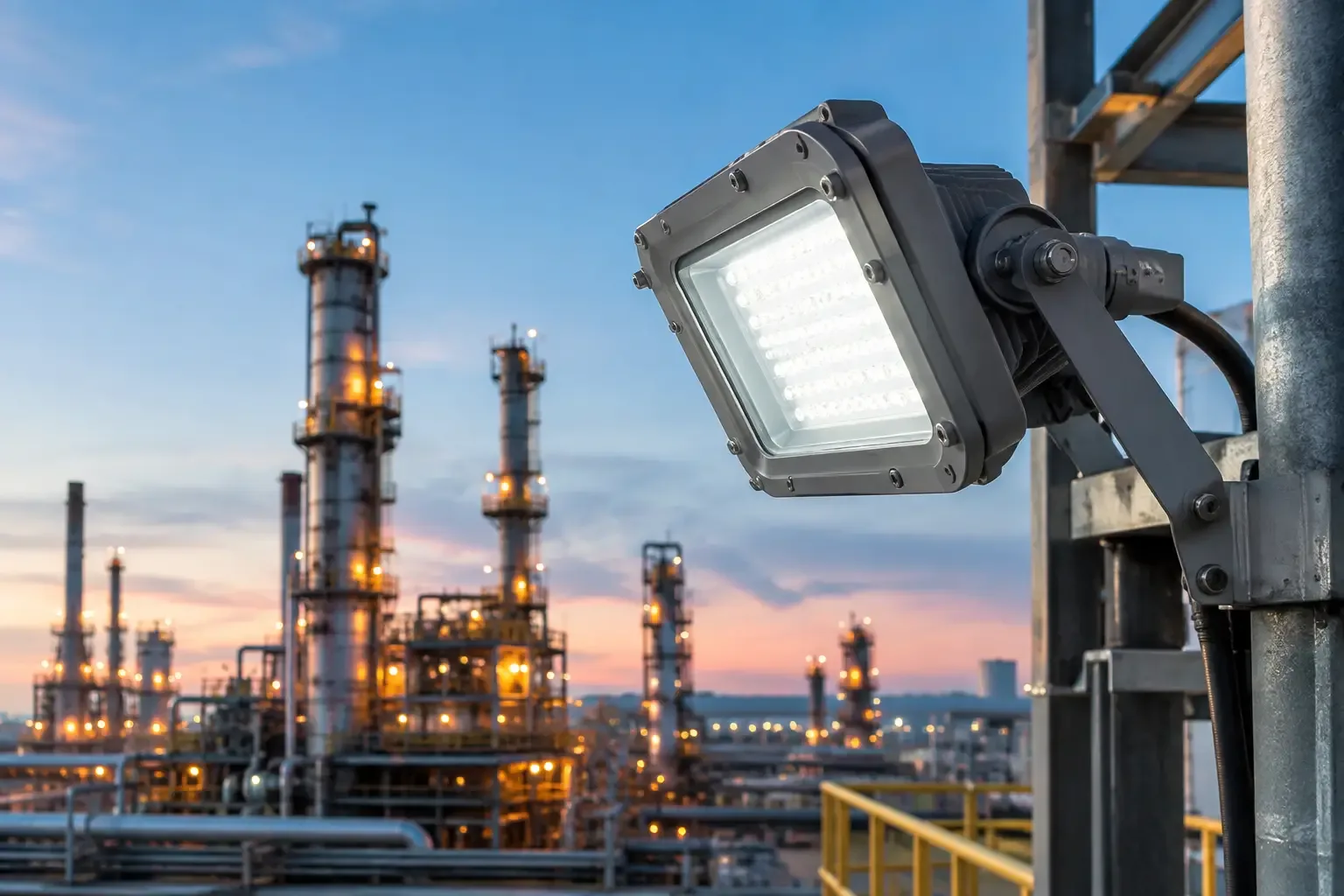
A refinery lighting failure is rarely just a visibility problem. A dark valve platform, poorly lit exchanger bay, or failed fixture near a vapor release point can affect safe access, maintenance quality, turnaround schedules, and hazardous-location compliance. The best refinery lights are not defined by lumen output alone. They are matched to the classified area, ambient temperature, corrosive exposure, mounting height, and the maintenance reality of the unit.
At Maes Lighting, we have found that refinery projects move faster when the lighting schedule begins with area classification and environmental conditions rather than a generic fixture preference. A luminaire that works well in a nonclassified pipe rack may be unacceptable at a loading rack, tank farm, analyzer shelter, or process unit where flammable vapors or combustible dusts may be present.
1. Explosion-Proof LED Fixtures for Classified Process Areas
Explosion-proof LED fixtures are often the right starting point for process areas where flammable gases, vapors, or liquids may be present under defined conditions. The term does not mean the fixture prevents an explosion. It means the enclosure is designed and tested to contain an internal ignition event and prevent it from igniting the surrounding hazardous atmosphere when installed as listed.
For U.S. refinery facilities, the National Electrical Code commonly uses Class I for flammable gases and vapors. Division 1 identifies locations where ignitable concentrations may exist during normal operations, maintenance, or repair. Division 2 applies where those materials are normally contained but could be present under abnormal conditions, such as a leak or equipment failure.
A Class I, Division 1 fixture is generally built for the more demanding classification, but specifying it everywhere can add unnecessary cost, weight, and installation complexity. The better approach is to use the facility area-classification drawing, then verify the fixture marking, temperature code, voltage, mounting method, and any special conditions of use. UL and Intertek listing documentation should be reviewed as part of the submittal package, not after fixtures arrive onsite.
2. Hazardous-Location Floodlights for Tank Farms and Loading Racks
Tank farms, truck and rail loading areas, marine transfer points, and perimeter process access routes frequently need long-throw light and controlled glare. Hazardous-location LED floodlights can provide broad area illumination while reducing the relamping burden associated with conventional high-wattage systems.
The key decision is optic selection. A wide distribution may suit a short tank-dike area, while a narrow or medium distribution can put useful light on a distant catwalk, valve station, or loading connection. More lumens are not automatically better. Excessive brightness can create reflected glare on wet surfaces, painted piping, vehicle windshields, and instrument panels.
Photometric files matter here. A competent layout should evaluate horizontal foot-candles at grade, vertical illumination on operating equipment, uniformity, pole location, and light trespass beyond the facility boundary. For elevated floodlighting, also confirm the fixture is rated for wind, vibration, and the actual ambient temperature expected at the mounting point.
3. Corrosion-Resistant Vapor-Tight Fixtures for Pipe Racks
Not every refinery location requires an explosion-proof housing. Pipe racks, utility corridors, maintenance shops, wastewater areas, and covered outdoor walkways may be nonclassified but still impose severe moisture, chemical, and corrosion exposure. In these locations, a vapor-tight industrial LED fixture can be a more efficient and practical choice.
Look beyond a basic wet-location statement. The enclosure material, gasket design, lens impact resistance, hardware, conduit entries, and ingress-protection rating all influence service life. Salt air at coastal refineries, sulfur-bearing compounds, cleaning chemicals, and persistent condensation can degrade a fixture that appears suitable on a standard commercial job.
For wash-prone or heavily contaminated areas, an IP66 rating helps indicate protection against powerful water jets and dust ingress. Where high-pressure, high-temperature cleaning is part of the maintenance practice, the installation may call for IP69K-rated equipment. The rating must align with how the fixture is actually cleaned, including spray distance, angle, pressure, and temperature.
4. High-Temperature Luminaires Near Furnaces and Hot Equipment
Refinery environments are not steel mills, but localized high-temperature conditions can still exist near fired heaters, furnaces, thermal oxidizers, flare systems, steam lines, and hot process equipment. A standard LED fixture installed near a heat source can suffer rapid lumen depreciation, driver failure, discoloration, or premature gasket breakdown.
The fixture's maximum ambient temperature rating is the governing number. It is not enough to estimate the weather temperature outdoors or rely on a general assumption about the process area. Measure or model the air temperature at the actual mounting location. Heat rises and accumulates under platforms, canopies, and structural steel, so the fixture may experience a significantly higher ambient than personnel at grade.
LED thermal derating deserves careful attention. Higher ambient temperatures reduce available driver and LED performance, and manufacturers may publish different lumen output values or operating limits at elevated temperatures. For a high-heat application, request the product datasheet, ambient rating, temperature-code information where applicable, and mounting guidance. Selecting a purpose-built high-temperature luminaire is usually less expensive than replacing a failed standard fixture during an outage.
5. Low-Profile Linear Fixtures for Access Platforms and Stairs
Refinery personnel make critical decisions while climbing stair towers, opening valves, reading gauges, and navigating grated platforms. These areas benefit from linear fixtures that deliver even light along the walking path rather than isolated pools of illumination.
A low-profile hazardous-location or vapor-tight linear fixture can reduce snag hazards and limit obstruction in narrow access ways. Place fixtures to minimize shadows created by handrails, structural members, and large pipe runs. On stairs, illumination should support each tread and landing, not merely the area at the top and bottom.
Maintenance access is just as important. If a fixture is mounted where technicians need scaffolding, a man lift, or a unit shutdown to service it, specify a longer-life system and ensure drivers or components can be replaced according to site practice. Good lighting design considers the cost of reaching the fixture, not only the cost of the fixture itself.
6. Emergency and Egress Fixtures That Match the Area Classification
Emergency lighting in a refinery must continue to function when workers need it most: during a power event, process upset, evacuation, or nighttime maintenance incident. The emergency solution must match the area classification just as carefully as the normal lighting.
In nonclassified locations, a battery-backed industrial emergency fixture or inverter-supported normal fixture may be appropriate. In classified areas, the emergency equipment, battery enclosure, wiring method, and associated controls must be suitable for the hazardous location. Do not assume a remote battery pack can be located wherever it is convenient. Its location and connection method need to be evaluated against the classification boundary.
Coordinate emergency lighting with the site's life-safety plan, generator capacity, transfer time, and required duration. Fixtures should also be positioned to identify exits, changes in elevation, muster routes, eyewash stations, and emergency equipment without causing confusion with normal task lighting.
7. Fixtures With Complete Documentation for Submittal Approval
The best refinery light on paper can still delay a project if its documentation is incomplete. Industrial buyers and electrical contractors should expect a fixture package that supports the submittal process: datasheets, hazardous-location markings, listing certificates, photometric files, installation instructions, dimensional drawings, and warranty information.
Verify that the certification is relevant to the installation, not simply a familiar logo on a product page. The published marking should match the required class, division or zone, gas group, temperature code, and ambient range. If the project follows the NEC Zone system or includes equipment evaluated to IECEx or ATEX requirements, confirm the authority having jurisdiction and owner specifications accept the proposed approach.
This level of review is especially valuable during turnarounds, when substitutions are tempting and installation windows are short. A fixture that arrives quickly but lacks the required marking or documentation can create more delay than a properly specified alternative.
How to Make the Final Refinery Lighting Selection
Before releasing a purchase order, compare each candidate against the area classification, mounting height, ambient temperature, corrosion exposure, cleaning method, voltage, optic, and maintenance access. Then confirm the submittal documents support the exact fixture configuration being supplied. For refinery lighting, the lowest initial price is rarely the lowest installed cost when rework, outage access, safety exposure, and approval risk are included.
The right fixture selection gives operators clear visibility, gives maintenance teams fewer failures to chase, and gives project teams documentation they can defend. That is the practical standard refinery lighting should meet.