
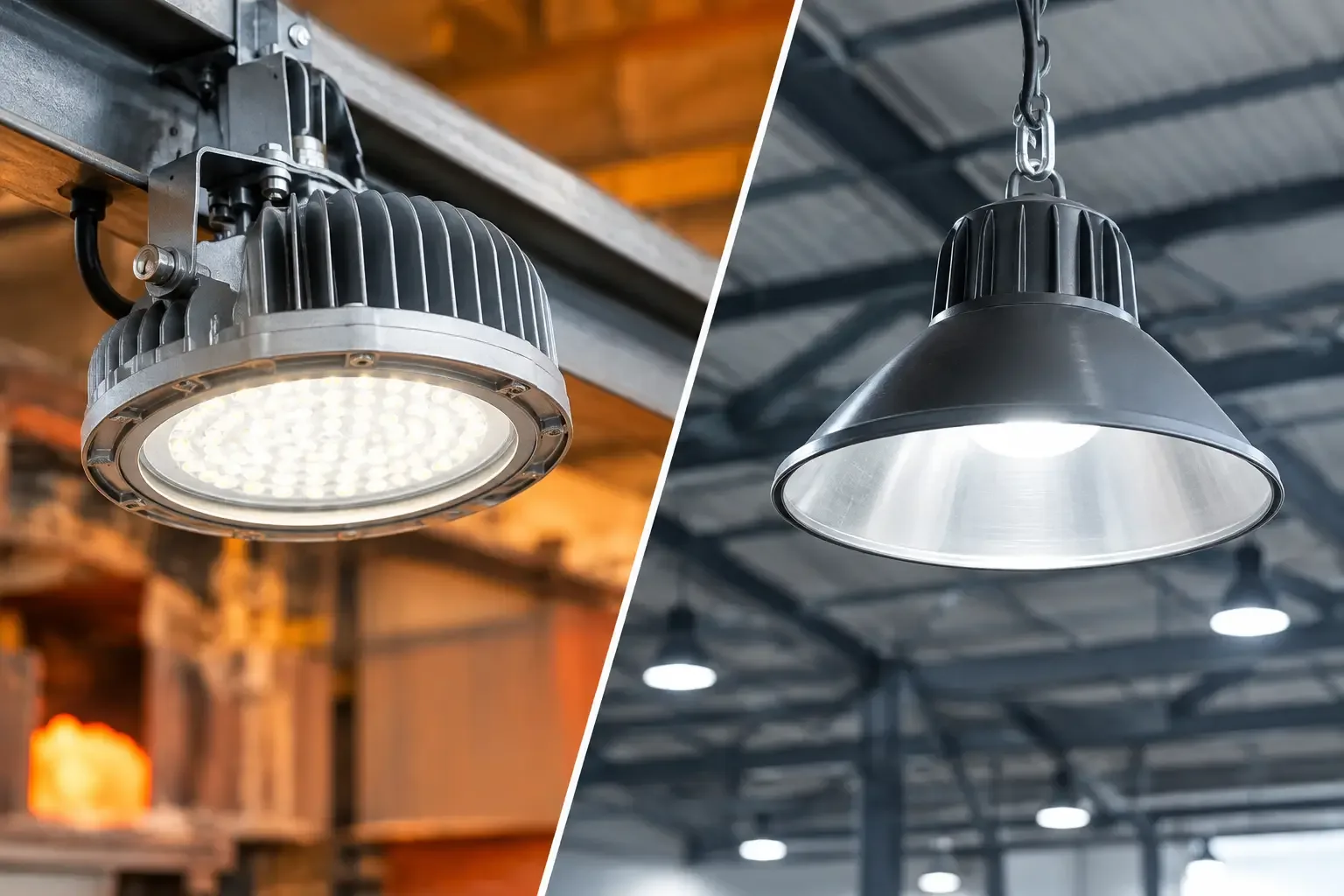
A fixture above a reheat furnace, curing oven, or hot rolling line is not judged by how bright it looked on day one. It is judged by whether it keeps operating at its rated ambient temperature without premature driver failure, lumen loss, unsafe maintenance exposure, or a documentation problem during review. So, how do high temperature LED lights compare with traditional industrial lighting? The practical answer is that a properly engineered high-temperature LED fixture can reduce energy use and maintenance substantially, but only when its complete assembly is rated for the actual heat exposure.
For facilities evaluating an upgrade, the comparison should begin with the fixture’s published maximum ambient rating, photometric performance at that temperature, mounting location, and required certifications. We have found that the most expensive lighting mistakes occur when teams compare watts and initial fixture price while overlooking radiant heat, enclosure temperature, vibration, dust, access constraints, and electrical component limits.
1. High-temperature LEDs handle heat differently than legacy sources
Traditional industrial lighting commonly includes metal halide, high-pressure sodium, fluorescent, and incandescent-based fixtures. Those sources generate significant heat as part of normal operation and often use ballasts, ignitors, capacitors, sockets, and reflectors that can degrade in demanding applications. They can remain useful in certain existing installations, but their performance and service requirements become difficult to justify where access is expensive or downtime is consequential.
High-temperature LED lighting is a system, not simply an LED emitter installed in a familiar housing. The LED board, driver, thermal interface materials, seals, wiring, optics, and enclosure must all tolerate the listed ambient condition. Heat must move away from sensitive electronics while the fixture continues to deliver usable illumination and maintain its safety listing.
That distinction matters around steel furnaces, kilns, foundry lines, glass processing equipment, and high-heat manufacturing cells. A standard LED high bay placed too close to a hot process can fail faster than the metal halide fixture it replaced. A purpose-built high-temperature fixture, selected for the measured operating environment, is a different comparison entirely.
2. The maximum ambient rating matters more than the wattage
For high-heat applications, “ambient temperature” is one of the first specifications to verify. It refers to the air temperature surrounding the luminaire, but real installations may also expose a fixture to radiant energy from hot surfaces, heated exhaust streams, trapped ceiling heat, and limited airflow. These conditions can push the fixture enclosure and internal components well beyond the room’s recorded air temperature.
A traditional fixture may tolerate a hot area in the short term because it has fewer electronics near the light source, but that does not make it the better long-term choice. Lamps, ballasts, sockets, and wiring still age under high heat, and lamp replacement in a restricted area can create recurring safety and labor costs.
High-temperature LED luminaires are generally more efficient, which means less internally generated waste heat. However, LEDs remain temperature-sensitive semiconductor devices. Their lifetime, color stability, driver reliability, and light output depend on thermal management. Buyers should request the fixture’s maximum ambient rating and confirm whether it applies to the complete luminaire rather than only to the LED package.
3. LED thermal derating is a performance issue, not a footnote
Thermal derating describes the reduction in output or allowable operating conditions as temperature rises. It is normal engineering behavior, not necessarily a defect. The question is whether the manufacturer clearly states how the fixture performs at the site’s expected ambient temperature.
For example, a high bay that produces acceptable foot-candle levels in a 77°F warehouse may not deliver the same output in a 140°F upper-bay environment. In some designs, the driver may reduce power to protect electronics. In others, the listed operating temperature may be exceeded, compromising service life and potentially the fixture’s intended use.
Traditional metal halide fixtures also suffer at elevated temperatures. Lamp output, ballast life, restrike behavior, and component reliability can be affected. The difference is that an engineered LED product can offer a more predictable design path when the supplier provides temperature data, photometric files, installation guidance, and product documentation.
At Maes Lighting, we have found that a temperature survey near the intended mounting plane is more valuable than relying on a plant-wide thermostat reading. Measure during normal production and, where possible, during the hottest process condition. Include the effect of heat rising into roof structures, since a fixture mounted above a furnace line may experience a far harsher environment than personnel at floor level.
4. LEDs usually reduce maintenance, but access conditions decide the value
Maintenance is often the strongest case for high-temperature LED lighting. Metal halide and high-pressure sodium systems require periodic lamp replacement and may require ballast or ignitor service. In a steel mill, kiln building, or elevated process area, each relamping event may involve lifts, production coordination, lockout procedures, and worker exposure to heat.
A properly selected LED fixture can extend the interval between service events because there is no conventional lamp to replace. This benefit grows where luminaires are mounted high, positioned over equipment, or installed in areas with limited maintenance windows.
There is a trade-off. LED fixtures are electronic assemblies, and a failed driver may require fixture-level repair or replacement depending on the design. Buyers should ask whether drivers are field-replaceable, whether surge protection is included, and what warranty conditions apply at elevated ambient temperatures. A long warranty is meaningful only if it covers the actual application temperature and installation configuration.
5. Light quality and instant operation favor LED in many industrial tasks
Legacy HID fixtures have a warm-up and restrike characteristic that can be operationally limiting. After an interruption, a metal halide fixture may not return to full output immediately. In process areas where visibility supports inspections, material handling, or safe egress, that delay matters.
High-temperature LED fixtures typically reach full output immediately. They can also provide more controlled optical distributions, directing light onto work surfaces instead of wasting it above the task plane. This can improve vertical illumination on equipment, control panels, catwalks, and inspection points while reducing the need to overlight an entire area.
Color rendering should be evaluated based on the task. Maintenance teams distinguishing wiring colors, identifying leaks, reading labels, or inspecting surface defects may benefit from better color rendering than many legacy high-pressure sodium installations provide. Still, a higher color rendering index alone does not guarantee a good design. Glare, mounting height, beam distribution, shadowing, and fixture spacing remain central to usable visibility.
6. Energy savings are real, but they are not the whole financial case
High-temperature LED systems commonly use less power than comparable legacy HID installations, particularly when paired with controls appropriate to the operation. The savings can be substantial in facilities with long operating hours. Yet energy calculations should not be the only basis for approval.
A complete comparison includes fixture cost, installation labor, electrical infrastructure, maintenance labor, lift rental, replacement components, outage risk, and the consequences of poor visibility. In a continuously operating plant, avoiding even one difficult maintenance intervention can materially affect the project economics.
Controls require judgment in high-heat settings. Occupancy sensing or daylight harvesting may make sense in intermittently occupied support areas, but process-critical zones may need constant illumination. Any control device must be suitable for the temperature, vibration, and environmental conditions where it will operate.
7. Listings and documentation must match the environment
High temperature is only one condition. A facility may also have combustible dust, flammable vapor, washdown, corrosive chemicals, water ingress, or vibration. A heat-rated fixture is not automatically suitable for a hazardous location, and an explosion-proof fixture is not automatically suitable for elevated ambient temperatures.
The National Electrical Code classification for the specific area should guide hazardous-location fixture selection. For third-party product safety evaluation, buyers often look for documentation from recognized testing organizations such as UL Solutions or Intertek. Where sanitary production is involved, NSF standards and material requirements may also affect the fixture selection. NSF provides guidance on equipment and material standards, while the fixture’s submitted certifications and marking identify the product’s specific evaluated conditions.
Verify the complete designation on the datasheet and product label. Do not assume that an IP rating, a vapor-tight enclosure, or a heavy cast housing substitutes for a temperature rating or hazardous-location listing. Project submittals should include cut sheets, certification documentation, photometric data, mounting information, voltage details, and any temperature-related operating limitations.
8. The right choice depends on the actual mounting location
Consider a maintenance bay next to a billet reheating furnace. Traditional metal halide fixtures may have been accepted for years because they were familiar and available. But frequent lamp changes, slow restart after power disturbances, and uneven light on elevated platforms can create ongoing operational friction.
A high-temperature LED solution may improve illumination and reduce service work, provided the fixture is located and rated for the true upper-level temperature. If the mounting location receives direct radiant heat, a remote-mounted approach, shielding strategy, or different fixture placement may be necessary. The correct solution is not always the fixture with the highest advertised lumen output.
Before replacing legacy industrial lighting, document the heat profile, mounting height, operating schedule, voltage, access method, contamination exposure, and required classifications. Then select a high-temperature LED fixture based on published limits and complete project documentation. That process gives maintenance and engineering teams a lighting system that supports safer work, fewer disruptions, and a defensible specification.