
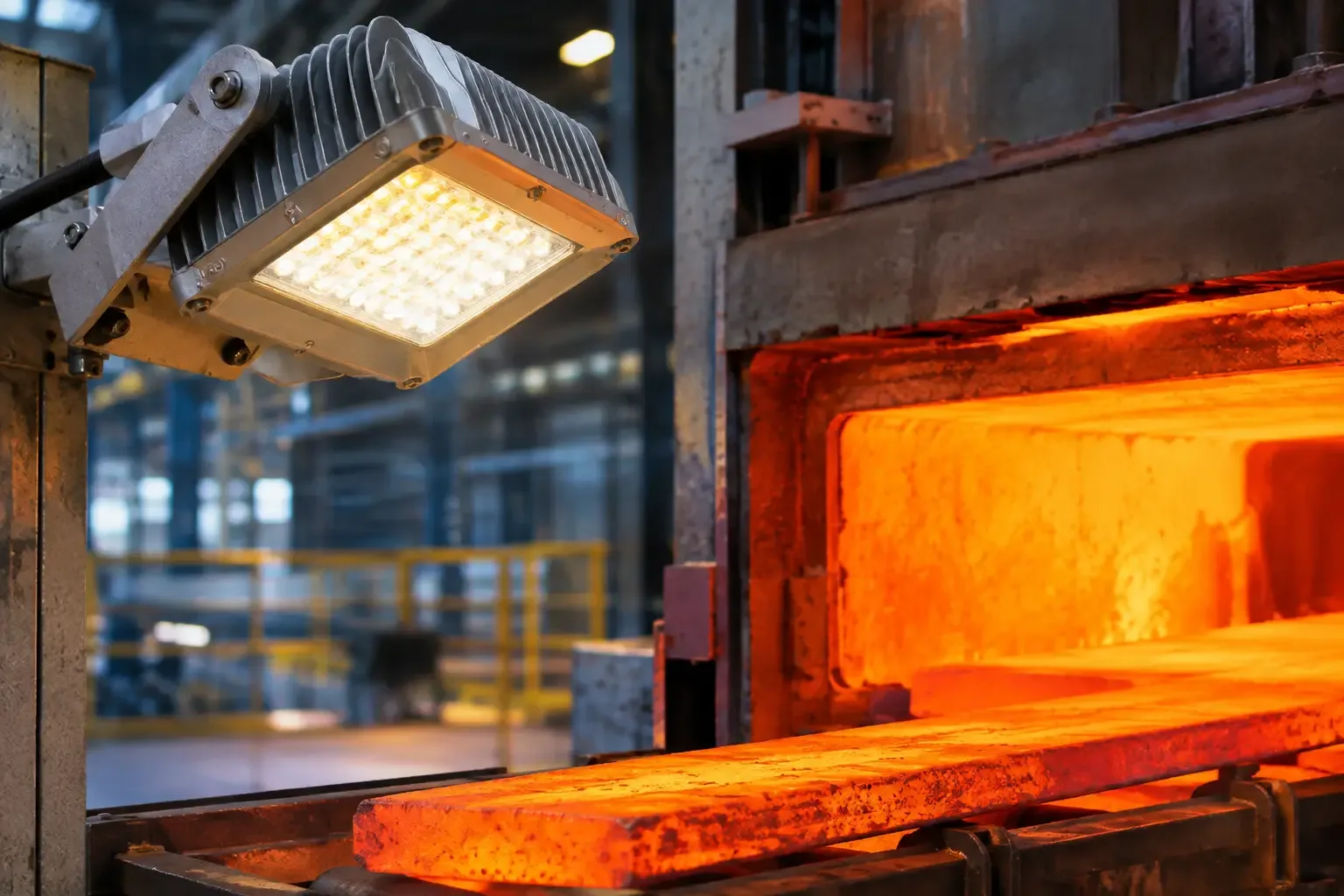
A fixture mounted near a reheating furnace can look perfectly acceptable during a cold inspection, then lose output, discolor, or fail once the surrounding steelwork reaches operating temperature. That is the central challenge of high temperature lighting: the fixture must survive not only radiant heat from the process, but also the actual ambient air temperature at its mounting point, plus dust, vibration, moisture, and access constraints.
For plants working around kilns, furnaces, annealing lines, foundries, and steel processing equipment, fixture selection cannot begin with wattage or lumen output alone. We have found that the fastest way to avoid premature failures is to document the thermal environment first, then match the luminaire's rated ambient range, ingress protection, mounting location, and electrical classification to that environment. The result is a lighting package that supports safer inspections and fewer unplanned maintenance calls.
Why High Temperature Lighting Fails in Ordinary Fixtures
Heat affects every major component inside an LED luminaire. The LED package, driver, capacitors, optical seals, wire insulation, and lens material each have temperature limits. An industrial fixture may be well built for a conventional warehouse ambient, yet be unsuitable over a furnace aisle where hot air pools near the ceiling or where a line-of-sight heat source raises the fixture housing temperature far above room conditions.
The driver is often the limiting component. LEDs generate less heat in the light-emitting element than legacy sources, but they still require effective thermal management. When ambient temperature rises, the fixture has less ability to shed internally generated heat. Capacitor life can decline rapidly, electronic protection may reduce output, and components can age before their rated service interval.
Radiant heat creates a separate problem. A fixture can be installed in air that measures within its stated ambient rating while its lens and housing absorb intense infrared energy from a furnace door, billet line, or kiln opening. In those cases, a remote driver, heat shield, different aiming angle, greater standoff distance, or an alternate mounting elevation may be more effective than simply selecting a fixture with a higher published temperature rating.
Start With the Maximum Ambient Temperature
The most useful specification question is straightforward: what is the maximum ambient temperature at the exact fixture location during normal production and upset conditions? Do not substitute the facility's general room temperature for this measurement. Ceiling zones, catwalks above ovens, and structural members beside exhaust paths often run much hotter than the occupied work area.
Capture the temperature during the hottest expected operating condition. If direct measurement is not practical, use process temperatures, ventilation patterns, mounting height, and the distance from hot surfaces to develop a conservative estimate. Maintenance personnel usually provide valuable context here because they know where paint burns off conduit, where previous fixtures have failed, and where access is difficult when the line is running.
A fixture's maximum ambient rating, often shown as Ta, is the upper surrounding-air temperature for which the product has been evaluated. It is not a guarantee that the fixture can be placed against a 1,800°F furnace wall or directly above a hot exhaust stream. The rating must be read alongside the product's mounting instructions, orientation limits, clearance requirements, and any stated output reduction at elevated temperatures.
For a steel mill, for example, a luminaire serving a crane aisle may see a manageable ambient temperature at the roof truss but significant radiant exposure from ladle operations below. Moving the fixture outward, changing the beam distribution, and shielding the driver can protect performance without sacrificing the task-plane light needed for crane travel and inspection.
LED Thermal Derating: What Buyers Should Expect
Thermal derating means a fixture intentionally reduces light output or changes operating behavior as temperature rises. This is often a protective design feature, not a defect. It helps prevent component temperatures from exceeding their limits when conditions approach the top of the stated ambient range.
The practical question is whether the photometric performance used in the lighting design remains valid at the actual site temperature. A layout based solely on nominal lumens at 77°F may overstate delivered light in a furnace bay or kiln room. Ask for performance data at the expected ambient condition when the application is near the product's limit.
Derating also changes maintenance planning. If a fixture provides adequate illumination only when operating at maximum output, any temperature-driven reduction may create shadows at critical work areas. We recommend designing with a realistic light-level margin, particularly around control stations, stairways, maintenance platforms, refractory inspection areas, and emergency egress routes.
There is a trade-off. Higher-temperature luminaires may have heavier housings, specialized optics, remote components, or lower nominal efficacy than standard industrial high bays. Those trade-offs are usually justified when they extend service life and prevent downtime in locations where relamping or fixture replacement requires a shutdown, lift equipment, or a confined-access work plan.
Consider More Than Heat Alone
A high-temperature application is rarely only a heat application. Steelmaking and foundry areas may involve metallic dust, vibration, washdown, corrosive fumes, or high-pressure cleaning. Cement and aggregate facilities can combine elevated temperatures with abrasive dust. Food baking operations may add steam, cleaning chemicals, and sanitation requirements.
That is why the rating package matters. An appropriate ingress-protection rating helps indicate resistance to dust and water intrusion, while the enclosure material and gasketing determine whether the fixture can tolerate its chemical and washdown exposure. Where combustible dust or flammable vapor may be present, the area classification under the National Electrical Code must drive fixture selection. A high ambient rating does not make a product suitable for a Class I or Class II hazardous location.
Independent safety certification should be verified rather than assumed. UL and Intertek publish certification information and marking guidance that buyers can use to confirm the product's evaluated standard and intended use. For sanitary processing environments, NSF materials and equipment standards can also be relevant, depending on whether the luminaire is installed in a food zone, splash zone, or non-food area. The project submittal should clearly show the fixture's ambient rating, electrical ratings, ingress rating, certifications, and applicable photometric files.
Installation Details That Protect Fixture Life
The mounting plan has as much influence on service life as the fixture selection. Avoid placing luminaires directly in the path of furnace exhaust, roof-level heat stratification, or repeated thermal discharge from doors and hoods. Where production equipment allows it, use a mounting position with airflow around the housing rather than enclosing the fixture in a hot pocket above ductwork or behind shielding.
Cable, conduit seals, junction boxes, and connectors must also be suitable for the local temperature. It is not enough for the luminaire to carry a high Ta rating if adjacent wiring insulation or connection hardware is rated lower. Electrical contractors should review conductor temperature ratings, branch-circuit conditions, grounding, and access before installation. A compliant luminaire can still become a weak point if the rest of the installation is not engineered for the same environment.
Optics deserve attention as well. A narrow distribution can keep a fixture farther from the heat source while placing light on a specific work zone. Conversely, wide distributions can create useful uniformity in open bays but may require mounting closer to high-heat equipment. A photometric layout should account for obstructions, reflectance changes caused by scale or dust, and the light-loss factors expected in the facility.
A Practical Review Before Procurement
Before releasing a high-temperature lighting order, confirm the maximum ambient temperature at the mounting point, potential radiant heat exposure, required light levels, mounting height, beam distribution, electrical voltage, and environmental hazards. Then verify that documentation supports every critical condition, not just the fixture's general industrial use.
For a kiln tunnel, this may mean comparing remote-driver and integrated-driver designs. For a furnace charging floor, it may mean separating the lighting circuit into zones so maintenance can occur without darkening the entire operating area. For a mill crane bay, it may mean prioritizing vibration resistance and service access alongside thermal capability.
Maes Lighting can help project teams narrow these variables before submittals are finalized, with specification-ready data that supports a defensible fixture decision. The right fixture is the one that maintains safe, usable illumination through the plant's hottest production day, not merely the one that looks adequate on a catalog page.