
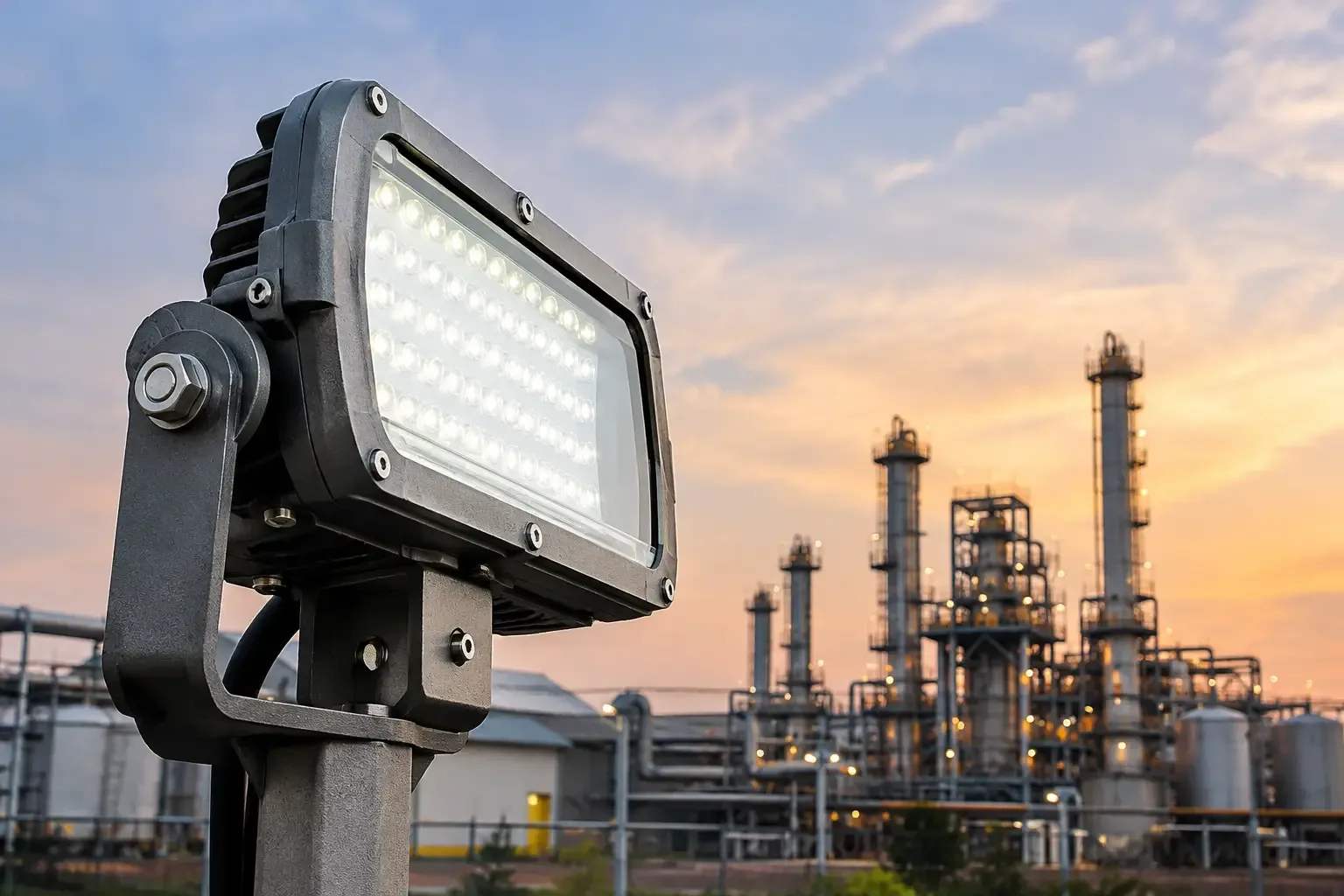
A refinery maintenance team rarely replaces a hazardous-location fixture because the LEDs suddenly stop producing light. More often, the decision follows declining illumination at grade, a damaged lens or gasket, a driver failure, or a process change that exposes the fixture to more heat, vibration, chemicals, or washdown than originally expected. So, how long do explosion-proof LED lights last? A properly selected fixture commonly has an LED lifetime rating of 50,000 to 100,000 hours, but the useful service life in the field depends on far more than the LED chip.
For hazardous locations, rated life is only one part of the maintenance calculation. The fixture must continue to meet the required Class, Division, or Zone classification while preserving enclosure integrity and safe operating temperature. At Maes Lighting, we have found that buyers get better long-term results when they evaluate the full fixture system, the environment, and the documentation together rather than comparing advertised hours alone.
1. Start With the Difference Between Rated Life and Useful Life
Most industrial LED fixtures are rated using lumen maintenance, commonly expressed as L70. An L70 rating of 100,000 hours means the LEDs are projected to provide at least 70% of their initial light output at that point under stated test conditions. It does not mean every fixture will operate without service for 100,000 hours.
At 24/7 operation, 100,000 hours equals about 11.4 years. At 12 hours per day, it is closer to 22.8 years. Those figures are useful for preliminary lifecycle planning, but the actual service interval can be shorter if the fixture is installed in excessive ambient heat, exposed to corrosive compounds, or subjected to voltage events.
For a facility manager, useful life is usually reached before total LED failure. If light levels fall below the maintained illuminance required for safe work, inspection, or process control, replacement may be necessary even though the fixture still turns on.
2. The Driver Often Determines When Service Is Needed
The LED array receives most of the attention in product literature, but the driver is frequently the component that sets real-world fixture life. Drivers convert incoming electrical power into the controlled current required by LEDs. They also face heat, line disturbances, and electrical transients.
A fixture with a 100,000-hour LED rating may have a driver rated for a shorter operating life. In a stable, temperature-controlled area, that difference may have little practical effect. In a pump station with frequent switching, an outdoor loading rack exposed to lightning-related surges, or a steel facility with electrical noise, it can be decisive.
Review the driver specifications separately. Look for input-voltage range, surge protection, driver operating temperature, power factor, and replacement availability where field service is permitted. A surge protection device at the panel or branch circuit can also protect a large lighting investment, particularly at outdoor process equipment.
3. Ambient Temperature Can Cut Explosion-Proof LED Life
Heat is one of the strongest predictors of LED and driver longevity. Hazardous-location fixtures are designed with enclosures and thermal paths that contain an internal ignition event or prevent ignition of the surrounding atmosphere, depending on the protection method and classification. That safety function does not eliminate thermal limits.
Every fixture has a maximum ambient temperature rating. Installing a fixture rated for 131 degrees F in an area that routinely reaches 145 degrees F can accelerate lumen depreciation, harden gasket materials, and reduce driver life. The fixture may still appear functional during a short inspection, while operating well outside the conditions used to establish its rating.
This issue is common near furnaces, kiln doors, steam lines, roof-level process heat, and hot transfer equipment. The correct approach is to document normal and peak ambient conditions at the mounting location, not simply the building's general temperature. Where high ambient heat is expected, a purpose-built high-temperature fixture may provide a better lifecycle outcome than an explosion-proof fixture chosen solely for its housing style.
4. Hazardous-Location Compliance Must Remain Intact
An explosion-proof label is not a generic durability claim. In the National Electrical Code system, the fixture must be suitable for the specific hazardous location, including the Class, Division or Zone, gas group or dust group, and temperature code required by the area classification.
For example, a Class I, Division 1 location has a more demanding exposure assumption than a Class I, Division 2 location. A grain-handling operation may involve combustible dust and require a Class II evaluation instead of a gas-vapor classification. The fixture's lifetime value disappears if its marking does not match the hazardous-area documentation.
Third-party certification matters here. Organizations such as UL Solutions and Intertek evaluate products against applicable safety standards and provide certification markings that specifiers and authorities having jurisdiction can verify. Before installation, confirm the exact catalog number, certification file, temperature code, and permitted ambient range. Do not assume that similar-looking fixtures share identical approvals.
5. Corrosion, Moisture, and Washdown Affect the Whole Fixture
A hazardous-location enclosure can be correctly certified and still lose service life in a harsh process environment. Salt air, sulfur compounds, caustic cleaning agents, cutting fluids, and repeated washdown can attack coatings, cable entries, fasteners, seals, and lens materials.
Consider a coastal marine terminal where fixtures are exposed to salt spray and vibration. The LED board may retain substantial life, but corrosion at conduit hubs or mounting hardware can create an inspection and maintenance problem years earlier. In a food or beverage facility, hot-water washdown and sanitation chemicals may place similar stress on seals and lenses, even when the hazardous-area classification is not the primary selection criterion.
Match the enclosure and materials to the exposure. Verify the IP rating, gasket material, lens construction, coating system, and hardware composition. Where sanitation is part of the operating environment, NSF standards and the specific construction requirements for the area should be reviewed alongside electrical safety listings.
6. Vibration and Installation Quality Can Shorten Service Life
Industrial LEDs tolerate vibration better than older lighting technologies in many applications, but no fixture is immune to poor mounting or continuous mechanical stress. Reciprocating compressors, conveyors, stamping equipment, cranes, and marine engines can loosen hardware or fatigue connections over time.
Installation details matter. Use the manufacturer-approved mounting method, protect conductors from strain, tighten entries correctly, and maintain the enclosure's required sealing method. An improperly installed conduit seal or damaged threaded joint is not just a longevity concern. In an explosion-proof installation, it can compromise the safety design that the listing depends on.
During maintenance rounds, inspect mounting points, hubs, covers, lenses, and cord grips. A quick visual check can identify corrosion, impact damage, condensation, or loose hardware before the fixture requires an unplanned replacement.
7. Plan Around Lumen Depreciation, Not Just Failure
A lighting plan should account for how illumination changes over time. Initial foot-candle readings can look excellent immediately after installation, then decline gradually as LEDs age and environmental contamination reduces light transmission.
A practical maintenance plan establishes a target maintained light level for the task. In a refinery walkway, that may support safe travel and emergency response. In a process area, it may support valve identification, gauge reading, and inspection work. In a hazardous material handling zone, consistent lighting can reduce the chance of an operational error.
Photometric files and lighting calculations help establish this plan before purchase. They show expected distribution and illumination, while the fixture's lumen-maintenance data supports a realistic replacement forecast. For large projects, include a maintenance factor that reflects dirt accumulation, ambient temperature, operating hours, and expected lumen depreciation.
8. Choose the Fixture for the Site, Not the Longest Hour Rating
When comparing explosion-proof LED lights, a higher hour rating is meaningful only when the products have comparable classification, ambient-temperature capability, driver design, optics, and material construction. A 100,000-hour fixture that is marginal for the environment can be a poorer investment than a 60,000-hour fixture designed specifically for the site.
Request the documentation needed for a complete comparison: datasheet, hazardous-location certification, temperature-code information, ambient limits, photometric report, warranty terms, and installation instructions. For replacement projects, verify mounting height, voltage, conduit configuration, emergency requirements, and the classified-area drawing before ordering.
The most dependable answer to how long explosion-proof LED lights last is this: expect many years of useful service when the fixture is correctly classified, thermally suitable, properly installed, and maintained as part of the facility's reliability program. The best time to protect that service life is before the fixture is selected, when the operating conditions can still guide the specification.