
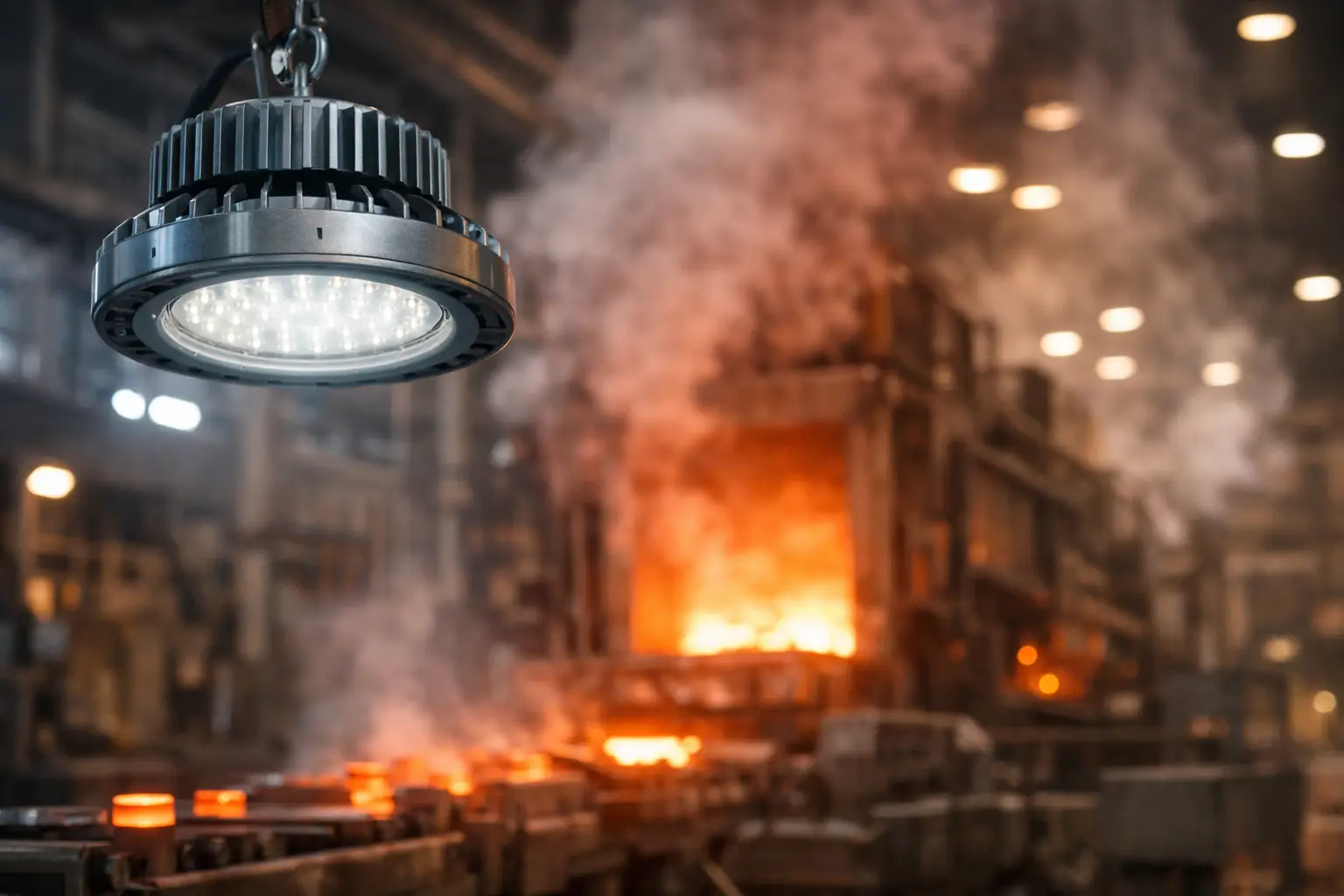
A fixture can survive a brief temperature spike and still fail prematurely when it operates near a furnace, kiln, oven, boiler, or process line every shift. That distinction drives the specification of LED lights for high temperature areas. The practical question is not whether an LED fixture produces light near heat. It is whether its complete system - LED board, driver, lens, seals, wiring, and mounting hardware - is rated to deliver useful output and service life at the actual ambient temperature surrounding the fixture.
For application-specific options, review Maes Lighting's high-temperature lighting range with the fixture data, temperature ratings, and submittal documentation needed for a project review. A proper selection starts with the environment around the luminaire, not the temperature of the process alone. Where a high-temperature zone also contains combustible gas, vapor, dust, or fibers, the fixture must meet the applicable hazardous-location classification in addition to its thermal requirements.
Why ambient temperature governs fixture life
Industrial LED fixtures generate their own heat. Under normal conditions, the heat sink transfers that energy to the surrounding air, keeping LED junction temperatures and driver components within their designed operating range. High ambient heat reduces that cooling margin. If the fixture is installed where the surrounding air is hotter than its stated maximum ambient rating, internal component temperatures rise even when the light appears to operate normally at startup.
The consequences are usually gradual rather than dramatic. Light output may depreciate faster, driver capacitors may age early, color may shift, and electronic protection may reduce output or cycle the fixture off. In a production environment, those failures become access, labor, and uptime problems long before they become a lighting problem.
Process temperature and ambient temperature are not interchangeable. A furnace wall may be several hundred degrees while a fixture mounted at a measured distance sees a lower air temperature. Conversely, a fixture positioned above an oven exhaust, near a roof pocket, or inside a poorly ventilated enclosure may experience much higher ambient conditions than the process-area average. Measure where the fixture will live, including temperature changes during peak production, cleaning, and upset conditions.
Start with the complete operating environment
A high-temperature rating is essential, but it is only one part of the fixture decision. Industrial areas often combine heat with oil mist, airborne scale, moisture, corrosive vapor, vibration, and physical impact. Each condition can change the housing, lens, gasket, mounting, and certification requirements.
Identify the maximum ambient at the mounting point
Use documented temperature readings whenever possible. Ask operations and maintenance personnel about startup, batch cycles, purge events, summer conditions, and nearby equipment changes. A temperature survey conducted during a low-load shift can understate the environment substantially.
Leave a realistic operating margin. Specifying a fixture at the exact measured maximum ambient gives little room for process variation, accumulated radiant heat, or restricted airflow. The appropriate margin depends on the process and mounting arrangement, but the fixture should not be selected on a best-case reading.
Account for radiant heat and airflow
A fixture can be exposed to radiant energy from hot steel, refractory surfaces, molten material, or exhaust ductwork. Radiant heat can increase housing temperature beyond what an air-temperature measurement suggests. Shielding, relocation, standoff mounting, or a different aiming angle may be more effective than simply selecting a higher-wattage fixture.
Air movement matters as well. A fixture rated for a given ambient condition may depend on natural convection around its heat sink. Mounting it in a tight recess, directly against a hot structure, or beneath an insulated hood can limit heat rejection. Follow the manufacturer's mounting orientation and clearance instructions, especially for high bay and floodlight installations.
Separate thermal requirements from area classification
High heat does not automatically mean a hazardous location, and a hazardous-location rating does not automatically mean a fixture is suitable for high ambient conditions. If flammable gases, vapors, combustible dust, or ignitable fibers are present, evaluate the Class, Division or Zone classification, gas group or dust group, and required temperature code.
The fixture's maximum surface temperature must remain below the ignition temperature associated with the classified material. High ambient heat affects this calculation, which is why the certification markings and ambient range must be reviewed together. Do not assume an explosion-proof fixture is acceptable beside a high-temperature process unless its marked ambient rating supports the installation.
What to verify on a high-temperature LED submittal
A specification-ready review should go beyond wattage and lumen output. High output from a fixture that cannot sustain its rated performance at site temperature is not a successful design. Confirm the published maximum ambient rating, rated input voltage, photometric distribution, ingress protection, mounting method, and warranty conditions.
Pay close attention to the driver. In many LED fixtures, the driver is the temperature-sensitive component most likely to determine useful service life. Purpose-built high-temperature luminaires may use remote drivers, thermally separated driver compartments, higher-temperature electronic components, or fixture designs that reduce internal heat loading. These features can be valuable, but only the documented ambient rating establishes the permitted operating range.
Lens and gasket materials deserve the same attention. Standard polycarbonate, acrylic, silicone, and elastomeric components each have different long-term behavior under heat, ultraviolet exposure, chemicals, and washdown. In food and beverage plants, a hot environment may also require NSF suitability and IP69K washdown resistance. In steel, foundry, or fabrication environments, impact resistance, dust exclusion, and corrosion resistance may carry equal weight.
Request documentation early in the purchasing process. Datasheets, certifications, dimensional drawings, photometric files, temperature markings, and installation instructions help electrical contractors, engineers, and AHJs verify the fixture before equipment arrives. This is particularly valuable when a project includes a mix of ordinary industrial areas, hazardous locations, and high-temperature zones.
Choose light levels and optics for the task, not the hottest catalog number
High-temperature fixtures are often installed in difficult visual environments: elevated platforms, furnace lines, rolling mills, drying tunnels, boiler rooms, and process corridors. A narrow beam can put useful light on a distant valve bank or work surface, while a wide distribution can improve uniformity across an access area. The right optic reduces the need to overdrive a fixture simply to overcome poor light placement.
Consider glare carefully. Bright point sources reflected from hot metal, stainless equipment, steam, or wet floors can hinder inspections and routine work. Mounting height, aiming, shielding, and distribution should support the actual task. A maintenance platform may need vertical illumination on gauges and control points, not only horizontal foot-candles on the walking surface.
There is also a trade-off between fixture quantity and fixture output. Fewer, higher-output luminaires can reduce installation points, but may concentrate heat, create glare, and leave less redundancy when a unit is out of service. More fixtures at lower output can improve uniformity and maintenance flexibility, provided the mounting locations remain within rated ambient limits.
Installation practices that protect the rating
Even a correctly selected luminaire can be compromised by installation details. Keep it clear of direct exhaust discharge and avoid mounting it where heat can collect against the housing. Use mounting hardware suited to the temperature, corrosion exposure, and vibration of the area. Verify that branch-circuit conductors, connectors, junction boxes, and cable glands are also rated for the local conditions.
Do not modify housings, drill unapproved openings, substitute lenses, or add field-made shields that restrict airflow. These changes can affect ingress protection, hazardous-location compliance, and thermal performance. If a guard, visor, remote mounting arrangement, or special bracket is required, select an approved accessory or obtain written confirmation that the configuration is acceptable.
Commission the installation under normal production conditions. Inspect fixture operation after the process reaches peak temperature, not just after energization. Look for unexpected dimming, cycling, discoloration, damaged seals, or mounting locations that receive more heat than anticipated. A short post-installation review can prevent a repeated maintenance issue from becoming the accepted cost of operating near heat.
When a standard industrial LED is not the answer
A standard high bay may work in a warm warehouse zone but not directly above a heat-treatment line. Likewise, a vapor-tight fixture may resist moisture and dust but have an ambient limit that is too low for a boiler room or oven discharge area. The correct answer may be a dedicated high-temperature fixture, a remote-mounted arrangement, a change in mounting location, or a revised lighting layout.
Thermal suitability is also not permanent. Adding insulation, replacing process equipment, closing roof vents, or increasing line speed can alter the temperature at existing fixtures. Treat lighting as part of the operating environment whenever process changes are planned.
The most dependable high-temperature lighting projects begin with actual site conditions, then match the fixture rating, area classification, optics, materials, and documentation to those conditions. That approach protects workers, reduces avoidable lift calls, and gives the project team a defensible basis for approval before the fixtures are installed.
Anonymized selection scenario
Paper-machine dryer hood lighting at 260°F.
A project inquiry described wall-mounted lighting inside a paper-machine dryer hood where the ambient may reach 260°F (about 127°C). This is a selection example, not a completed project or performance claim.
That stated ambient exceeds the documented 100°C (212°F) limit of the RT-IL 100°C family. The RT-IL-150C light head is documented to 150°C (302°F), but its driver is limited to 100°C (212°F), so the driver needs a verified cooler-zone location and the complete installation still requires application review.
Confirm before product approval
- Continuous, peak and upset temperature at the exact fixture position
- Cooler remote-driver location, cable distance, fixture dimensions and available mounting envelope
- Voltage, quantity, target light level, wall orientation and beam distribution
- Steam, moisture, chemicals, vibration, paper dust and area classification
- Required ingress protection, listings, photometrics and approval documents