
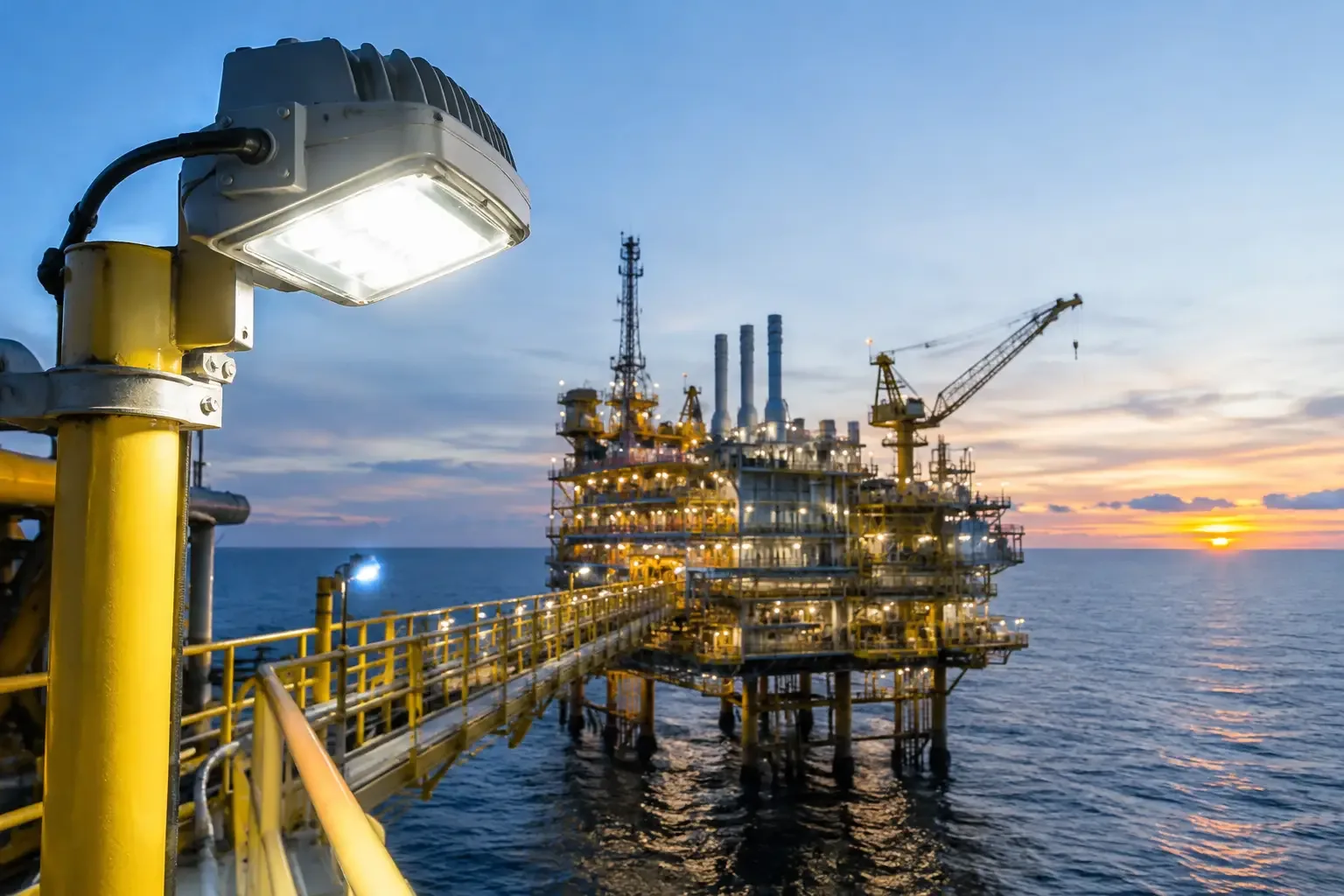
Salt spray does not fail a fixture all at once. It starts at cable entries, fasteners, lens seals, mounting hardware, and dissimilar-metal contact points. On an offshore platform, those small weaknesses can become water intrusion, corroded connections, reduced output, unplanned maintenance, and unsafe work areas. That is why marine lighting for offshore platforms must be selected as critical operating equipment, not as a commodity replacement.
The right fixture package begins with a clear view of the platform's hazardous-area drawings, mounting locations, ambient conditions, electrical system, maintenance access, and task requirements. We have found that projects move more efficiently when the lighting schedule is reviewed alongside the classification plan and submittal requirements before fixtures are ordered. This is where complete datasheets, certification records, photometric files, and mounting details protect both the installation schedule and long-term uptime.
Why Offshore Lighting Fails Faster
Offshore facilities combine several demanding exposures in one installation. Chloride-rich air attacks unprotected metals. Wind-driven rain challenges seals and cable glands. Vibration from rotating equipment can loosen hardware and fatigue connections. High heat around process equipment shortens electronic component life, while low temperatures and high winds can affect exposed locations.
The fixture's housing material matters, but it is only part of the answer. A marine luminaire should be evaluated as an assembly: housing, lens, gasket, driver compartment, fasteners, conduit hub or cable entry, mounting yoke, and grounding provisions. A die-cast housing with ordinary steel hardware, for example, can still create a corrosion problem at the points where the fixture is mounted and serviced.
Coating quality also deserves scrutiny. Marine-grade powder coating, suitable aluminum alloys, stainless hardware, and corrosion-resistant cable glands can materially extend service life. The appropriate combination depends on the platform zone. A protected interior electrical room has different exposure than an open-air helideck, crane boom, boat landing, or perimeter walkway receiving constant spray.
Hazardous Locations Come Before Lumen Output
Many offshore platform locations handle or are adjacent to flammable gases and vapors. Lighting in these areas must match the hazardous-location classification established for the site. Under the National Electrical Code, Class I locations involve flammable gases or vapors. Division 1 generally addresses locations where ignitable concentrations may exist during normal operations, while Division 2 applies where they are not normally present but could occur because of abnormal conditions.
Some projects use the NEC Zone system instead. Zone 0, Zone 1, and Zone 2 classifications define the expected presence of explosive gas atmospheres differently than the Division method. International projects may also reference IECEx or ATEX documentation. These systems are related, but they are not interchangeable by assumption. The authority having jurisdiction, project specification, and jurisdictional code determine what listing or certification is acceptable.
Do not treat the phrase "explosion-proof" as a universal answer. An explosion-proof fixture may be appropriate for a specific Class I, Division 1 application, but the nameplate must match the actual class, division or zone, gas group, temperature code, ambient rating, and installation method. A fixture can be well built and still be unacceptable if its certification does not cover the classified area or expected ambient temperature.
UL Solutions and Intertek are widely recognized testing and certification organizations whose marks may appear on industrial lighting documentation. The relevant documentation should identify the applicable standard and exact rating, rather than relying on a general statement that a product is "hazardous location rated." For offshore work, procurement teams should request the certification file early, especially when the project requires formal submittal review.
Temperature Code and Ambient Rating Are Separate Checks
A common specification mistake is focusing on the fixture's maximum ambient temperature while overlooking its temperature code. The ambient rating indicates the air temperature in which the luminaire can operate. The temperature code addresses the maximum surface temperature under specified conditions, helping prevent ignition of a surrounding flammable atmosphere.
Both values matter near process skids, compressor packages, exhaust paths, and enclosed equipment areas. An LED fixture may run cooler than legacy technology, but it still has a driver, thermal pathway, and operating limits. Higher ambient temperatures can reduce driver life and light output unless the product is specifically designed and rated for that environment.
Optical Design Is a Safety Decision
Offshore platforms need light that supports practical work: reading gauges, identifying valves, moving safely across grating, performing inspections, and responding during abnormal conditions. More lumens do not automatically deliver better visibility. Poorly controlled glare can make a wet deck or reflective pipe rack harder to see, particularly when workers are looking toward a fixture from below or across an open platform.
Floodlighting should be aimed and selected around the task plane, mounting height, shadowing, and line of sight. Narrow distributions can support targeted equipment illumination, while wider distributions can improve deck coverage. On a crane platform or loading area, the layout must account for boom shadow, handrails, piping, and structural members that block light.
Photometric files are valuable here because they let electrical designers model actual fixture output and distribution rather than estimate from a catalog lumen figure. For critical areas, evaluate maintained illuminance, uniformity, glare, and shadow patterns at the work surface. The goal is not merely to satisfy a drawing count. It is to give crews usable light through the end of the maintenance cycle.
Match the Fixture to the Platform Area
A single fixture family rarely suits every offshore application. Open decks, enclosed process modules, machinery spaces, access stairways, escape routes, marine loading areas, and control rooms have different classification, corrosion, mounting, and optical needs.
For exterior walkways and platforms, sealed vapor-tight or marine-rated luminaires can provide broad, low-glare coverage when the area is unclassified. Where hazardous gases may be present, a listed hazardous-location fixture must be selected instead. For high-mounted process structures, hazardous-location floodlights may provide better aiming flexibility, but their wind loading, bracket strength, and access for adjustment should be considered.
Emergency lighting requires its own review. Battery-backed fixtures may face shorter battery life in high heat or cold. Central emergency power arrangements can reduce some fixture-level maintenance demands, but they introduce system-level design considerations. The emergency lighting strategy should coordinate with egress requirements, muster areas, and the facility's emergency power design.
Installation Details Can Undermine a Good Fixture
The most durable luminaire can be compromised by incorrect installation. Cable entries must use fittings and glands suitable for the enclosure, area classification, cable type, and environmental exposure. Unused openings need properly rated plugs. Grounding must be continuous and verified. Improperly oriented fixtures can expose drains, seals, or lens joints to standing water.
Mounting deserves similar attention. Offshore vibration and wind loading can stress brackets that are perfectly adequate in a warehouse. Use compatible materials and isolation practices where needed to reduce galvanic corrosion. Confirm that junction boxes, supports, conduit systems, and hardware carry the same environmental and hazardous-location discipline as the fixture itself.
Maintenance teams should also be able to inspect and service fixtures without creating unnecessary exposure. A design that requires frequent lifts, extensive disassembly, or access near live process equipment may carry a higher lifecycle cost than its purchase price suggests. Long-life LED systems can reduce relamping work, but only when drivers, seals, and thermal management are suited to the site.
A Better Offshore Lighting Submittal
For offshore lighting, a complete submittal should answer the questions that field teams and reviewers will actually ask. It should identify hazardous-location ratings where applicable, ingress protection, ambient range, temperature code, voltage and frequency, material and finish, mounting arrangement, photometric data, and warranty terms. Installation instructions and certification documents should match the exact catalog configuration being supplied.
Before release, verify the fixture schedule against the latest area classification drawing. Confirm marine exposure requirements with the owner or EPC team, not just the initial bid specification. A fixture may need a different coating system, hardware package, optic, voltage, or emergency option after the final platform layout is issued.
At Maes Lighting, the practical objective is to help teams select lighting that can be documented, installed, and maintained with confidence in severe operating conditions. Offshore projects reward that discipline. When fixtures are matched to the classification, exposure, optics, and installation details from the start, crews spend less time chasing corrosion failures and more time operating safely.