
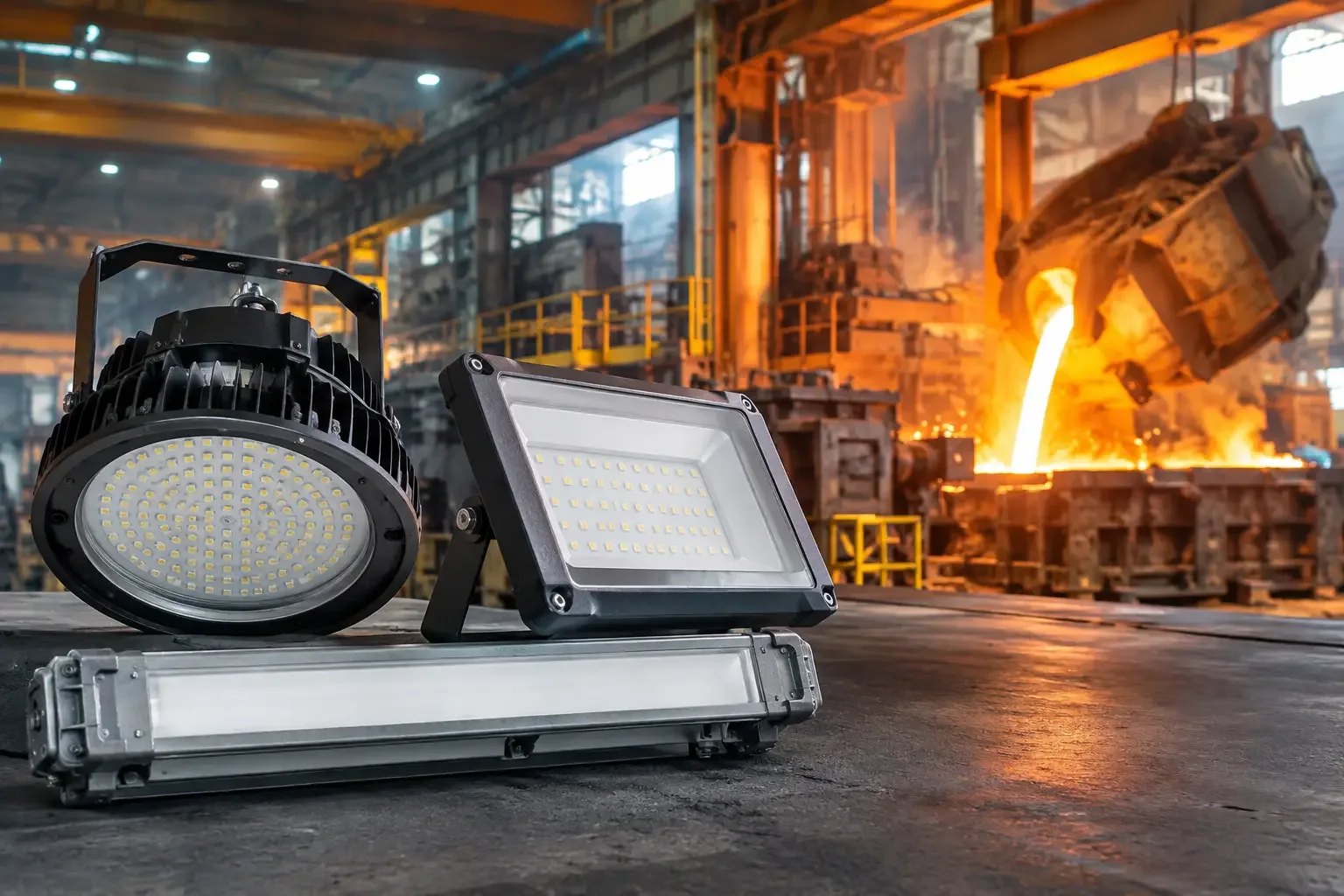
A foundry lighting failure rarely happens in a clean, forgiving location. It happens above a melt deck where radiant heat is highest, over shakeout equipment where vibration is constant, or in a dusty aisle where maintenance access is difficult. When buyers ask which top LED fixtures foundries should specify, the useful answer is not a brand list. It is a fixture-by-area decision based on ambient temperature, airborne material, mounting conditions, maintenance access, and the electrical classification assigned to that location.
At Maes Lighting, we have found that the best projects begin with a short operating profile rather than a wattage target. Document the maximum ambient temperature at the fixture mounting height, identify dust and process byproducts, note washdown or corrosive exposure, and confirm the site’s hazardous-location drawing with the authority having jurisdiction. That information determines whether a standard industrial high bay, a high-temperature luminaire, a vapor-tight fixture, or hazardous-location equipment is appropriate.
Why Foundry Lighting Requires Area-by-Area Selection
A foundry is not one lighting environment. The melt shop, casting line, cooling area, finishing department, maintenance bay, and outdoor material-handling area can have entirely different demands. A fixture that performs well over a warehouse staging area may fail quickly over a ladle-preparation zone.
Heat is usually the first differentiator. LEDs generate less fixture heat than legacy HID systems, but the driver and LED array still have operating limits. High ambient temperatures accelerate driver degradation, reduce light output, and can shorten useful life. The fixture’s maximum rated ambient temperature must exceed the actual sustained ambient at its installed location, with an appropriate margin for radiant loading and restricted airflow.
Dust is the next issue. Fine sand, metallic particulate, and process dust can accumulate on lenses and heat sinks, reducing delivered illumination and restricting thermal performance. A sealed housing with a suitable ingress-protection rating helps, but the rating alone does not make a fixture appropriate for a classified combustible-dust location. Classification must come first.
Vibration, impact, and maintenance access also matter. Casting equipment, cranes, conveyors, and shakeout systems create conditions that can loosen hardware and fatigue lower-grade components. In high mounting locations, selecting a fixture with durable mounting options, replaceable surge protection where available, and complete photometric documentation can reduce both installation risk and future service interruptions.
The Top LED Fixtures for Foundries by Application
High-temperature LED luminaires for melt and furnace areas
Melt decks, furnace platforms, ladle areas, and locations adjacent to hot process equipment need fixtures engineered for elevated ambient conditions. A high-temperature rating is not a marketing label. It is a stated maximum ambient limit, often expressed as Ta, supported by the product’s thermal design and certification documentation.
Specify these fixtures by the temperature at the fixture, not the temperature of the molten metal. A furnace may operate at extreme temperatures while the luminaire mounted several feet away experiences a lower but still damaging combination of ambient heat and radiant exposure. Field measurement during normal production is preferable. If measurements are unavailable, use conservative assumptions and consult the fixture manufacturer’s installation guidance.
Look for a heat-tolerant driver arrangement, metal housing, high-temperature gasket and lens materials, and a photometric distribution suited to the mounting height. Narrow distributions can help place light on a task area from high mounting elevations, while wider distributions are often better for platform and aisle coverage. Higher lumen output is not automatically better if glare affects crane operators or workers handling hot material.
Industrial LED high bays for general production and finishing
High bays are typically the workhorse fixture in foundry production areas that are hot, dusty, and active but outside the most severe thermal zones. They are a strong fit for mold preparation, finishing, machining, warehousing, and indoor material movement when their environmental rating matches the location.
The selection question is usually not simply how many watts to install. It is whether the photometric layout provides adequate maintained foot-candles on work planes, travel paths, inspection stations, and vertical surfaces. Dark walls, overhead cranes, and suspended ductwork can materially affect light levels and shadowing.
We recommend using an application-specific photometric plan rather than duplicating the quantity of existing HID fixtures. LED optics distribute light differently, and one-for-one replacement can leave task zones underlit or create excessive brightness directly beneath fixtures. Documentation should include IES files, spacing criteria, mounting information, voltage, and fixture weight so the electrical and structural portions of the installation can be reviewed together.
Hazardous-location fixtures for classified dust or vapor areas
Foundry operations do not automatically require explosion-proof lighting. The presence of heat, smoke, or ordinary industrial dust does not by itself establish a hazardous location. The applicable classification depends on the material present, its concentration, process conditions, ventilation, and the site’s electrical area classification.
Where combustible metal dust, carbonaceous dust, flammable gases, or vapors create a classified area, use luminaires listed for that exact classification. Under the NEC Division system, the selection may involve Class I for gases or vapors and Class II for combustible dust, with Division 1 or Division 2 determined by the likelihood of the hazard being present. Zone-based classifications may also apply in facilities designed around IEC practices or specific project requirements.
Do not treat “explosion-proof” as a universal replacement term. A fixture must carry markings that match the required class, division or zone, gas group or dust group, temperature code where applicable, and ambient range. Listings from recognized organizations such as UL Solutions or Intertek should be reviewed on the actual product documentation, not inferred from a catalog category. The authority having jurisdiction remains the final interpreter for the installation.
Vapor-tight and enclosed fixtures for wet, dirty support areas
Vapor-tight LED fixtures can be effective in maintenance rooms, utility corridors, covered loading areas, cooling-water locations, and process support spaces exposed to moisture and routine cleaning. Their enclosed design helps protect internal components from water, dirt, and incidental exposure.
They are not a substitute for high-temperature or hazardous-location fixtures. A vapor-tight fixture with an IP rating may be excellent for wetness and dust ingress but unsuitable near a furnace or in a classified area. This distinction prevents a frequent specification error: selecting the highest apparent IP number while overlooking temperature and electrical classification requirements.
Floodlights for yards, charging areas, and exterior access
Outdoor foundry operations need dependable illumination around scrap yards, rail access, truck circulation, security perimeters, and material staging. Industrial LED floodlights should be selected for the actual aiming distance, mounting elevation, wind exposure, and glare-control requirement.
For vehicle and pedestrian safety, emphasize uniformity as well as peak light level. A very bright floodlight aimed poorly can create glare, obscure hazards, and reduce visibility at transition points between indoor and outdoor spaces. Corrosion resistance, surge protection, and appropriate mounting hardware are especially important where weather, airborne contaminants, or vibration are present.
A Practical Specification Checklist
Before releasing a fixture schedule, confirm the mounting height, voltage, ambient temperature, location classification, ingress exposure, corrosive exposure, and required illumination levels. Then verify the fixture’s listing marks, temperature limitations, photometric files, installation instructions, warranty terms, and lead time.
For a major retrofit, ask whether emergency lighting, controls, and egress illumination are part of the scope. Controls can save energy in intermittently occupied spaces, but sensors and control components must be located and rated appropriately. In a harsh process area, simplicity and maintainability may be more valuable than an aggressive control strategy that adds failure points.
A common retrofit pattern illustrates the value of this review. A plant replaces aging high-intensity fixtures in a finishing bay with general-purpose LEDs, only to discover that fixtures nearest the process line run hotter and fail earlier than units over the aisle. Reclassifying the space by exposure zone often leads to a mixed schedule: high-temperature fixtures near the process, industrial high bays over general production, and enclosed fixtures in wet support locations. The result is more defensible than forcing one fixture family into every area.
Documentation Is Part of the Fixture Decision
For industrial projects, the fixture itself is only part of the submittal. Electrical contractors, engineers, safety teams, and procurement groups need documents that answer practical questions before equipment arrives on site. Those typically include cut sheets, certification information, photometric data, mounting details, electrical characteristics, and environmental limitations.
This is particularly important when hazardous locations or severe heat are involved. A product may look similar to another fixture in a schedule while carrying a different ambient limit, lens material, mounting restriction, or certification. Comparing documentation line by line helps avoid field substitutions that delay approval or create a mismatch with the facility standard.
The right foundry lighting plan does not pursue a single “best” fixture. It assigns the right LED luminaire to each operating zone, gives maintenance teams realistic service expectations, and gives the project team the documentation needed to install with confidence.