
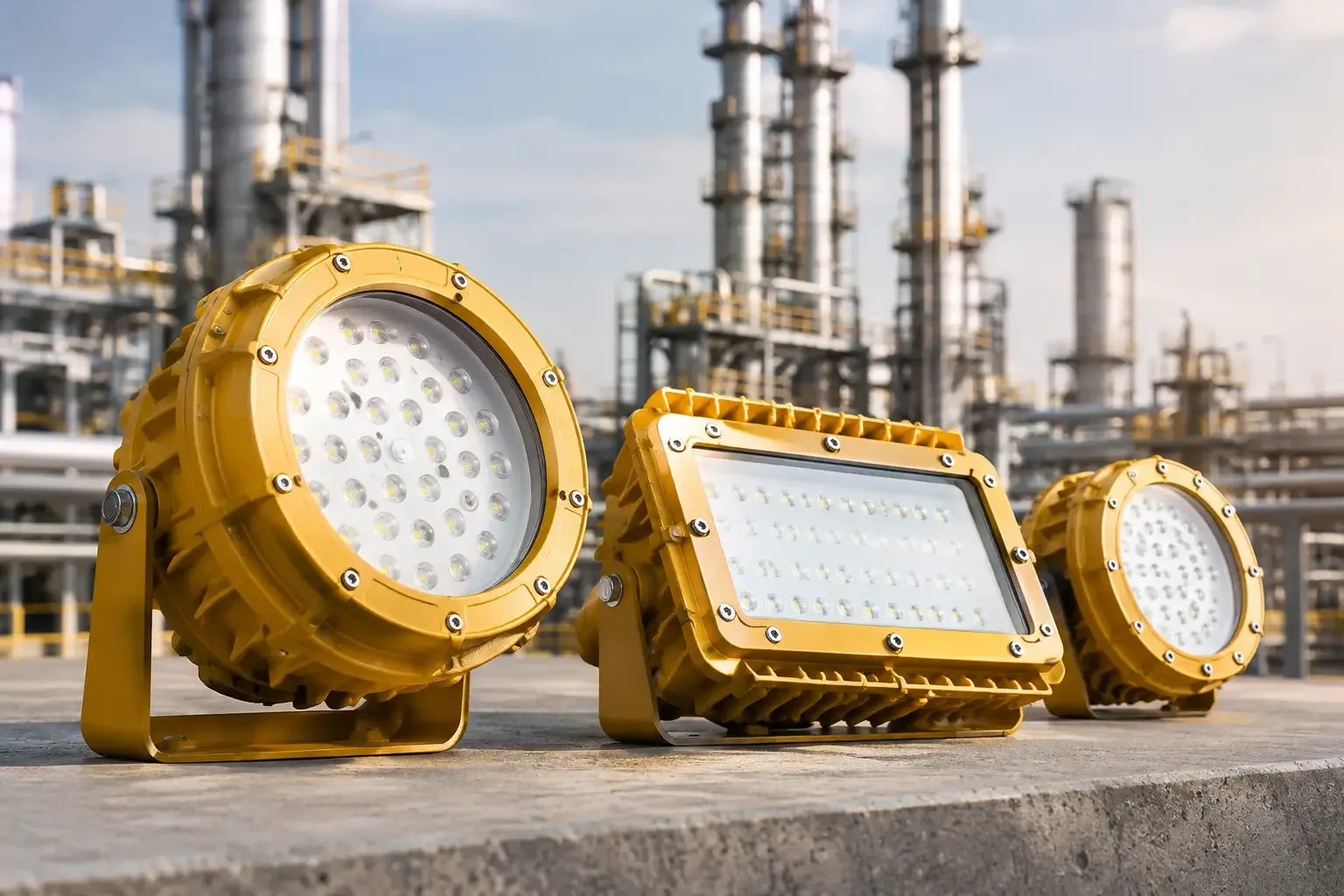
A refinery electrician replacing a failed fixture near a vapor recovery unit cannot treat the purchase like a standard industrial lighting order. The fixture must match the classified area, the gas group, the ambient temperature, mounting conditions, and the facility’s electrical code requirements. If you are asking, where can I buy explosion-proof LED lighting?, the better question is where you can obtain correctly rated fixtures along with the documentation needed to approve, install, and maintain them.
Buying from a hazardous-location lighting specialist gives engineering, maintenance, and procurement teams a more dependable path than selecting from a general commercial catalog. At Maes Lighting, we have found that most costly delays occur before installation: an incorrect Class or Division is specified, a certification is assumed rather than verified, or the submittal package is incomplete when the contractor needs it.
1. Buy From a Hazardous-Location Lighting Specialist
Explosion-proof LED fixtures should be sourced from suppliers that regularly work with classified industrial environments, not sellers that simply label a fixture as “industrial” or “heavy duty.” A qualified supplier should be able to discuss the fixture’s approved hazardous-location marking, voltage, ingress protection, operating temperature range, mounting configuration, and photometric distribution.
This matters because “explosion-proof” is not a generic performance claim. In North American electrical practice, it describes equipment designed to contain an internal ignition and prevent it from igniting the surrounding hazardous atmosphere when installed within its approved conditions. The fixture must be appropriate for the exact area classification established by the facility or the authority having jurisdiction.
For facilities in refining, petrochemical processing, tank farms, grain handling, wastewater treatment, and solvent storage, a specialist can narrow the selection quickly. That includes identifying whether a linear fixture, high bay, floodlight, wall pack, or low-profile luminaire is appropriate for the work area and maintenance access constraints.
2. Verify the Class, Division, Zone, and Group Before Requesting a Quote
The most useful purchase order begins with the site classification, not with wattage or lumen output. Under the National Electrical Code, hazardous locations may be designated by Class and Division or by the Zone system. Class I addresses flammable gases or vapors, Class II addresses combustible dust, and Class III addresses ignitable fibers or flyings.
The Division designation defines how likely the hazardous material is to be present. Class I, Division 1 locations are areas where ignitable concentrations can exist during normal operations, maintenance, or leakage conditions. Class I, Division 2 locations are areas where those concentrations are normally contained but could be present under abnormal conditions, such as a seal failure or equipment malfunction.
A fixture approved for Division 2 is not automatically suitable for Division 1. The same principle applies to gas and dust groups. A quote request should identify the classification shown on the area drawing, such as Class I, Division 1, Groups C and D, or Class II, Division 2, Groups F and G. If the facility uses the Zone system, provide the designated Zone and gas group as well.
We have seen lighting projects stall when a fixture is selected on the assumption that “explosion-proof” covers every classified location. It does not. The fixture marking and the site classification must align.
3. Buy Fixtures With Verifiable Third-Party Certification
Before approving a fixture, ask for the manufacturer’s datasheet and certification documentation. The product marking should identify the applicable hazardous-location approval and the certifying organization. In the United States and Canada, buyers commonly encounter listings or certifications associated with UL, Intertek, CSA, and other recognized testing laboratories.
UL and Intertek maintain product certification resources that help buyers and inspectors verify product categories and listing information. These resources are especially valuable when a submittal must be reviewed by an engineer, contractor, owner representative, or authority having jurisdiction. A product page alone is not enough evidence for a safety-critical installation.
Check whether the documentation addresses the exact model number, not merely a family name. Options such as emergency backup, different drivers, lens materials, cord sets, junction boxes, or mounting accessories may affect the final configuration. The approved model should match the product actually delivered to the jobsite.
4. Ask for a Complete Submittal Package, Not Just a Price
A low fixture price can become expensive if the product cannot clear submittal review or if the contractor cannot confirm field installation requirements. For hazardous-location projects, the purchasing package should include a cut sheet, certification information, dimensional drawing, wiring and mounting details, and photometric files when lighting calculations are required.
Photometric files matter in a pump station, loading rack, processing bay, or grain elevator because fixture spacing is not interchangeable. A 120-degree distribution may work well for an open process area but waste light or create glare when mounted on a low canopy. A narrower flood distribution may provide better task illumination for a vertical tank wall or equipment skid.
The fixture’s voltage must also be confirmed. Industrial sites may require 120-277V, 347-480V, or a specific DC arrangement. Do not assume that a multi-voltage driver covers every facility voltage. Verify it against the electrical one-line and the fixture’s published electrical specifications.
5. Match the Fixture to the Actual Environmental Exposure
Hazardous location approval is only one part of fixture selection. A lighting system at an offshore terminal, steel mill, chemical blending room, or grain transfer point may also face moisture, salt spray, vibration, corrosive vapors, high heat, and repeated washdown.
For example, a Class I fixture installed near an outdoor transfer skid may need a corrosion-resistant housing, suitable gasket materials, and a wet-location rating. A fixture at a grain elevator may need dust-area approval plus a lens and housing design that limit dust accumulation and simplify cleaning. In a steel operation, ambient temperature near a furnace or hot process line may exceed the rating of a typical hazardous-location LED fixture.
Ask for the maximum ambient temperature rating, commonly shown as Ta, and confirm it against real operating conditions at the mounting location. Heat trapped beneath a canopy, adjacent process equipment, or poor airflow can raise the fixture’s environment well above the temperature measured at floor level.
6. Compare Total Installed Value, Not Fixture Cost Alone
The right explosion-proof LED fixture can reduce relamping labor, access-equipment time, outage exposure, and the frequency of work performed in a classified area. Those savings often outweigh a lower upfront price on a fixture with uncertain approvals or a shorter useful life.
Still, higher cost is not automatically better. A premium marine-grade housing may be unnecessary for a dry indoor Class I, Division 2 room with limited corrosive exposure. Conversely, a low-cost fixture can be a poor value when it lacks the needed documentation, has an unsuitable temperature rating, or requires replacement after early corrosion.
Compare warranty terms, driver serviceability, surge protection, housing material, lens type, and expected maintenance access. For elevated rack lighting, determine whether a failed unit can be replaced safely without disrupting production. For remote sites, confirm lead time and availability of matching replacements.
7. Use Application Support When the Classification Is Unclear
A lighting supplier should not replace the facility’s hazardous-area classification process. That determination belongs to qualified engineering professionals, facility safety personnel, and the authority having jurisdiction. However, a knowledgeable supplier can help translate an established classification into fixture requirements and identify information missing from a request for quotation.
Provide the area classification drawing, mounting height, voltage, target illumination level, ambient temperature, environmental exposure, and any owner specification. Photos of the installation area can also reveal practical issues such as conduit entry direction, obstruction shadows, ladder access, vibration sources, and the need for pendant versus surface mounting.
For food, beverage, or sanitary chemical-processing areas, consider whether the location also requires washdown resistance or materials appropriate for sanitation procedures. NSF resources can help teams understand the distinction between food-equipment and material standards, while IP ratings help define resistance to water and particulate ingress. Those ratings complement hazardous-location approvals; they do not replace them.
8. Purchase Early Enough to Protect the Construction Schedule
Hazardous-location lighting is often treated as a late electrical package, then becomes a critical-path item when a specific voltage, mount, optic, or certification package is required. Early review allows the project team to resolve substitutions, lighting calculations, and documentation questions before equipment installation begins.
For a retrofit, survey existing fixtures before ordering. Record mounting style, conduit size and entry orientation, circuit voltage, control method, mounting height, and any corrosion or heat damage. A replacement that is electrically approved but mechanically incompatible can create unplanned field labor and shutdown time.
The best place to buy explosion-proof LED lighting is a supplier that can provide properly certified fixtures, application-specific guidance, and complete project documentation before the product arrives. That approach gives your team something more valuable than a fixture: confidence that the installation can withstand the conditions it was designed to serve.