
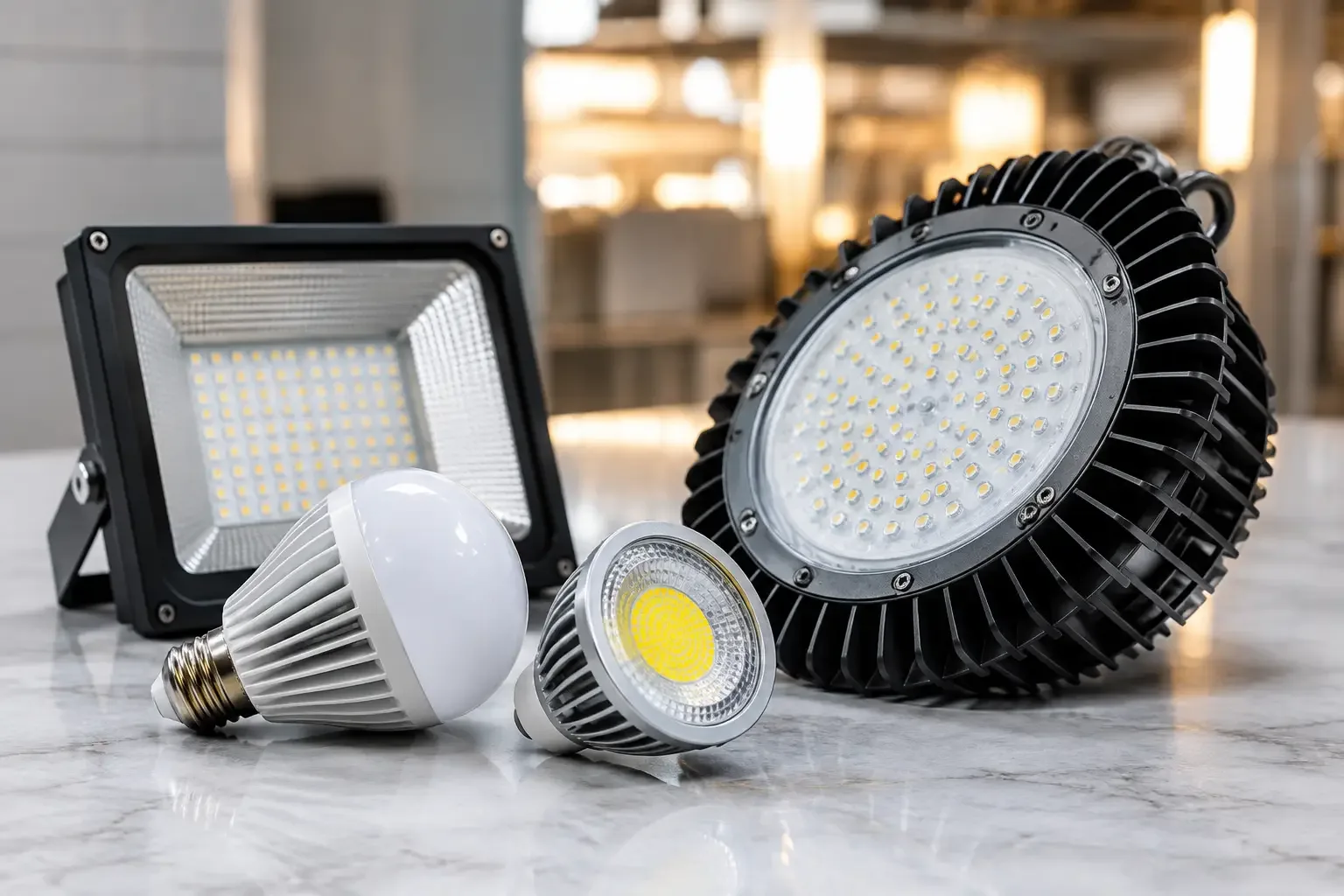
A fixture mounted near a reheating furnace, kiln discharge, oven exhaust, or steel mill process line is not operating in normal warehouse conditions. Heat migrates into the driver, degrades LED junction performance, hardens gaskets, and can shorten service life long before a standard commercial fixture visibly fails. When buyers ask, “where can I buy high-temperature LED lights?” the better question is where they can obtain fixtures with a documented maximum ambient rating that matches the actual conditions at the mounting point.
High-temperature lighting should be sourced from industrial specialists that can provide the fixture datasheet, thermal limits, photometric files, mounting information, and applicable certification documentation before an order is released. At Maes Lighting, we have found that the most costly problems are usually created by an incomplete application review, not by the initial fixture price. A light that performs well at 104°F may be unsuitable at 140°F, especially when radiant heat, dust accumulation, vibration, and enclosed mounting conditions are present.
1. Buy From an Industrial Supplier That Specifies Maximum Ambient Temperature
The first screening criterion is not wattage, lumen output, or appearance. It is the fixture’s listed maximum ambient temperature, commonly shown as Ta or “max ambient” on the specification sheet. This rating defines the surrounding air temperature in which the fixture is designed to operate while maintaining its stated safety and performance limits.
Industrial high-temperature LED fixtures are commonly selected for ambient ranges such as 122°F, 140°F, 149°F, 158°F, or higher, depending on construction and driver design. The exact requirement depends on where the fixture will be installed. A fixture mounted ten feet away from a furnace opening may experience a dramatically different thermal load than a fixture installed above a nearby maintenance aisle.
A qualified supplier should ask for the measured or estimated ambient temperature at the fixture location, mounting height, distance from the heat source, operating cycle, and whether the fixture is exposed to radiant heat. If those questions are absent, the recommendation may be based on assumptions rather than the conditions that determine fixture life.
2. Purchase High-Temperature LED Lighting With Complete Documentation
A high-temperature rating without supporting documentation is not enough for a capital project, plant expansion, or safety-driven replacement program. Procurement teams and electrical contractors typically need documents that can move through submittal review without creating delays.
Ask for the product datasheet, installation instructions, dimensional drawing, photometric file, certificate information, ingress-protection rating, and warranty terms. If the installation is in a hazardous location, the documentation must also identify the approved Class, Division, Zone, gas group, dust group, and temperature code as applicable.
UL Solutions and Intertek are widely recognized third-party testing and certification organizations. Their marks can help buyers verify that a product has been evaluated to a defined standard, but the mark must be relevant to the intended installation. A listed fixture still needs to be evaluated for ambient temperature, mounting method, and environmental exposure. Listing does not override an application mismatch.
3. Source Fixtures Built for Steel Mills, Kilns, Furnaces, and Foundries
The best place to buy high-temperature LED lights is a supplier with experience in severe industrial processes, not a general commercial catalog. Steel production, glass manufacturing, ceramics, heat treating, foundries, and industrial baking all create different combinations of convective heat, radiant heat, airborne particulate, vibration, and restricted maintenance access.
Consider a maintenance walkway near a continuous casting operation. The air temperature may be within the fixture’s published limit during normal production, yet intermittent radiant heat from hot steel can elevate the fixture housing temperature well beyond what the ambient reading suggests. In this case, fixture location, shielding, bracket orientation, and stand-off distance may matter as much as the nominal Ta rating.
We have found that high-temperature projects benefit from a site-condition review before fixture selection. A short discussion of process temperatures and mounting geometry can prevent repeated replacements in areas where lift access, production interruptions, and safety permits make every maintenance event expensive.
4. Verify LED Thermal Derating Before Comparing Lumen Output
LEDs are efficient, but they are not unaffected by heat. As operating temperature rises, LED output can decline and component stress increases. This relationship is commonly described as thermal derating. A fixture’s published lumen output may be measured under controlled test conditions that do not represent a 140°F process area.
Buyers should ask whether the manufacturer provides output data at elevated ambient temperatures. If not, compare fixtures cautiously. A lower-wattage fixture with an appropriately rated driver, heat management system, and documented high-temperature performance may deliver more dependable useful illumination over time than a higher-output unit designed for moderate conditions.
Thermal design also affects the driver. In many LED fixtures, the driver is the component most vulnerable to elevated temperature. Some high-temperature luminaires use remote-driver arrangements, separated thermal zones, or components specifically selected for higher operating temperatures. The right approach depends on service access, cable routing, environmental sealing, and whether the driver location itself is exposed to heat or contaminants.
5. Match the Enclosure to Dust, Moisture, Chemicals, and Washdown
Heat is rarely the only environmental concern. A high-temperature fixture in a steel facility may require resistance to metallic dust and vibration. A fixture near a food process oven may need a sealed enclosure that tolerates heat, humidity, and sanitation chemicals. A marine installation may combine heat with salt exposure and constant vibration.
Look beyond a generic claim of “industrial grade.” Evaluate the enclosure rating, lens material, gasket construction, finish, cable entry, and corrosion resistance. IP ratings address ingress protection, but they do not independently confirm suitability for every chemical, thermal, or washdown exposure. For food and beverage applications, NSF standards may also matter. NSF International, known as NSF, provides standards and certification programs used to evaluate equipment and materials for specific food-related applications.
For example, NSF/ANSI 2 and NSF/ANSI 51 address different equipment and material considerations. A food-processing team should confirm which standard, if any, is required by the facility, customer, sanitation program, or project specification. The same discipline applies to IP66 and IP69K ratings: they can be highly relevant for washdown areas, but only when the fixture’s temperature rating and chemical compatibility also fit the process.
6. Do Not Treat High Temperature as a Substitute for Hazardous-Location Approval
A heat-resistant fixture is not automatically explosion-proof, and an explosion-proof fixture is not automatically rated for the required high ambient temperature. Refineries, grain operations, chemical processing areas, and certain metalworking environments may present flammable gas, vapor, or combustible dust hazards in addition to elevated temperatures.
Where a location is classified under the National Electrical Code, the fixture must be suitable for that classification. This may involve Class I, Division 1 or Division 2 for gases and vapors, or Class II locations for combustible dust, along with the applicable groups and temperature code. The temperature code is particularly important because it identifies the maximum surface temperature permitted for equipment in a hazardous environment.
A supplier should review the area classification rather than infer it from the process. Plant engineering, the authority having jurisdiction, and the electrical design team determine the classification. The lighting supplier’s role is to match the selected equipment to the documented requirements and provide supporting information for the submittal.
7. Buy From a Supplier That Can Support Layouts, Submittals, and Fast Replacement Needs
High-temperature lighting purchases often start as a replacement request: a failed fixture above a furnace platform, an unreliable high bay in a hot production bay, or a maintenance burden caused by frequent driver failures. But selecting a direct physical replacement without reviewing light levels and operating conditions can repeat the original failure.
A capable industrial supplier can help compare mounting height, beam distribution, target foot-candles, voltage, mounting options, and environmental ratings. Photometric files are especially useful when an engineer or contractor must confirm illumination levels for work areas, aisles, inspection points, or safety paths.
For urgent replacements, provide photographs of the existing fixture and label, mounting details, voltage, approximate ambient temperature, and the process area description. For a larger project, provide fixture schedules, reflected ceiling plans where applicable, mounting heights, electrical one-lines, and the facility’s environmental requirements. Better input leads to a recommendation that is easier to approve and more likely to stay in service.
8. Ask These Questions Before You Place the Order
Before buying, confirm the maximum ambient temperature at the fixture, exposure to radiant heat, available voltage, required mounting style, and maintenance-access constraints. Also confirm whether dust, moisture, chemicals, vibration, washdown, corrosion, or hazardous-location classification apply.
Then request the documents needed by the project team and verify the fixture’s ratings against the installation conditions. If the facility has a history of early LED failures, treat that history as useful field data. It may point to excessive ambient heat, a poor mounting location, inadequate sealing, voltage issues, or a fixture that was never designed for the process area.
The right place to buy high-temperature LED lights is one that treats fixture selection as an engineering and compliance decision, not a commodity transaction. A properly specified luminaire can reduce maintenance exposure, protect uptime, and give the project team the documentation needed to install with confidence.