
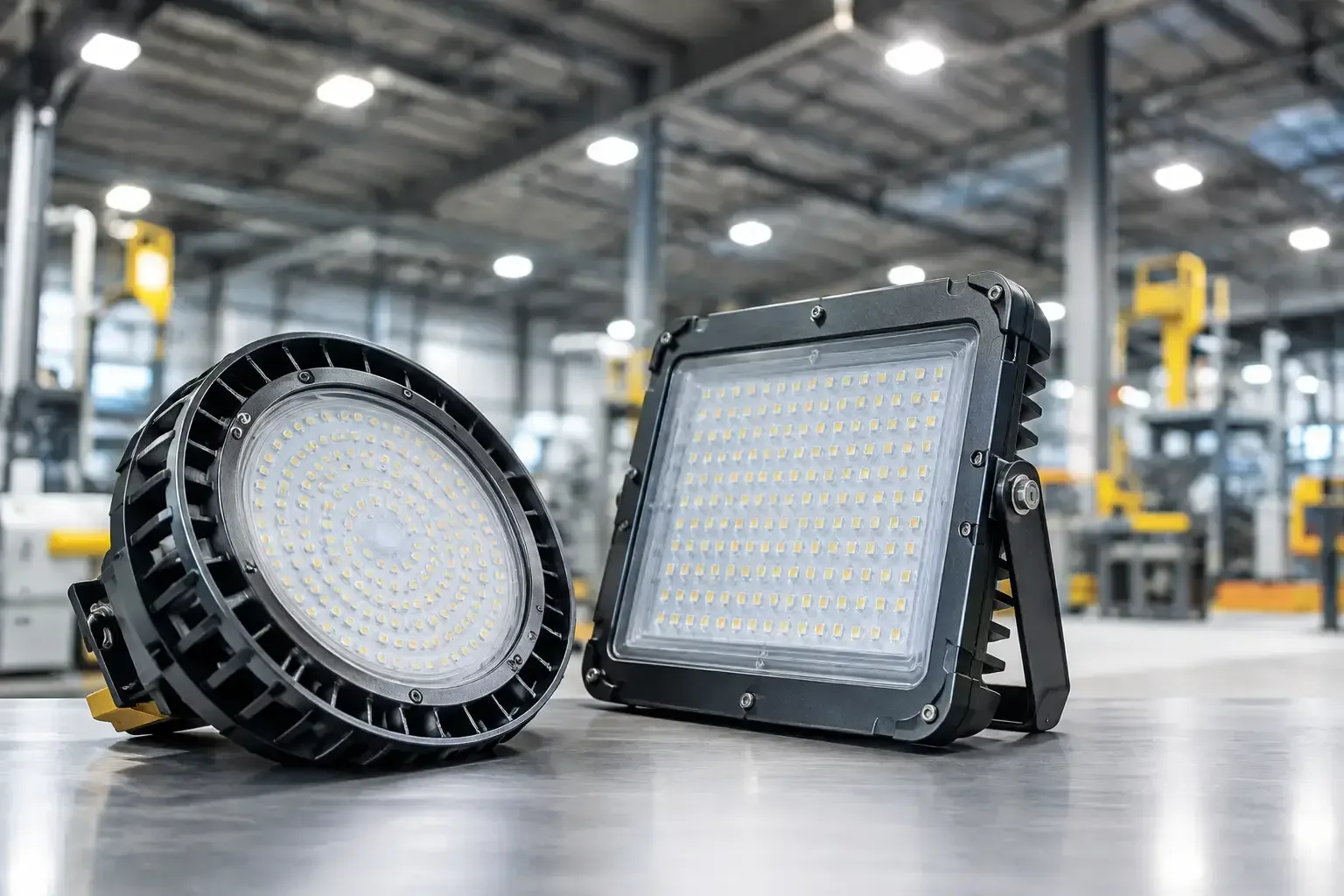
A fixture mounted above a reheat furnace, kiln discharge line, or steel rolling operation is not facing an ordinary lighting load. Heat rises into the driver compartment, airborne scale settles on heat sinks, vibration works on mounting hardware, and access for relamping may require a shutdown or lift. When buyers ask, what are the best high-temperature LED lights for industrial applications?, the correct answer is not a single fixture model. It is the fixture that maintains safe, documented performance at the actual ambient temperature where it will operate.
At Maes Lighting, we have found that temperature-related failures usually trace back to a missed site condition: the ambient was estimated at floor level, the fixture was installed near a roof pocket, or radiant heat from process equipment was treated as ordinary room heat. A proper high-temperature lighting selection starts with the application, then matches thermal rating, driver design, ingress protection, optics, mounting, and required approvals to that environment.
1. High-Ambient LED High Bays Are Best for Hot Production Floors
High-temperature LED high bays are often the right starting point for steel mills, foundries, fabrication bays, glass plants, boiler rooms, and industrial processing areas with elevated ceilings. They provide broad distribution from mounting heights commonly ranging from 20 to 50 feet, while reducing the maintenance burden associated with legacy fixtures in difficult-to-reach locations.
The critical specification is the fixture's maximum ambient temperature rating, commonly shown as Ta on a datasheet. A general industrial high bay may be rated only for 104°F or 131°F ambient conditions. A purpose-built high-temperature LED high bay may be engineered for 149°F, 158°F, 176°F, or higher, depending on the product and configuration. Buyers should never assume that a fixture with a metal housing is suitable for high heat. The LEDs may tolerate substantial junction temperatures, but the driver, capacitors, seals, wire insulation, and lens materials often determine the practical limit.
For a rolling mill, for example, a high bay above a hot slab path may see a much higher temperature than a fixture at the opposite end of the same bay. Measure ambient conditions at the proposed mounting elevation during normal production, not during a maintenance outage. If the fixture is exposed to direct radiant energy from a furnace opening, the ambient temperature alone may not capture the real thermal load.
2. High-Temperature Floodlights Are Best for Directed Process Lighting
When light must be aimed at a specific work area rather than distributed across an entire bay, high-temperature LED floodlights are generally a better fit. Typical applications include furnace platforms, conveyor transfer points, ladle areas, kiln entrances, outdoor processing stations, and maintenance zones adjacent to heat-generating equipment.
Floodlights allow the designer to place the fixture farther from the source of heat while directing output precisely where workers need visibility. That separation can be more valuable than selecting a higher-wattage fixture installed too close to the process. A narrow or medium beam can illuminate a target from a safer mounting location, reducing both thermal exposure and glare.
The trade-off is coverage. A floodlight can produce excellent task illumination but may leave dark areas between targets if the layout is not modeled correctly. Request photometric files and use them to confirm foot-candle levels, uniformity, aiming angles, and shadowing from structural steel. In high-heat facilities, fixture placement is as much a thermal engineering decision as a lighting design decision.
3. Remote-Driver Fixtures Are Best Where Electronics Need Distance From Heat
A remote-driver LED system separates the driver from the optical engine. This approach is especially useful where the light source must be near a hot process but the driver can be mounted in a cooler, more accessible location. Since electrolytic capacitors in drivers are often among the most temperature-sensitive components, distancing the driver from heat can support longer service life and simpler maintenance.
This configuration can work well at kiln hoods, furnace walls, enclosed equipment cells, and certain steel-processing operations. It is not automatically the best option for every facility. Remote-driver systems introduce additional wiring, connection points, voltage-drop considerations, and installation coordination. The cable and connectors must also be rated for the temperature, chemicals, vibration, and mechanical exposure along the route.
For facilities with planned shutdown windows, a remote driver can offer a practical maintenance advantage. An electrician may be able to replace a driver from an accessible platform without removing the luminaire from an elevated or heat-exposed position. That can materially reduce labor and downtime.
4. Sealed High-Temperature Fixtures Are Best for Dust, Moisture, and Scale
Heat is rarely the only environmental issue. Steel mills can combine high ambient temperatures with conductive dust and scale. Cement and aggregate facilities may have fine particulate accumulation. Food and beverage operations may combine heat with steam, humidity, chemicals, and washdown procedures. In these settings, the best high-temperature LED lights for industrial applications must manage both heat and contamination.
Look for the appropriate ingress protection rating. An IP66 fixture is protected against powerful water jets and dust ingress, while IP69K is intended for high-pressure, high-temperature washdown conditions. The rating must align with the actual cleaning process and installation location. A fixture installed outside the direct washdown zone may not need the same construction as one located over an open processing line.
For sanitary operations, material selection matters as much as sealing. Smooth housings, corrosion-resistant hardware, protected gaskets, and shatter-resistant lens construction can support cleanability and long-term performance. NSF standards are commonly referenced in food-processing environments, and NSF certification should be evaluated against the plant's specific sanitation and equipment requirements. NSF and UL Solutions both provide product-certification information that can help project teams verify claims rather than rely on general marketing language.
5. Hazardous-Location High-Temperature Fixtures Are Best Where Ignition Risk Exists
A high operating temperature does not itself make a location hazardous, but hot industrial environments often overlap with flammable gases, vapors, combustible dust, or fibers. Refineries, petrochemical sites, grain handling operations, paint areas, solvent rooms, and some process plants may require luminaires certified for the applicable hazardous-location classification.
Do not substitute a standard high-temperature fixture for an explosion-proof or hazardous-location fixture simply because the housing appears heavy-duty. The fixture must carry markings appropriate to the classified location, such as Class I, Division 1 or Division 2 under the National Electrical Code, or an applicable Zone classification where specified. Temperature code also matters. The luminaire's maximum surface temperature must remain below the ignition temperature of the material present.
Certification labels and project documentation deserve close review. UL Solutions and Intertek are recognized testing organizations that evaluate products to applicable safety standards. For a hazardous-location project, confirm the complete marking, ambient range, temperature code, voltage, mounting arrangement, and any installation limitations. A fixture can be correctly certified yet still be unsuitable if its ambient rating falls below the temperature at the mounting point.
6. Thermal Derating Is Best Treated as a Design Constraint, Not Fine Print
LED output and driver life decline as operating temperature rises. This is called thermal derating. Manufacturers may publish a lumen-maintenance curve, a reduced-output rating at higher ambient temperatures, or a maximum mounting temperature. These values should be reviewed before comparing lumens or efficacy across products.
A fixture producing fewer lumens at 158°F may still be the better choice than a higher-output fixture rated only to 131°F. The goal is not to purchase the highest initial lumen package. It is to deliver maintained illumination after years of operation under actual site conditions.
Ask for the ambient-temperature performance data, not only the catalog lumen figure. Also confirm whether the stated life rating applies at the intended ambient condition. A projected life value measured under moderate laboratory conditions may not represent performance above a furnace line or under a hot roof deck.
7. The Best Fixture Includes Documentation That Supports Approval and Maintenance
Industrial lighting selection often moves through engineering review, contractor submittals, safety review, procurement, and field installation. A technically suitable fixture can still delay a project when the supporting documents are incomplete. The best selection process includes current datasheets, photometric files, dimensional drawings, installation instructions, certification records, warranty terms, and environmental ratings.
Before releasing an order, verify the maximum ambient rating, voltage, driver configuration, mounting method, optical distribution, ingress rating, corrosion resistance, and hazardous-location approval where required. Confirm replacement-driver availability if the plant expects to service fixtures rather than replace complete units. For high mounting heights or shutdown-sensitive areas, consider whether standardized fixture families can simplify spares inventory.
The right high-temperature LED fixture is the one that gives your maintenance team usable light without asking it to gamble on heat, contamination, or compliance. Start with a temperature survey at the mounting point, document the process exposure, and select from fixtures built and certified for that exact operating reality.