
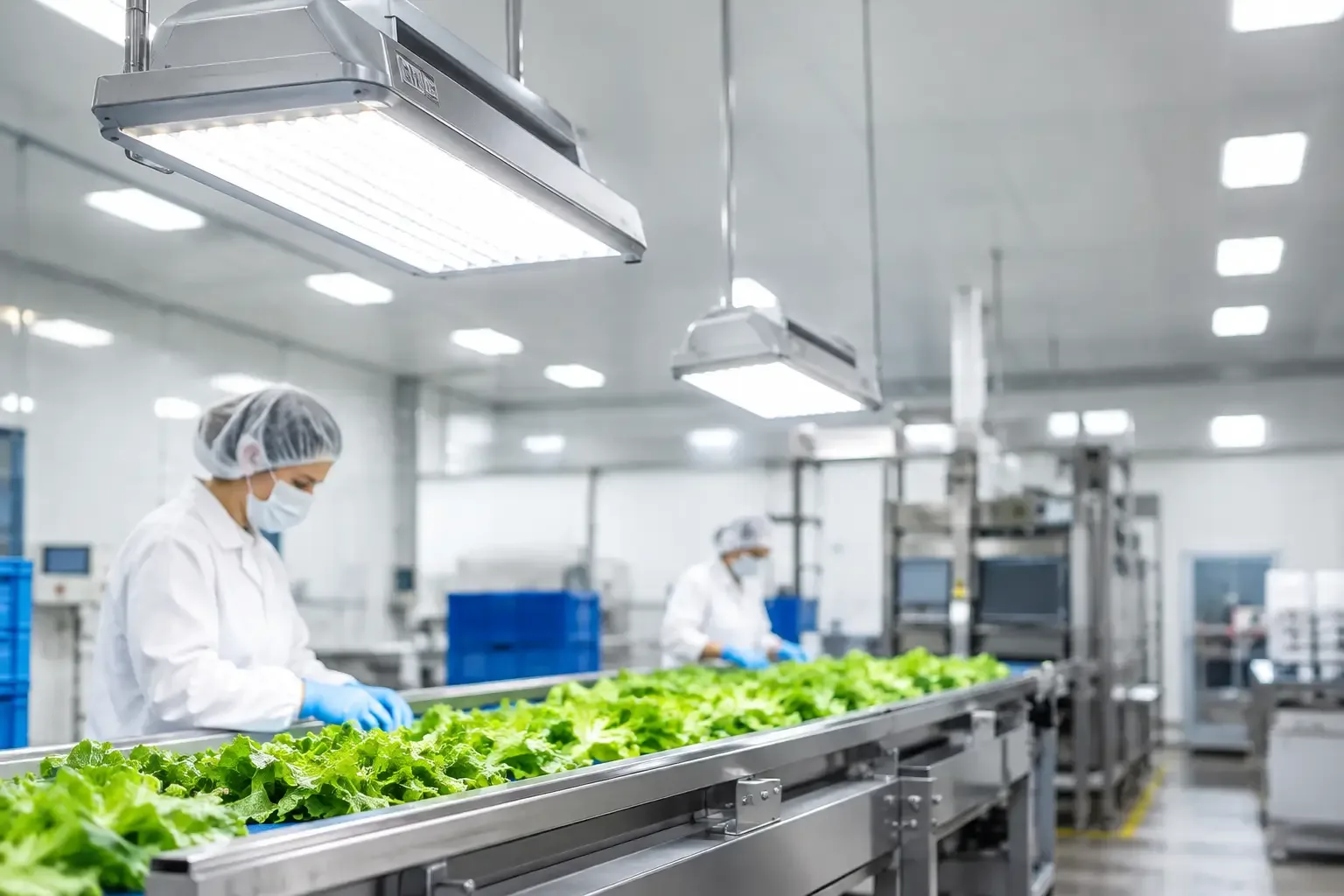
A fixture over an open mixing line or raw-protein conveyor has a different job than one over a dry packaging room. It must tolerate repeated chemical washdown, resist corrosion, avoid debris-catching geometry, and deliver usable illumination without becoming a sanitation concern. That is why the answer to “what are the best NSF-rated LED lights for food processing plants?” is not one fixture model. It is the correct combination of NSF suitability, ingress protection, construction, photometrics, and mounting method for the room.
At Maes Lighting, we have found that specifications become more reliable when the lighting decision starts with the sanitation process rather than wattage or initial fixture price. NSF, UL, and Intertek documentation should be reviewed alongside a facility’s washdown procedures, chemical concentrations, ambient temperature, and required foot-candle levels. A fixture that looks appropriate on a cut sheet but lacks the needed certification scope or washdown resistance can create an avoidable replacement and approval problem.
1. NSF/ANSI 2-Rated Fixtures for Direct Food-Area Conditions
For many wet food-production spaces, an NSF/ANSI 2-rated LED fixture is the strongest starting point. NSF/ANSI 2 addresses food equipment requirements, including cleanability and materials suited to the intended environment. In practical terms, it helps buyers identify luminaires designed for locations where sanitation, exposed surfaces, and routine cleaning receive close scrutiny.
The best candidates generally use smooth, non-porous housings and sealed lenses with minimal external hardware. Stainless steel is often preferred in aggressive washdown areas because it withstands corrosion better than standard painted metal. A fixture should also be designed so water, foam, and residue do not collect on top of it.
NSF/ANSI 2 is especially relevant above production lines, processing tables, filling areas, and other spaces where the fixture is near food-handling operations. Still, buyers should verify the exact certification and intended use on the product documentation. “NSF-rated” is a broad sales description, while the actual listing scope is what a project reviewer and plant sanitation team need to see.
2. NSF/ANSI 51-Compliant Materials for Support Areas
NSF/ANSI 51 covers materials used in food equipment. It is commonly referenced when evaluating whether fixture components, such as lenses, gaskets, coatings, and polymers, are appropriate around food-processing equipment. It does not automatically mean a completed luminaire is approved for every washdown area.
This distinction matters. A fixture may use NSF/ANSI 51-compliant materials yet lack the enclosure design, drainage characteristics, or certification basis needed for direct food-zone installation. Conversely, a complete fixture certified to an applicable NSF standard may provide a clearer compliance path for a processing room.
For dry ingredient rooms, secondary packaging, and support areas outside direct food exposure, a properly documented fixture using suitable materials may be the right value decision. For open-food environments, we recommend specifying the complete fixture certification first, then confirming component materials and gasket compatibility with the cleaning program.
3. IP69K LED Fixtures for High-Pressure Washdown
IP69K-rated LED lights are often the best choice where sanitation crews use high-pressure, high-temperature water jets. The IP69K test evaluates protection against close-range, high-pressure washdown from multiple directions. It is substantially more demanding than a basic damp-location or IP65 claim.
That rating is valuable in meat and poultry processing, dairy facilities, seafood plants, beverage bottling operations, and ready-to-eat production rooms. These areas can expose fixtures to heated water, alkaline detergents, foam cleaners, disinfectants, and repeated thermal cycling. A conventional industrial high bay may provide enough light at startup but fail early when water reaches drivers, seals, or lens joints.
IP69K alone is not a food-safety certification. It tells the buyer about enclosure resistance, not whether the fixture is suitable for a specific food-equipment or sanitation application. The best washdown specification pairs IP69K with the applicable NSF documentation and corrosion-resistant construction.
4. Stainless Steel Vapor-Tight Fixtures for Wet Processing Rooms
For ceiling heights that do not require a high-bay distribution, stainless steel vapor-tight linear fixtures are often a practical answer. They provide controlled illumination over conveyors, workstations, inspection lanes, and perimeter circulation areas while maintaining a sealed construction.
Look for a fixture with a gasketed, impact-resistant lens and stainless steel latches or hardware. Plastic clips, exposed fasteners, and complicated lens seams may become weak points after hundreds of wash cycles. The same is true of poorly selected gasket materials. Chemical compatibility with quaternary sanitizers, chlorinated products, peroxide-based cleaners, and caustic compounds should be reviewed before procurement.
Vapor-tight fixtures can be a strong fit for lower mounting heights, but they are not always the answer for tall processing halls. Their output and optical distribution may not deliver the required average and minimum foot-candles from a 25- or 30-foot mounting height. A lighting layout should settle that question before a fixture type is standardized throughout the plant.
5. NSF-Rated High Bays for Tall Production and Cold Storage Areas
High-bay fixtures are typically the best NSF-rated LED lighting option for tall rooms with broad equipment footprints. Think production halls, large packaging floors, blast freezer staging, and high-bay warehousing adjacent to food operations. The fixture needs a wide, consistent distribution that minimizes shadows around machinery without putting excessive glare into operators’ sightlines.
The right optical package depends on mounting height, aisle width, equipment layout, and target light level. A wide distribution can reduce fixture quantity in an open room, while a narrower distribution may be better for defined processing lanes or tall-rack storage. Brighter is not automatically better. Excessive contrast can make wet floors and stainless equipment harder to read visually.
Cold storage introduces another layer of selection. Driver performance, startup behavior, thermal management, and lens impact resistance all matter when fixtures operate below freezing or experience condensation during door cycles. A fixture should be specifically rated for the expected ambient temperature, not assumed suitable because it is marketed as industrial.
6. Sealed Low-Profile Fixtures for Inspection and Packaging Lines
Inspection, labeling, and quality-control stations need lighting that supports visual tasks, not just general area illumination. Low-profile, sealed LED fixtures can work well where operators must identify print quality, packaging defects, fill levels, color variation, or foreign-material concerns.
Here, color rendering and glare control deserve more attention. A high-output fixture with poor color quality or direct glare can work against the inspection process. Neutral-white light is often specified for task visibility, but the final color temperature should align with the product, packaging materials, and operator feedback.
Low-profile housings also reduce the chance of interference with overhead utilities and can simplify cleanability. The trade-off is that close mounting requires careful placement to prevent reflections from stainless tables, wet belts, and glossy packaging film.
7. Hazardous-Location Fixtures Where Food Dust or Vapors Create a Classified Area
Some food plants require more than NSF and washdown protection. Grain handling, flour milling, sugar processing, spice blending, and certain powder-transfer operations can create combustible dust hazards. Alcohol-based processes and solvent use may also introduce flammable vapor concerns.
In these spaces, the electrical area classification under the National Electrical Code takes priority. The luminaire must be selected for the designated Class, Division, or Zone, as applicable, while still addressing dust, cleaning, and corrosion exposure. An NSF-rated fixture that is not approved for the classified location is not an acceptable substitute for hazardous-location lighting.
This is where documentation is essential. Review the fixture marking, installation instructions, ambient-temperature rating, and third-party safety certification. UL and Intertek listings are commonly used to demonstrate electrical safety compliance, but the specific listing must match the installation conditions. The Authority Having Jurisdiction and the facility’s electrical engineer should be involved before equipment is released for a classified area.
What to Verify Before Ordering
A strong food-processing lighting submittal should establish more than lumen output. Confirm the NSF certification and its scope, the IP rating, enclosure materials, gasket and lens composition, rated ambient temperature, mounting configuration, and chemical exposure assumptions. Request the photometric file so the design team can confirm light levels at the actual work plane.
Also evaluate serviceability. LEDs reduce relamping, but drivers, gaskets, and mounting hardware still require eventual attention. A fixture that is difficult to access or requires opening multiple seals for maintenance may increase downtime and sanitation labor. In operating plants, the best fixture is often the one that delivers the required light for years without becoming a recurring maintenance item.
For a food plant, the most dependable lighting choice is rarely the lowest-cost sealed fixture. It is the documented, application-matched luminaire that can remain clean, sealed, compliant, and useful through the plant’s actual washdown cycle.