
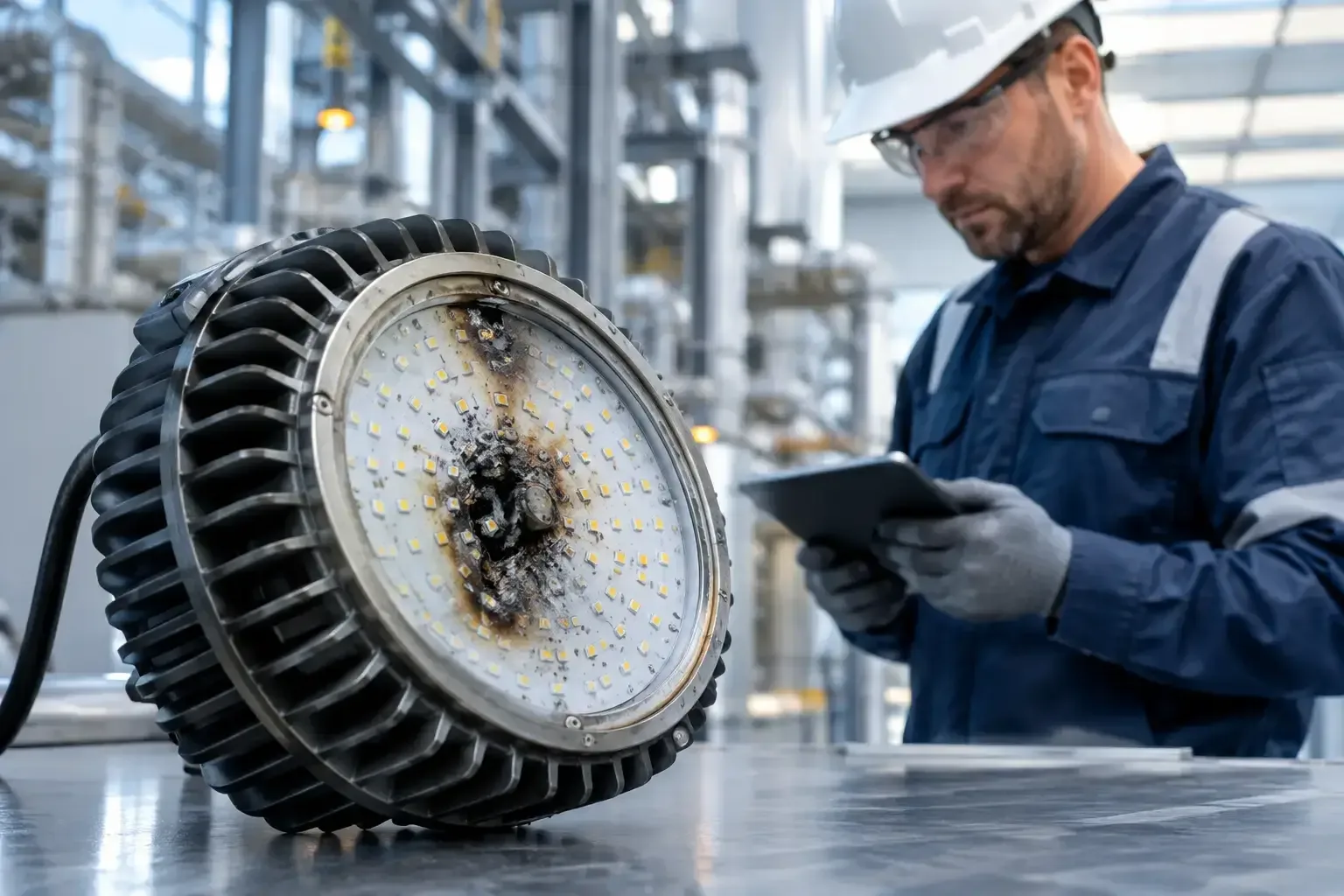
A fixture above a furnace line may appear to work normally for months, then begin cycling, discoloring, losing output, or failing outright. These are common signs of LED thermal failures, and they rarely begin with a visibly damaged fixture. More often, heat has been building at the LED junction, driver, gasket, or wiring compartment long before maintenance receives the first outage report.
For industrial facilities, thermal performance is not a marketing specification. It is a reliability, safety, and maintenance issue. A fixture selected for a 104°F ambient environment cannot simply be moved closer to a kiln, oven, roof monitor, or process vessel where ambient temperatures routinely exceed its rating. We have found that the most expensive lighting failures are often caused by a mismatch between actual site conditions and the fixture's complete thermal design.
1. Ambient Temperature Exceeds the Fixture Rating
Every industrial LED fixture has a maximum rated ambient temperature, commonly identified as Ta. This rating defines the highest surrounding air temperature at which the fixture can operate while maintaining its listed performance and safety conditions. It is not a suggestion and it is not the internal temperature of the fixture.
A high bay installed in a steel mill can see far more heat than the facility's general indoor temperature. Radiant energy from molten material, hot equipment surfaces, roof-level heat stratification, and restricted airflow can push the local fixture environment well beyond the temperature measured at floor level. The same problem occurs near industrial ovens, dryers, boilers, and exhaust systems.
The practical fix is to measure temperature where the fixture will actually operate, preferably during peak process load. Review the fixture's maximum Ta rating, mounting restrictions, and photometric data before selecting equipment. High-temperature lighting is designed around elevated-ambient operation, but its rating still must match the installation conditions.
2. The Heat Sink Cannot Release Heat
An LED heat sink transfers heat away from the LED board and into the surrounding air. Its effectiveness depends on surface area, airflow, orientation, material, and the temperature difference between the fixture and its environment. If the surrounding air is already hot, the heat sink has less capacity to reject heat.
Dust accumulation, oil film, overspray, process residue, and blocked airflow can all reduce thermal dissipation. In fabrication areas, a fixture may collect fine metallic dust and oily contaminants that effectively insulate cooling fins. In food processing, residue can collect around housings and mounting points if cleaning practices do not reach those areas.
Do not treat fixture cleaning as cosmetic maintenance. When a site depends on passive cooling, contamination on external thermal surfaces can materially affect operating temperature. The cleaning method must also be compatible with the fixture enclosure, gasket system, lens material, and ingress-protection rating.
3. Driver Temperature Is Shortening Fixture Life
The LED array is only one part of the thermal system. Drivers contain electronic components, including capacitors, that can be especially sensitive to sustained heat. A fixture can still produce light while its driver is operating outside the conditions needed for long service life.
Driver-related thermal failures often appear as intermittent operation, flickering, delayed startup, reduced output, or repeated shutdown and restart cycles. These symptoms may be mistaken for a utility issue or control problem. Before replacing drivers, maintenance teams should verify voltage quality, fixture temperature, enclosure temperature, and whether the driver compartment is exposed to direct process heat.
Higher-rated components can help, but they do not solve a fixture selection error. In a high-heat application, the driver location, thermal isolation, housing construction, and approved ambient rating matter as much as nominal wattage. Review the manufacturer's documentation and the conditions associated with any UL or Intertek safety listing.
4. Thermal Derating Is Reducing Light Output
Thermal derating is the controlled reduction of LED drive current or output as temperature rises. It is intended to protect the LEDs and electronics from excessive heat. This can prevent an immediate failure, but it also means the installed lighting may no longer deliver the illuminance levels assumed in the original design.
This matters in loading areas, production cells, inspection stations, and egress routes where lighting levels support safe work. A fixture that provides acceptable foot-candles during a commissioning visit may deliver less light during summer conditions or peak production, when ambient temperatures are highest.
Ask for photometric information and operating-temperature performance data rather than relying solely on catalog lumen output. For critical applications, calculate light levels using the expected operating condition, not an idealized room temperature. There is a trade-off: a lower-output fixture with a properly matched high-temperature rating may outperform a higher-lumen standard fixture that derates aggressively or fails early.
5. Enclosed or Incorrect Mounting Traps Heat
Many fixtures are thermally tested in a specific mounting configuration. Recessing a surface-mounted fixture, mounting it against a hot ceiling, placing it under a solid cover, or crowding fixtures together can alter its ability to cool. Even a well-built industrial luminaire can overheat if the installation defeats the airflow assumed by its design.
This issue frequently appears after facility modifications. A new process hood, duct run, protective guard, or ceiling enclosure may change the thermal environment without triggering a lighting review. Maintenance then sees premature failures in only one zone and assumes there is a product defect.
Compare field installation details with the fixture instructions. Verify orientation, clearance, mounting surface temperature, and whether guards or accessories are approved for the specific luminaire. If physical protection is needed in an impact-prone area, select a fixture and guard combination designed and tested to work together.
6. Sealed Enclosures Need the Right Thermal Design
Vapor-tight, washdown, marine, and hazardous-location fixtures need enclosures that keep out water, dust, vapors, or corrosive contaminants. That protection is essential, but sealing also changes how heat moves through the fixture. The answer is not to compromise enclosure integrity. It is to select equipment engineered to manage heat while maintaining its required classification.
For example, a washdown fixture in a food facility may be exposed to warm processing areas, high-pressure cleaning, chemical sanitation, and rapid temperature changes. An enclosure with an appropriate IP rating may address water ingress, but buyers should also confirm temperature ratings, lens material, gasket compatibility, and applicable sanitation requirements. NSF documentation can be relevant where fixture materials and cleanability are part of the specification.
Hazardous locations require the same discipline. An explosion-proof fixture must be suitable for the classified location and installed according to its listing and the applicable electrical code. Thermal limits can affect both longevity and safety compliance, particularly where surface temperature is relevant to the atmosphere present.
7. Heat Is Being Diagnosed Too Late
By the time multiple fixtures fail, the root cause may have become a maintenance pattern rather than an engineering question. Replacing failed units with identical models can repeat the same failure cycle, especially when the facility has changed process temperatures, ventilation, or mounting conditions.
A better investigation starts with pattern recognition. Are failures concentrated near a furnace, roofline, washdown bay, or process exhaust? Do they occur during hot weather or only after equipment runs for several hours? Is output declining before complete failure? These details help separate a component issue from a thermal-environment issue.
For a meaningful assessment, document local ambient temperature, radiant heat sources, fixture mounting height, distance from hot equipment, airflow, contamination, voltage, and operating hours. Infrared imaging can support the investigation, but it should be interpreted carefully because surface temperature alone does not reveal LED junction temperature or internal driver conditions.
Selecting Against LED Thermal Failures
Preventing LED thermal failures begins before purchase. Specify the maximum expected ambient temperature at the fixture location, not simply the general building temperature. Then account for radiant heat, ventilation, mounting configuration, contamination, washdown, vibration, corrosive exposure, and any hazardous-location classification.
For severe applications, request the submittal package early: datasheets, temperature ratings, installation instructions, safety certifications, photometric files, and product-specific limitations. This makes it easier for engineers, contractors, and facility teams to confirm that the fixture is suitable before it is installed. It also provides a defensible record when a project requires review by safety, quality, or code-compliance personnel.
The right fixture is not always the highest-lumen or lowest-cost option. It is the one that can maintain safe, useful light at the actual temperature and exposure level of the work area. Treat heat as a site condition to engineer around, and the lighting system is far more likely to support uptime instead of becoming another recurring maintenance task.