
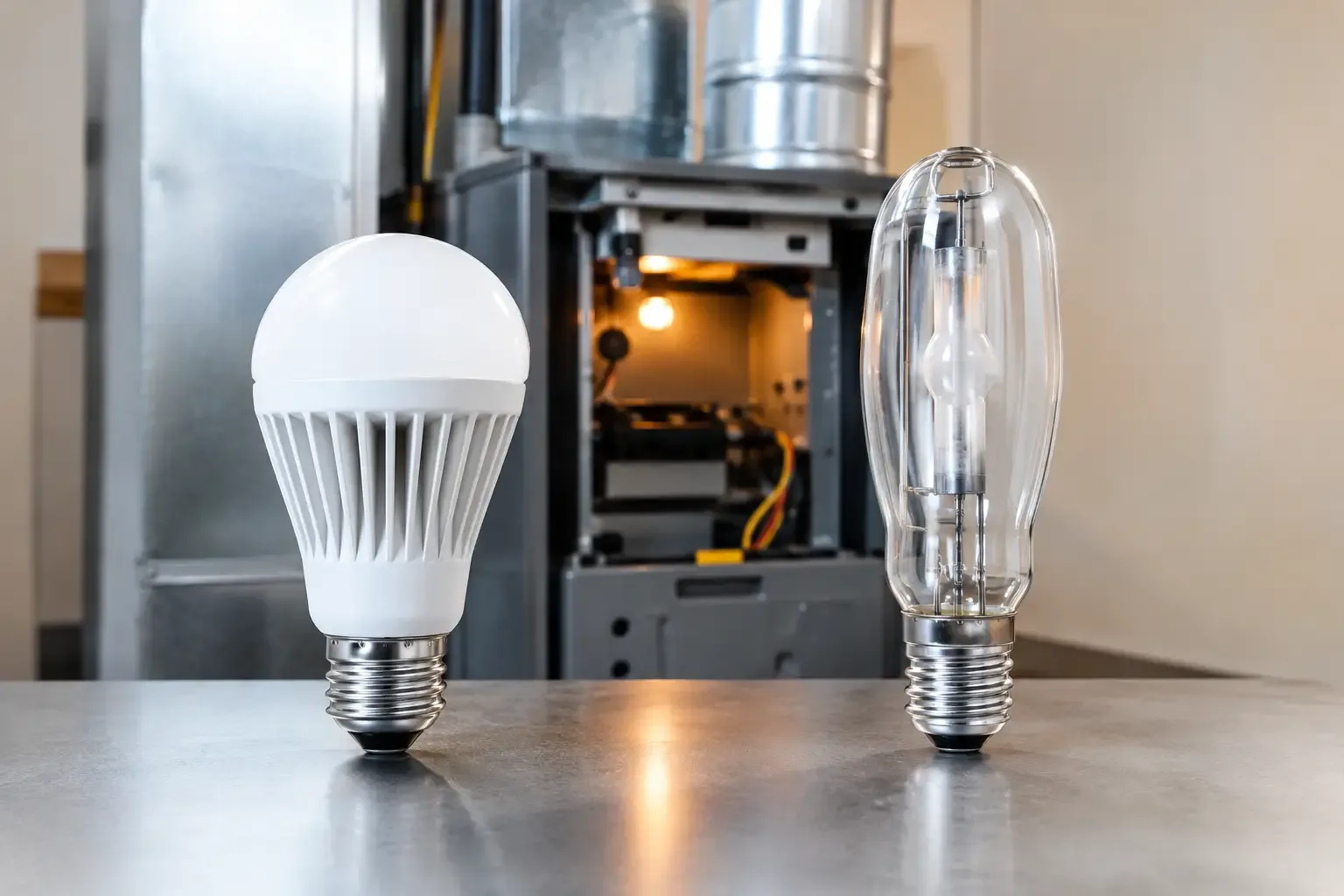
A furnace bay makes ordinary lighting comparisons meaningless. Ambient temperature, radiant heat, scale, vibration, airborne particulates, and difficult access all change the decision. In LED versus HID furnace lighting, the correct answer is rarely based on nominal wattage or initial fixture price. It depends on the actual thermal environment at the mounting point, the required light levels at the work plane, maintenance access, and the facility's safety and approval requirements.
For steel mills, foundries, glass plants, kilns, and heat-treatment operations, we have found that fixture survivability is the first specification question. A high-output LED fixture that exceeds its rated ambient temperature can lose output, shorten driver life, or fail prematurely. An HID fixture may tolerate higher surrounding temperatures in some configurations, but it brings warm-up delays, lumen depreciation, restrike limitations, and recurring maintenance that can be costly above an active production line.
LED Versus HID Furnace Lighting: The Operating Difference
HID lighting has a long history in high-bay industrial spaces. Metal halide and high-pressure sodium systems can produce substantial output and have traditionally been used where mounting heights are significant. However, their output and operating characteristics are not static. Metal halide systems typically experience meaningful lumen depreciation over service life, while color quality can shift. High-pressure sodium offers efficiency for its generation, but its color rendering can make it harder to distinguish surface conditions, labels, or safety markings.
LED furnace lighting reaches useful output immediately. That matters when lighting is controlled by occupancy sensors, when a power interruption occurs, or when maintenance crews need clear visibility without a warm-up period. LEDs also provide better optical control in many industrial fixture designs. Rather than sending light broadly from a high-intensity arc source, a properly engineered LED luminaire can direct output toward platforms, charging areas, control stations, ladles, conveyors, and inspection zones.
That advantage should not be oversold. LED is not automatically the right choice simply because it is newer. Heat is the central constraint. LED emitters and electronic drivers require disciplined thermal management. A fixture rated for a 149°F ambient is not suitable for a location where sustained ambient temperatures reach 180°F, even if the building's general ambient temperature is lower. Furnace operations often create localized heat pockets near roof lines, walls, exhaust paths, and crane rails.
Start With Ambient Temperature, Not Fixture Wattage
The most reliable furnace-lighting specification begins with temperature data. Measure or estimate the continuous ambient temperature at the proposed mounting location, not at floor level and not only during a shutdown. Then account for radiant exposure from furnace doors, hot product, ducting, and process vessels. A fixture can be located outside the hottest air stream but still receive enough radiant heat to affect its housing, lens, gasket system, wiring, or driver compartment.
High-temperature luminaires are designed around this reality. Their rated maximum ambient temperature, often identified as Ta, establishes the environmental limit for normal operation. The rating must be reviewed alongside the fixture's mounting orientation, photometric configuration, voltage, and any optional controls. A product family may have different ratings depending on the exact configuration.
We have found that failures blamed on "bad LEDs" are often application mismatches. A standard industrial high bay mounted near a reheating furnace may run reliably during commissioning, then degrade after months of production cycles. The driver is usually the first vulnerable component because electronics are sensitive to prolonged heat exposure. Selecting a purpose-built high-temperature fixture may cost more at purchase, but it can prevent repeated lifts, shutdown coordination, and unplanned dark areas over critical work zones.
Where LED Delivers a Clear Advantage
When the mounting environment is within the fixture's documented thermal range, LED generally improves total operating performance. The first benefit is maintained visibility. Quality LED luminaires provide consistent light distribution and color rendering that supports inspection, material handling, and safer movement around equipment. In a fabrication or heat-treatment department, this can make contrast easier to see on control panels, floor markings, and work surfaces than older high-pressure sodium systems.
The second benefit is maintenance reduction. HID systems require periodic lamp and ballast service, and relamping a furnace bay is not a simple task. It can involve production scheduling, elevated work platforms, hot-work restrictions, and exposure to congested overhead structures. LED does not eliminate maintenance, but a correctly specified fixture can extend service intervals substantially.
The third is control compatibility. LED output responds well to zoning, occupancy-based control, and scheduled dimming where process conditions permit. This is useful in large facilities where furnace areas, support aisles, and maintenance zones have different operating hours. Controls should still be selected carefully. Sensors and control components must be rated for the same heat, dust, vibration, and electrical conditions as the luminaire.
Where HID May Still Be Considered
HID can remain a practical option when ambient temperatures exceed the capabilities of available LED systems, when an existing infrastructure is designed around HID maintenance practices, or when a highly specialized process environment limits electronic equipment. The comparison is also different for an emergency replacement. If a plant needs a temporary solution during an outage, the lead time, mounting compatibility, and available electrical circuits may drive the short-term decision.
However, HID's operating compromises should be explicit. After a power interruption, metal halide systems may require cooling and restriking before full illumination returns. That delay can affect safe egress, restart procedures, and maintenance response. HID output also declines over time, which means a design that appears adequate when new may not maintain target illumination later in the maintenance cycle.
For facilities moving from HID to LED, a one-for-one wattage replacement is not a sound design method. Evaluate delivered lumens, mounting height, beam distribution, reflectance from walls and ceiling surfaces, obstructions from cranes or ductwork, and the required horizontal and vertical light levels. Photometric files are especially valuable in furnace bays because shadows and glare can create operational problems even when average foot-candle readings look acceptable.
Heat, Dust, Water, and Hazardous Location Requirements
Furnace lighting may need more than a high-temperature rating. Steel and foundry operations can expose fixtures to dust, metallic particulates, vibration, oil mist, washdown, corrosive agents, and impact. The enclosure rating should match those exposures. An IP rating can address ingress protection, but it does not replace a temperature rating, hazardous-location listing, or material-compatibility review.
Where combustible dust, flammable gas, or vapor may be present, fixture selection must follow the area's hazardous-location classification. A high-temperature fixture is not automatically explosion-proof, and an explosion-proof fixture is not automatically rated for furnace-adjacent heat. The equipment marking, applicable Class and Division or Zone designation, temperature code, and installation instructions must align with the classified area documentation.
Authorities such as UL and Intertek evaluate products to applicable safety standards, while NSF establishes recognized criteria for equipment used in food environments. Their names alone are not a substitute for reviewing the actual listing, certification scope, and product documentation. For project submittals, request the datasheet, certification records, installation instructions, ambient-temperature rating, photometric files, and warranty terms for the exact catalog configuration.
A Practical Selection Process for Furnace Bays
Before choosing between LED and HID, document the mounting height, supply voltage, target light levels, operating schedule, and access constraints. Identify the sustained and peak ambient temperatures at each fixture location. Then separate general illumination from task lighting. A furnace charging area, elevated platform, and maintenance aisle may require different optics or fixture placements even when they are within the same bay.
Consider glare as carefully as output. Operators looking toward hot material, open furnace doors, or reflective surfaces already work in visually demanding conditions. Poorly aimed high-output fixtures can add glare rather than improve visibility. A lighting layout should direct illumination onto the task while limiting direct view of high-intensity sources.
Finally, account for the whole maintenance cycle. The lower-cost fixture is not always the lower-cost installation once lift access, production interruption, spare inventory, and premature replacement are considered. Maes Lighting helps industrial teams evaluate high-temperature luminaires against actual site conditions and assemble the documentation needed for a defensible specification. The right fixture is the one that stays within its ratings, delivers usable light where crews need it, and remains serviceable through the heat and demands of production.